First, the CIA locates the leader of an oil-rich nation that opposes the U.S. at a heavily fortified compound in the heart of his country’s mountainous capital. Then, that leader is ousted through a decisive and overwhelming display of U.S. military power. Finally, a more cooperative successor is put in place to align with Washington’s interests.
This was the blueprint for Donald Trump’s recent takeover of Venezuela’s government. The country’s president, Nicolás Maduro, was captured in Caracas before dawn on January 3. After special forces seized Maduro, his vice president, Delcy Rodríguez, assumed power with Trump’s support, ushering in a once-unlikely, pro-U.S. era for a South American nation whose leaders had long denounced “Yankee” imperialism.
“I thank President Donald Trump for his government’s kind willingness to work together,” Rodríguez posted on X on Thursday, in what may have been her most overt display of deference since her ally’s fall from power.
Three months after Maduro’s removal, Trump seems eager to replicate this “regime capture” model in Iran, following the death of its supreme leader, Ayatollah Ali Khamenei, in Tehran during a devastating joint Israeli-U.S. operation targeting his base.
“I have to be involved in the appointment [of his successor], like with Delcy in Venezuela,” Trump told the U.S. news website Axios this week. Speaking to the New York Times, he added, “What we did in Venezuela, I think, is… the perfect scenario.”
A State Department official told the Wall Street Journal that Trump’s strategy—managing a regime’s behavior from afar without deploying U.S. troops—might be termed “decapitate and delegate.”
However, experts on South America and the Middle East have serious doubts about whether the approach that worked in Caracas would succeed 7,000 miles away in Tehran.
“Turning Iran into a pliable puppet regime is much less practical than in Venezuela, where even under Maduro, the government was already inclined to work with the U.S., its historic partner in energy and the key player in the region,” said Benjamin Gedan, a former South America director on the National Security Council staff and now director of the Stimson Center’s Latin America Program. He added, “The idea that after Venezuela, the U.S. could go around the world intervening and installing a Delcy Rodríguez figure wherever our aircraft carrier drops anchor is a bit silly.”
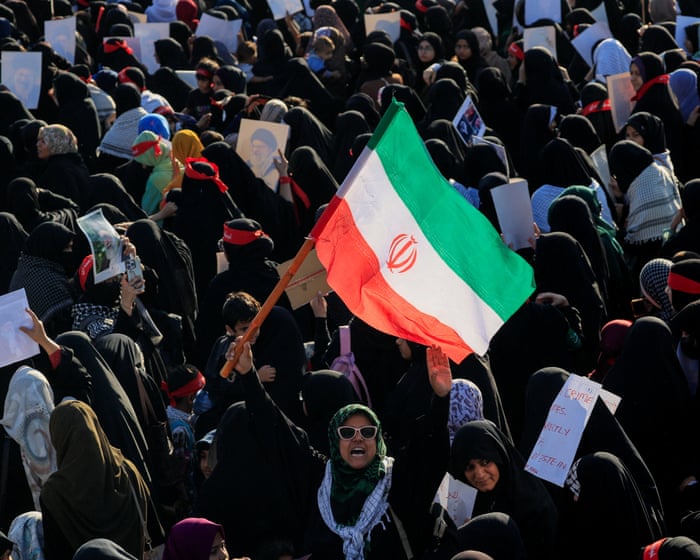
Iran experts believe Trump’s demand to be involved in choosing the country’s next leader will likely be outright rejected by its surviving officials as blatant interference in domestic politics. Iran has bitter memories of meddling by outside powers, including Britain, Russia, and the U.S. To a large extent, the 1979 revolution that brought the Islamic regime to power was driven by nationalist resentment over perceived foreign intervention. The then-ruling pro-Western monarch, Shah Mohammad Reza Pahlavi, was widely seen as an American puppet.
Anti-American sentiment, epitomized by the revolutionary chant “Marg bar Amrika” (Death to America), has been central to the regime’s ideology since its spiritual founder, Ayatollah Ruhollah Khomeini, labeled the U.S. “the great Satan.” Slogans and murals expressing hostility toward the U.S. are prominent throughout Tehran and other Iranian cities.
Trump’s insistence on being consulted seems even more far-fetched given that the two countries have had no diplomatic relations for 46 years—unlike Venezuela, where the U.S. maintained ties until as recently as 2019. U.S. relations with Iran were cut by the Carter administration in 1980 after revolutionaries stormed the U.S. embassy in Tehran and took 52 American diplomats hostage.
Alex Vatanka, head of the Iran program at the Middle East Institute in Washington, D.C., called Trump’s attempt to insert himself into Iran’s leadership selection “beyond unrealistic.”The expert described the idea as “delusional” and doubted there was any feasible plan to replicate a Venezuela-like situation in Iran. “Regime change would have been simpler than trying to turn existing Shia militant Islamists into supporters of the Maga movement, which is essentially what he’s proposing,” Vatanka stated.
He noted that outside influence is possible because some individuals within “what’s left of Khamenei’s inner circle” are cooperating with foreign intelligence services. “But you still need a strategy,” he emphasized. “You have to identify who inside the regime you can collaborate with. Then, together with that group, you either persuade the others currently resisting to join your side, or you help the Americans eliminate them. That way, a leader can emerge and do what Rodríguez is doing in Venezuela… But I’ve seen no indication that such detailed planning has gone into current U.S. actions. They might just decide to withdraw, saying, ‘We killed Khamenei, there are no nukes left, the missile launchers are destroyed.'”
“It’s open warfare, and in that situation, it becomes even harder for anyone left in the regime to suggest working with the U.S…. They’d be killed before they got out of bed the next day.”
Naysan Rafati, a senior Iran analyst at the International Crisis Group, said that while the U.S. and surviving regime insiders might share an interest in maintaining continuity, this approach risks alienating most of Iran’s population, who remain angry over the violent suppression of recent protests that cost thousands of lives. “Even if the system has a shrinking base of ideological supporters, those supporters likely feel this is an endgame scenario unless they unite. So you might see a rallying effect,” he explained.
“The smoothest outcome for Washington would be to secure change within continuity—finding a partner who can quickly bring together a critical mass of the Iranian system on terms acceptable to the U.S.,” Rafati added. “But that goal faces two challenges: finding enough voices within the regime willing to accept change, and leaving many Iranians disaffected by the continuity.”
Experts believe the real decision over Iran’s next leader will rest with the powerful Revolutionary Guards, which controls Iran’s military policy and large portions of its economy.
South America specialists think Trump’s apparent desire to repeat “the Delcy model” reflects his confidence after what seems like Washington’s successful takeover of the remnants of Maduro’s authoritarian regime in Venezuela. “There was no loss of aircraft, no loss of U.S. service members, and you have a government that was portrayed to him as implacably hostile but is now very accommodating. You have a country with immense natural resources that, in Trump’s view, are newly available to the United States,” said Gedan.
However, the former White House adviser added that beyond the fact Iran is much farther away and better armed than Venezuela, it is far too early to tell whether Trump’s gamble has even worked in South America. “A year from now, if the U.S. navy is no longer stationed in the Caribbean, the Venezuelans might gradually feel they have some breathing room and autonomy again,” Gedan predicted.
The distraction of conflict in the Middle East could even benefit Maduro’s successors as they try to outlast Trump and extend their 27-year rule. “Their plan isn’t to be a puppet regime forever,” Gedan said. “Their plan is to hope the U.S. moves on.”
Frequently Asked Questions
FAQs Iran Venezuela and US Foreign Policy
BeginnerLevel Questions
Q What do people mean when they say Iran is not Venezuela
A It means the two countries are fundamentally different in their history political systems economy regional influence and societal structure A policy or strategy that might have been applied in Venezuela cannot be simply copied and pasted onto Iran with the same expected results
Q What was Trumps regime change approach in Venezuela
A It primarily involved recognizing opposition leader Juan Guaidó as the legitimate president imposing severe economic sanctions and encouraging military defections to pressure President Nicolás Maduro to leave power The goal was to replace the existing government
Q Why would someone think the same approach could work in Iran
A Some policymakers might see both countries as oildependent economies ruled by governments opposed to the US They might believe that maximum pressure through sanctions and diplomatic isolation could weaken the government and trigger a popular uprising or force concessions
Q Whats the main reason this comparison is flawed
A Iran has a much more resilient complex and entrenched political system a stronger military and security apparatus a more diversified economy and far greater influence and proxy networks across the Middle East Venezuelan society and state institutions were already in deep crisis before US pressure intensified
Advanced Comparative Questions
Q How does Irans internal political stability differ from Venezuelas
A Irans government led by the Supreme Leader and supported by the Islamic Revolutionary Guard Corps faces dissent but maintains firm control over security and key institutions Venezuelas crisis led to a nearcomplete collapse of its economy and public services creating mass emigration and fracturing its political control more visibly before US intervention
Q What role does nationalism play in Iran versus Venezuela regarding US pressure
A In Iran historical grievances and a strong sense of national sovereignty are deeply embedded US pressure often consolidates domestic support behind the government framing resistance as patriotic In Venezuela while antiUS sentiment exists the catastrophic economic situation has eroded much of the governments popular support more decisively
Q How do Irans regional alliances make it less vulnerable than Venezuela
A