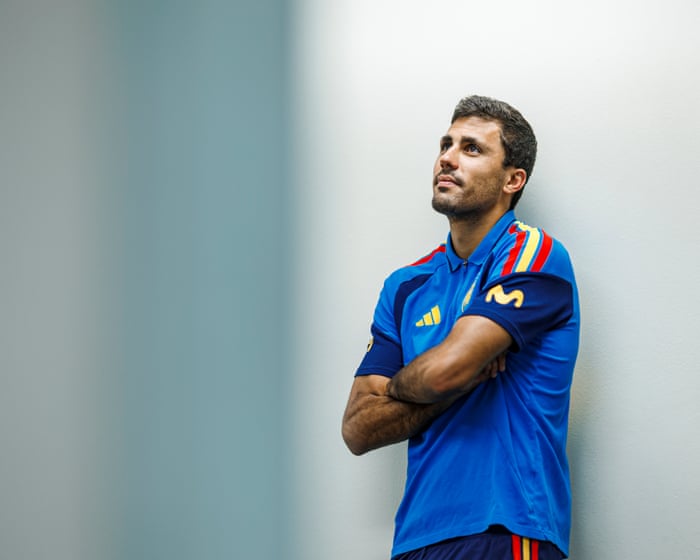
“I’m not that bad,” says Rodri Hernández. It’s the morning after the 100th game of the World Cup, and in a conference room at the Cotton Bowl—where old posters line the walls and Spain is about to start their second-to-last training session before the 101st match—their captain is doing the math. Even with the six games he’s played in and all the travel, from Atlanta to Guadalajara, Dallas to Los Angeles and back, covering 9,000 miles so far, he figures he’s watched the “vast majority” of matches. More than anyone else here, at least. “Some as a fan—teams we can’t face—others I analyze. But it’s not like I’m sitting there with a pen and paper,” he says. Then he laughs and admits, “But yeah, I’m probably the worst.”
They wouldn’t have it any other way; he couldn’t have it any other way. This is who Rodri is: a Ballon d’Or winner and a business graduate from Castellón University. The kid who was at a camp in the Connecticut woods, aged 14, when Spain last won the World Cup, and the captain who hopes to lift the trophy again, back in the US 16 years later. The midfielder who sometimes seems like a de facto coach, analyzing everything. The adult in the room, a leader aware of his responsibility. When Rodri talks, they listen. Sometimes they have to. And, oh, Rodri talks, with a calm authority about him.
Spain’s Mikel Merino has a knack for scoring late winners. Read more.
A hundred games in, there are conclusions to draw. The ball is fast, the pitches are perfect, the stadiums are incredible. And, above all, he says, unusually, the four semi-finalists are actually the best teams here. “England vs Argentina will be very, very close, two very different styles of football, but I’d rather focus on ours,” he says, and so he does. “France is one of the best teams here, in great form, but so is Spain. We can beat them—we’ve seen that at the Euros and in the Nations League.”
Like the game in Dallas on Tuesday, both of those were semi-finals. Last summer, Spain beat France 5-4 in the Nations League, which makes it sound closer than it really was: Spain led 5-1 with 11 minutes left. The summer before, Spain beat France 2-1 at Euro 2024. The omens get even better: the first time Rodri won anything with Spain—the 2015 Under-19 European Championship—they also beat France in the semi-final. He and Mikel Merino were midfield partners that day in Katerini, Greece. Unai Simón was on the bench. Luis de la Fuente was the coach. “Luis hasn’t changed at all,” Rodri says. “That’s where he started building everything we see now.”
Rodri was 19 then; he’s 30 now. This hasn’t been an easy season or tournament. It hasn’t been like Euro 2024, where Spain blew everyone away from the start, but Rodri trusts that things are coming together at the right time. That includes him: after the hamstring injury that forced him to limp off at half-time in the Euro 2024 final came the cruciate knee ligament injury in September that year, which saw him hobble onto the stage with crutches to collect the Ballon d’Or that autumn. Last season was about becoming himself again. Grateful for Manchester City’s understanding, slowly improving since arriving here, now he believes he’s there.
Rodri profile.
“I feel good, and I’m happy about the team’s growth, which is so important at tournaments,” Rodri says. “We’ve gotten a feel for things as we’ve gone along, and now we’re in a good moment. I see a team that’s as competitive as they were at the Euros. The form people were in when we arrived is different, the physical condition. That’s why I kept saying it would be a long tournament, that we would have to ‘chew’ on it, become a good version of ourselves. We can see that now. If we can keep up this progression, we can reach our level, but what I’d emphasize is how competitive this team is.
“France has great attackingThey have good qualities, but I’d also highlight their defensive strength. They defend well in a low block, they’re very physical, very aggressive. We’ll have to take the game where we want it. It’s rare for any game to end 5-4 like last year, and we can’t let that fool us into thinking this will be something it’s not. If only it could be like that! But I don’t think it will be. We’ll see a stronger team, harder to score against. World Cups are different. And I’m not sure an open, back-and-forth game like that suits us. We’ll have to control more. This is a big challenge against one of the best teams right now, and we’re looking forward to it.
View image in fullscreen
Rodri’s shirt in the dressing room. Photograph: Sarah Stier/Fifa/Getty Images
One man – one kid – left a huge mark on those matches and seems destined to do so again. Lamine Yamal was 16 when he scored an incredible goal in the semi-final as Spain went on to become European champions. He was 17 last summer, when he scored twice more against France to reach the Nations League final. Tipped to be the star this summer, his impact hasn’t been as explosive here so far. He keeps saying his time is coming, as if trying to convince himself too. On Monday, the day before facing France again, he turns 19.
Skip past newsletter promotion
Free newsletter | Every weekday
Sign up to Football Daily
Kick off your evenings with the Guardian’s take on the world of football
Preview latest
Enter your email Sign up
After newsletter promotion
World Cup 2026 power rankings: who leads the pack as semi-finals loom?
Read more
“At 19, I would be in halls at university,” Rodri says. “There would be the occasional little party that I couldn’t possibly tell you about.” He’s laughing now, but there’s a serious point: about exposure, pressure, expectation. At Lamine Yamal’s age, the European Championship Rodri won was with the under-19s, in front of 3,812 people. He hadn’t made his Villarreal debut. Each day he would lug his bike onto the local train to go from lectures to training. His classmates didn’t know he was a footballer, let alone the whole world. When his wife-to-be found out, she kept him at arm’s length until one day, watching a cartoon together, she gave in. “Mine was a totally different ‘movie’ to the one Lamine is living,” he says.
“It’s life, it’s football,” Rodri adds, and it’s not always easy. “Lamine showed so much maturity at the Euros. He’s two years older now, and you’ve seen what he’s capable of, so maybe it doesn’t impress you as much. But at his age, two years on, I was just starting out. I hadn’t even played professionally yet. He’s a kid, he’s shown such maturity, but he still has things he can improve: in understanding the moments of the game, for example. Which is normal because of his age. We all know the level he has.
“The manager said it best. The way to help Lamine is to keep him calm. He needs to calm that anxiety, that urge he sometimes has to show what he can do. He’s so important for us, with and without the ball. He’s an intelligent boy. But he’s 19 and there are times when you have to calm him in games. He has so much football inside that he wants to bring out; it’s about finding the right moment. Against France, we hope he can be important.”
View image in fullscreen
Rodri and Lamine Yamal in the quarter-final win against Belgium. Photograph: Sarah Stier/Fifa/Getty Images
Does he listen? It would be easy for an absurdly talented teenager to tune out, to not take kindly to being told what to do. To think: here comes that pain in the arse again. “No, no, not at all, far from it,” Rodri says. “He always listens, he’s always ready to improve, to mature. He’s very self-critical, very demanding of himself. Wingers can sometimes get into that dynamic where it feels like referees aren’tHe doesn’t blow fouls on you, and you tend to stop. I insist he keeps going. Don’t stop. He’s a boy who listens, always eager to learn. He’s a role model.”
And it’s not just Lamine Yamal. Rodri stands above them all, even more than before. De la Fuente likes to say the national team is a family, built more on good people than good players. At the European Championship, leadership came from three men. Rodri brought the football. Dani Carvajal brought the competitiveness. Álvaro Morata brought the empathy. But Carvajal and Morata have left, leaving Rodri with the captain’s armband and a deeper sense of duty, a broader responsibility.
Spain is full of belief as De la Fuente highlights ‘high expectations’ for World Cup clash with France
Read more
That shows in countless small details and in bringing together 26 players, many of whom don’t play but all contribute and can affect the group for better or worse. David Raya, Joan García, Eric García, Víctor Muñoz, Álex Grimaldo, and Martín Zubimendi haven’t had a single minute. Marc Pubill has only had four, Borja Iglesias two. Fabián Ruiz is a three-time European champion for club or country, yet he’s started four games on the bench. Pedri was a substitute against Belgium. Merino has started just once, but he’s scored the winning goal in two straight games. “I’m not going to lie; it’s tough,” Grimaldo said.
“The role of captain is important: leadership is vital on the pitch, but especially off it,” Rodri says. “On the pitch, my role is pretty much the same—I’ve always tried to lead from my position. Off the pitch, the captain sets the path for the group. In times of doubt, it’s up to him to bring calm. I’ve tried to absorb what the dressing-room leaders did, those different roles. We miss Carva and Álvaro, but I’m trying to pass on what I learned from them.
“You try to be close to the players who aren’t playing. It’s personal. We’ve all been through it; we know it’s part of football. You can’t say too much, but you support them and keep them involved. Think about how you’d like to be treated and do the same. Important players don’t always have to start. The other day, Fabián starts and is spectacular, scoring. Then Pedri comes on and gives the team what it needed: that finesse, that stability. Mikel is an example.”
So here they are: 100 games down, four to go, the culmination of everything, really. Champions League, European Championship, Ballon d’Or… World Cup-winning captain? “The highest thing you can aim for,” Rodri says. “That’s the challenge, and it’s only been done once in history.”
Frequently Asked Questions
Here is a list of FAQs based on Rodris statement France is one of the best teams here and in great form but so is Spain We can beat them
BeginnerLevel Questions
Q Who said France is one of the best teams here and in great form but so is Spain We can beat them
A Rodri a Spanish soccer player
Q What does Rodri mean by France is one of the best teams here
A He means France has a very strong squad and is a top contender in the tournament they are both playing in
Q Why does Rodri say so is Spain
A Hes saying Spain is also a top team with great form just like France Hes showing confidence in his own team
Q What does we can beat them mean in this context
A It means Rodri believes Spain has the ability and skill to win the match against France
Intermediate Questions
Q Was Rodri being arrogant when he said we can beat them
A No its a confident statement not arrogant He acknowledges Frances strength first then shows belief in his own team This is common in sports psychology
Q Why is this quote significant for a big match
A It shows respect for the opponent while boosting team morale It also sets up a psychological battleRodri is saying Spain wont be intimidated
Q Does Rodris comment put extra pressure on Spain
A It could but Rodri is an experienced leader By saying we can beat them hes taking pressure off younger players and showing he trusts the teams game plan
Q How does this quote reflect Rodris role as a midfielder
A As a defensive midfielder Rodri is often calm and analytical The quote shows his leadershiphes not just thinking about defense but about winning
Advanced Questions
Q What tactical insight can we take from Rodris statement