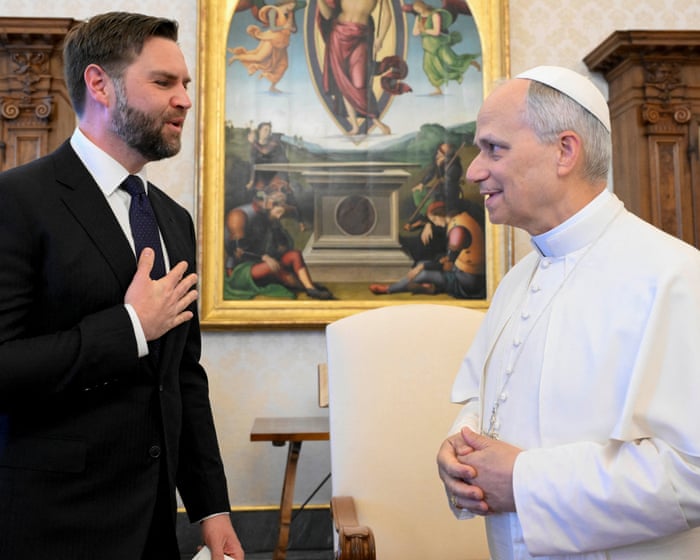
The contrast between the two men debating war and theology was striking. On one side stood Pope Leo XIV, the first North American to lead the Catholic Church and the first Augustinian pope, who recently visited the Algerian city where Saint Augustine once lived. For Leo, who wrote his doctoral thesis on Augustine’s ideas, the trip was the peak of a lifelong intellectual journey.
On the other side was U.S. Vice President JD Vance, a recent convert to Catholicism with no academic background in church history.
At the core of their disagreement was how Augustine, the fourth-century thinker, developed the concept of a “just war”—a departure from earlier Christian teachings that rejected all violence, even in self-defense. This idea has remained deeply influential in Western thought for centuries, debated by philosophers, jurists, and theologians.
Their dispute is part of the wider controversy sparked by the Trump administration’s efforts to frame the U.S. conflict with Iran in terms of a confused Christian militancy. In a particularly strange moment, President Trump posted an AI-generated image on social media depicting himself as a Christ-like figure healing the sick beneath fighter jets and armed angels. The image was later deleted.
Meanwhile, U.S. Defense Secretary Pete Hegseth has acted like a modern crusader, embracing the idea of righteous violence.
In a series of statements last month, Pope Leo emphasized that Christ’s teachings reject war, adding that God “does not listen to the prayers of those who wage war, but rejects them.” His language grew sharper in recent weeks. He called Trump’s threat on April 7—that “a whole civilization will die tonight” unless Iran struck a deal with the U.S.—“truly unacceptable” and a violation of international law.
Vance responded at a Turning Point USA event at the University of Georgia on April 14. “When the pope says that God is never on the side of people who wield the sword, there is more than a 1,000-year tradition of just-war theory,” he said. He pointed to U.S. troops who liberated France from the Nazis and freed Holocaust prisoners as examples where divine support seemed evident. Vance urged the pope to “be careful when he talks about matters of theology,” a remark that led some on social media to accuse him of “popesplaining” to the pontiff.
Augustine himself argued that a just war was the state’s responsibility, justified only if fought with the “right intention” and to restore peace. The leader waging war should act like a Christian judge, protect the innocent, and avoid motives like revenge or greed. These principles, developed by Augustine and later thinkers, still guide the laws of conflict today.
In a March interview, Cardinal Robert McElroy of Washington, D.C., said the U.S. and Israeli attack on Iran failed to meet just-war standards, particularly the criterion of clear intention. Then, on Wednesday, Bishop James Massa, speaking for the U.S. Conference of Catholic Bishops’ doctrine committee, clarified the bishops’ stance in support of Pope Leo.The pope’s remarks were not merely his personal opinion, but reflected Catholic teaching as outlined in the church’s catechism.
“For over 1,000 years, the Catholic Church has taught just-war theory, and it is that long tradition the Holy Father carefully references in his comments on war,” said Massa.
“A constant tenet of that 1,000-year tradition is that a nation can only legitimately take up arms in self-defense, once all peace efforts have failed. That is, to be a just war, it must be a defense against an aggressor. This is what the Holy Father actually said: ‘He does not listen to the prayers of those who wage war.'”
JD Vance commented: “I think it’s very, very important for the pope to be careful when he talks about matters of theology.”
While many have been offended by Trump’s post depicting himself as Jesus and by the attacks on the pope, the controversy has also drawn in Trump’s staunch defenders. These include House Speaker Mike Johnson, who identifies as a Southern Baptist and seems as unclear as Vance about Pope Leo’s point.
“If you wade into political waters, you should expect some political response,” said Johnson.
Others, like conservative Catholic New York Times columnist Ross Douthat, have found themselves in a middle ground. Douthat has expressed that the church can sometimes appear hostile to conservatives, while also acknowledging that the Trump administration’s justifications for the war against Iran have shifted and at times lacked substance.
“Is the war just or is it not?” Douthat asks, offering his own reasons why it might be considered just. “The administration simply has not made a coherent and consistent case for the justice of the conflict.”
Frequently Asked Questions
Of course Here is a list of FAQs about the situation where JD Vance is criticized for being out of his depth in the debate over whether the conflict with Iran constitutes a just war with accusations of popesplaining
BeginnerLevel Questions
1 What does out of his depth mean in this context
It means critics believe Senator JD Vance lacks the necessary expertise knowledge or nuanced understanding to competently engage in the complex theological and geopolitical debate about a just war with Iran
2 What is the just war theory
Its a centuriesold Christian framework primarily Catholic used to determine when it is morally permissible to go to war and how to conduct warfare ethically It considers criteria like just cause proportionality and last resort
3 Who is JD Vance
JD Vance is a US Senator from Ohio a bestselling author and a convert to Catholicism He is often seen as a leading voice in the New Right or nationalist conservative movement
4 What does popesplaining mean
Its a newly coined critical term suggesting that a nonexpert is condescendingly explaining or interpreting complex Catholic doctrinespecifically on an issue where the Pope has a stated positiondespite lacking the authority or deep theological training of clergy or scholars
5 Why is Vance talking about this
As a Catholic public figure commenting on potential military conflict with Iran he is invoking moral and religious principles to justify or critique US policy aligning his political stance with his religious identity
Advanced Contextual Questions
6 What specifically did Vance say to prompt these criticisms
While the exact remarks depend on the specific debate criticism typically arises when Vance makes definitive claims about whether a potential war with Iran meets the just war criteria especially if his analysis seems to dismiss or argue against more nuanced theological positions or the cautious stance often taken by the Vatican
7 What is the Popes position and how does it contrast with Vances
Pope Francis and the Vatican generally emphasize diplomacy deescalation and the heavy burden of proving a war is just They are typically extremely skeptical of preemptive strikes Vances position as a nationalist