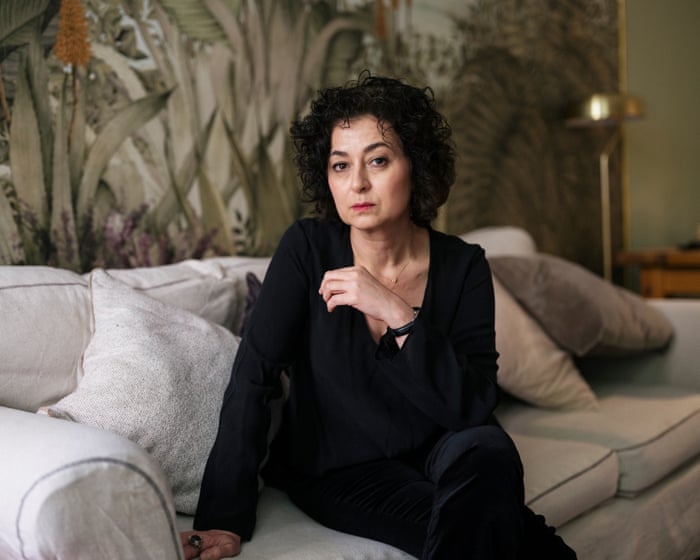
One summer evening in 2022, Turkish writer Ece Temelkuran was lying on a stretcher in a doctor’s office in Hamburg, Germany, with an IV drip in her arm. After six intense years of work and travel, her body had given out. “I now know that I need to talk,” she writes in her latest book, Nation of Strangers, which was shortlisted for the 2026 Women’s Prize for Nonfiction. “I fear that not speaking will make me really sick. And when homeless, you cannot afford to get sick.”
She hadn’t been silent in the years before, though. She had published two well-received books: How To Lose a Country: The Seven Steps from Democracy to Fascism (2019) and Together: A Manifesto Against a Heartless World (2021). She had also shared her warnings publicly, on stages across the West, saying: this is what happened to us in Turkey—make sure it doesn’t happen to you. And technically, she isn’t homeless; she lives in Berlin. But by “speaking” and “home,” Temelkuran means something specific and far-reaching. Nation of Strangers argues that the idea of home, and the emotions tied to it, is one of the most powerful political forces of our time.
Temelkuran became a journalist at 19, while still deep in a law degree. She worked as a senior reporter for CNN Türk and later as a political columnist critical of Recep Tayyip Erdoğan’s government. She has also published several novels and prose poems. For years, she thrived in the tough, male-dominated newsrooms of a patriarchal and increasingly nationalistic culture. But as Erdoğan tightened his control, life grew harder: death threats, rape threats, and emails “reporting [my] life minute by minute” to show her she was being watched closely.
She and her colleagues coped by laughing it off. “And then our friend Hrant Dink was killed [by a Turkish nationalist on 19 January 2007]. One day before that, we were joking—you know, comparing our death threats.”
Her books began to be used as evidence in people’s arrests. Soon after, six or seven columns called for her own detention. Then, one night, she woke up to find the iron bars on her windows had been removed and a window left open. Nothing was stolen, but, she writes, “I took it as a message saying: ‘We could do it.'” On 6 November 2016, she called her mother from Zagreb, Croatia, to tell her she wasn’t coming back: “A one-minute phone call; half of it was silence. But that’s all it took for me, in the autumn of 2016, to become homeless.” She was 43.
“I despise telling this story,” she writes, seven lines into Nation of Strangers. It makes her “cringe—politically, morally, emotionally.” She fears “appearing as yet another whining exile demanding recognition” and hates the objectification and alienation that label brings. She is aware of how often the word is used as a comfort by the (usually Western) user: “they” are exiles who should be grateful; “we” are a civilized haven. The challenge, she writes, is to figure out “how to speak like a homeless person yet not sound like a victim or a survivor.”
Her response was to warn about how fragile such havens can be. She wrote three books where novelist, poet, reporter, and political columnist blend with a lifetime of travel and absorbing culture—from the writings of philosopher Baruch Spinoza and Sufi mystic Mansur al-Hallaj to French films, Leonard Cohen, and Pikachu—creating a kind of sharp, aphoristic clarity. And she wrote them all in English.
It wasn’t just that her target audience had changed. English was a way to push aside her feelings. “It was really complicated, you know, what I went through,” she says, staring out ofThe window of the rental property in Barcelona, where she’s staying with her partner, looks out onto a secondary school. Students are being cheerfully shouted at through a megaphone. Her cigarette smoke drifts across the screen during our video call. When she decided to move to Zagreb, she only knew one person there. She had seen a billboard at the airport that asked: “Why Zagreb?”
“That was the question people kept asking me later, when I started living there. They meant: why would someone like me go to Zagreb?” she says. “As in, instead of London or Berlin. And that’s exactly why I stayed. I wanted to be alone and really understand what had happened to me all those years. Why and how people let go of those they’re supposed to support. I know a lot of people think fascism is just evil guys showing up and taking over, but no, that’s not how it works. It happens through a million small acts of complacency. And those complacencies—especially when you experience them in both your private and public life—break your heart in a way that’s hard to handle. I had to deal with that heartbreak, I think. It took me ten years to even call it a heartbreak, by the way.”
She also had to deal with everything she had seen before leaving. Recently, the writer Pankaj Mishra told her he noticed that in public, she always starts her story in 2016. “You never tell the other parts,” as she puts it now: reporting on the aftermath of earthquakes; interviewing a mother who chose to run over her daughter with a tractor to prevent an even worse “honor” killing (“of course, she lost her mind”); documenting “how people kill each other for stories,” usually nationalist ones. She makes a sound of pure disgust. “And I said to Mishra: ‘I wouldn’t tell westerners, because they’d be traumatized.’”
She laughs. “That’s a line I borrowed from Ziko [an interviewee in Nation of Strangers]. It is traumatizing. And when I tell it, it feels unreal. I don’t like the look in people’s eyes. I become an object to observe.”
She moved to Zagreb because she “wanted to be alone and really understand what had happened to me.” Writing in Turkish felt “too emotional,” she thought. She wanted to “be a brain, only a brain”—and the distance of English allowed that. She refused to listen to Turkish music or meet Turkish people. She wrote and talked, wrote and talked. Then she ended up at the doctor’s. There’s a moment in Nation of Strangers, sometime after that visit, where she tentatively goes into the Turkish area of Berlin and finally has a Turkish coffee. The world doesn’t fall apart. In fact, it becomes a little more whole. And that’s her point. National stories urgently need to be told differently. The personal is political. Specifically, emotion is political—especially in a world where, as Temelkuran argues, more and more of us feel unhomed. That might be because we’ve been forced to leave our homes, or because we’re at war, or because the political ground has shifted beneath us and we no longer recognize the country we live in. It could be because AI is reshaping work, or the cost of living has pushed us out of a life we knew, or because the climate crisis is changing the weather and the face of the Earth. The left ignores this at its own risk, she argues, especially since the right certainly hasn’t.
Temelkuran spent much of the last five months on a book tour. In every audience, she says, she met at least one “American exile.” “These people call themselves exiles. They say: ‘I came from the United States because I felt under threat. I felt like this wasn’t my country anymore.’ And their voices start trembling, because they’re new to this. I make jokes and get them to laugh, like: ‘Welcome to the club.’” Many Germans feel it too, she says.Those of us who write, think, and speak have a new moral duty—not just to understand and analyze, but to care about how people are feeling right now,” she says. “Loneliness, fear, anxiety, uncertainty—all these emotions have political consequences, and today those consequences are being used, weaponized, organized, and mobilized by the far right. From the very start, they’ve given a masterclass in managing emotions.”
Democracy isn’t just failing, Temelkuran argues—the left has also failed to grasp how to handle the fallout. She’s thought a lot about Western arrogance, but especially about “our own arrogance as progressives, as intellectuals, as the cultural elite, if we can call it that. We still think someone will ask us what to do and what we think. But in this new world order that’s been building very quickly, we don’t matter.”
“People get angry when I draw parallels between Turkey and European countries. But I do it mainly because I don’t want others to fail the way we did, to make the same mistakes. We went through that arrogance—and it cost us our country.”
She’s impatient with those who ask her to define fascism or suggest she’s really talking about authoritarianism. She turns the question back on them: “Why don’t you call it fascism?” She thinks there are a few reasons. First, many Westerners believe “there can’t be fascism in a free-market economy, which was treated as a natural fact after the Berlin Wall fell.” Second, there’s a search for comfort: a strict historical definition of fascism lets you box it up as “World War II” and close the lid. Third is plain fear: “We can’t be one of those crazy countries.”
But mostly, she says, it’s about responsibility: “Once you call it fascism, you have to do something about it. If you call it authoritarianism or right-wing populism, you can sit back and treat it as a passing phase—people have gone mad for a while. They’ll vote for these leaders, get a taste of it, and then it’ll be over.”
This makes it easier to laugh off, she says: “I think the UK has been stuck at the laughter stage for quite a long time. That laughter is very strong. It’s built into British culture. And it’s hard to separate from cynicism… But nothing is funny right now, and people should let themselves be very serious.”
“I’m afraid that when Nigel Farage comes to power—if he does—when Trump shows up in London, when Jared Kushner arrives with his new PowerPoint plans for, I don’t know, the NHS, people will still feel they have to laugh about it just to feel safe.”
I mention that I walked alongside part of Tommy Robinson’s “Unite the Kingdom” march last month and thought how many of those marchers were probably there because of a sense of loss or impending loss—of a familiar home, of a possible future. The fact that this was expressed through St. George and crusader flags, and seen as aggressively exclusionary and threatening to anyone who didn’t look like them, doesn’t erase that. This isn’t discussed much in her books, which focus on progressive, left-leaning losses.
“I’m not one of those liberals who thinks, ‘Oh, we should always have a dialogue,’” Temelkuran replies. “We should always recognize fascism when it’s there. You don’t have a dialogue. You just fight against it. Period. But on the other hand, I think home is at the heart of the zeitgeist today for several reasons.”Sons. I lost my home because of fascism—but now, people who are afraid of losing their homes are using that fear to build fascism. Home is at the heart of all this debate.
Temelkuran agrees with Iris Murdoch, who argued in books like The Sovereignty of Good that paying attention is a moral act—that real, humble, open attention is the essence of care. The tough reporter in her is embarrassed to say it, she admits, but attention is the essence of human love: “Paying attention means being there, I think, not just staring at the situation. Being in the reality, not observing it.”
That means paying attention to everyone, not just to certain political groups, or making a distinction between people inside or outside a particular national story. It means being open to and accepting the messiness of it all, and making a real effort to see how much we share, rather than what divides us. “Yes, let’s talk about losing a home, but let’s talk about it from the perspective of human love.”
She says she’s been struck in recent months by how “when I start speaking along those lines, with that tone about human love in a political context, people start getting teary-eyed. Literally, I’ve seen so many people cry. And it’s not because I had some deep revelation. They’re exhausted. They’re tired of being in survival mode: ‘I’m not going to feel anything. I’m not going to let myself be vulnerable.’”
Temelkuran’s parents got together after Erol, a young lawyer, got Lale—the militant-left woman who would become his wife—released from jail by sending a general photos of his own daughter at a protest. (Lale had been locked up for distributing the last letters of three students hanged by the military during the 1971 coup.) For Temelkuran, politics has never been a casual game, where people share ideas and then “everyone goes back to their homes.” It’s about morality: “Your political choice is also a moral choice. It’s what makes you who you are—plainly, whether you’re a good person or a bad person.”
“I think our political language will be less gentle from now on. I think we’ll have to talk about sacrifice very soon,” she adds. “Gaza was a test in that sense. Are you going to sacrifice your career, your social circle? That question has been asked of us. Some of us answered correctly, some didn’t. But that question will grow wider and deeper. It will involve all of us.”
Every summer, Temelkuran’s family meets on a Greek island in the Aegean Sea. Her brother and his family come from the US, her parents from Turkey. It’s not a place, she writes, that “usually pops up in your email inbox as a travel ad destination.” It’s a village on Lesbos, the island that hosted Moria—the now-closed refugee camp that was the largest in Europe. They chose Lesbos because it was easy for her parents to reach. For a week, they try not to discuss dark topics—but it’s hard when, in clear weather, they can see the Turkish coast across the bay.
Nation of Strangers: Rebuilding Home in the 21st Century is out now (Canongate, £11.99). To support the Guardian, order your copy at guardianbookshop.com. Delivery charges may apply.
Frequently Asked Questions
Here is a list of FAQs based on the statement and context provided by Ece Temelkuran
BeginnerLevel Questions
Q Who is Ece Temelkuran
A She is a prominent Turkish author and journalist She has written books like Turkey The Insane and the Melancholy and is known for speaking out against political oppression
Q What does she mean by I dont want Europe to fail the way Turkey did
A She is warning that Europe is showing the same warning signslike rising nationalism attacks on the media and weakening of democratic institutionsthat Turkey experienced before sliding into authoritarianism She wants Europe to learn from Turkeys mistakes
Q Why does she live in exile
A She received death threats and faced legal pressure in Turkey because of her critical writings about the government She now lives abroad to stay safe and continue her work
Q What does fascism mean in this context
A She uses the term to describe a political system where a leader or party uses fear nationalism and attacks on opponents to silence dissent and centralize power rather than a historical reference to WWII
IntermediateLevel Questions
Q What specific warning signs does Temelkuran say Europe is repeating
A She points to 1 Normalizing hate speech against minorities 2 Weakening independent courts 3 Using enemies of the people language against journalists and 4 Creating a culture of fear where people selfcensor
Q How did Turkey fail according to her
A She argues that Turkish society and intellectuals failed to unite and resist early warning signs The media became silent opposition parties became weak and citizens accepted small erosions of freedom until it was too late
Q What kind of death threats did she receive
A She has received online and direct threats from nationalist groups and government supporters She has been called a traitor and warned that she would be killed if she returned to Turkey
Q Is her warning just about Turkey or is it a general lesson
A It is a general lesson She uses Turkey as a case study to show how a democracy can slowly collapse from within and she believes Europe is now following a similar path
AdvancedLevel Questions