The border between India and Pakistan is lined with 50,000 tall poles holding 150,000 floodlights, creating a glow so bright at night that it’s visible from space. Driving through towns on the Indian side, it’s hard to tell—even in daylight—where one country ends and the other begins. Along the rolling wheat fields, unnamed dirt roads wind past men sitting on rope benches, whiling away their afternoons, staring as you pass by.
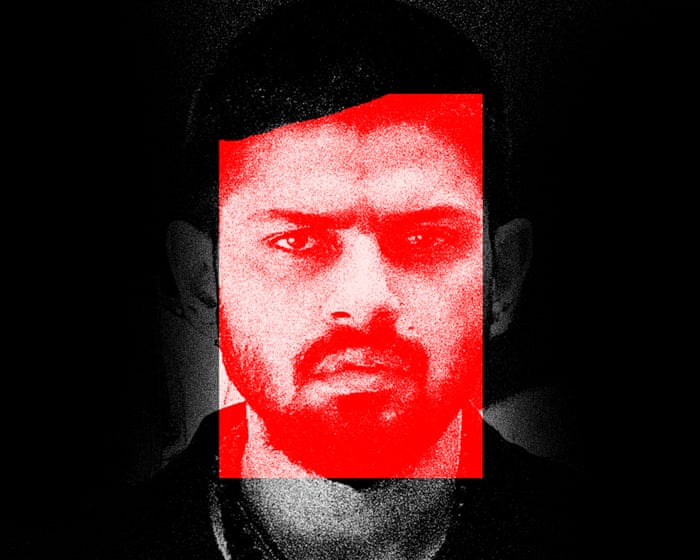
Dutarawali, right by the highway, is a bit different: the houses here are big, with spacious courtyards. One three-story house, painted white with red accents, has a 7-foot boundary wall topped with barbed wire and four CCTV cameras overlooking the unpaved street. The symbol of Om curls across its brown iron door, which has no nameplate. This is the home of Lawrence Bishnoi, who at 33 is India’s most notorious gangster.
In October 2024, members of the Bishnoi gang carried out one of the most high-profile murders in recent memory: Baba Siddique, a senior Indian politician, was left in a pool of blood next to his car in a wealthy Mumbai neighborhood. Soon after, Bishnoi was linked to several killings and attempted assassinations on Canadian soil. By then, he was already well-known. Two years earlier, he had ordered the shooting of Siddhu Moosewala, a Punjabi rapper with an international following, who was gunned down near his village in Punjab. Moosewala was killed, Bishnoi told the National Investigation Agency (NIA) in 2023, to avenge the death of a Bishnoi gang member.
What’s most striking about these killings is that Bishnoi orchestrated them while locked up in a “high-security prison” in the national capital. He has a well-publicized hitlist with a dozen names, including Bollywood stars and stand-up comedians. According to the NIA, the Bishnoi gang has about 700 members spread across northwestern India, the Middle East, and North America. He’s been in jail for over 10 years, awaiting trial for several counts of murder and extortion, but that hasn’t held him back. His most serious crimes have happened while he was in Indian state custody.
I rang the bell next to the brown door, knocked, and waited. No one answered. Bishnoi’s immediate family, among the wealthiest in the village, has never spoken to the media. Happy Bishnoi, who isn’t directly related to Lawrence but grew up in Dutarawali and knew him as a boy, had dropped me off nearby. He’d advised me not to knock, not to take pictures—just to look at the house from a distance. After getting no response, I found him parked two streets away. He explained he didn’t want the CCTV to catch his car on camera.
I’d spent the day with Happy in and around the village, talking to locals and Lawrence’s relatives, and so far he’d been cheerful, living up to his name. But now he wanted to leave, immediately. Ringing the bell was a step too far. Minutes later, out on the highway, I asked Happy if we should stop for tea. “Once we’re out of this area,” he said. What area? I asked. “Lawrence’s area,” he replied, speeding up.
India is adrift in lawless waters. Sectarian violence is raging in the northeastern state of Manipur. Insurgents are fighting the Indian state in Kashmir, where army generals have been accused of personally overseeing the torture of militants. In Uttarakhand, in northern India, a brutal campaign of cultural homogenization is underway. (Last year, in one case, Hindus coordinated attacks on their Muslim neighbors, forcing them to flee the village.) In central India, young Hindu men patrol highways, frequently harassing—and sometimes lynching—anyone they suspect of eating or transporting meat. Meanwhile, the ghettoization of Muslims in the western state of Gujarat, where Modi served as chief minister for 12 years before moving to Delhi, is presented as normal.An example for the rest of the country to learn from. The chief minister of Uttar Pradesh, India’s most populous state, is a saffron-clad strongman who talks like a street criminal. A man widely accused of inciting the worst riots in the national capital this century was recently named Delhi’s law minister. The country’s home minister spent three months in jail after being arrested for murder—though the charges were later dropped.
In India today, where official impunity meets the constant threat of violence, Bishnoi is as recognizable as Bollywood stars and top cricketers. Old-school Indian gangsters like Dawood Ibrahim, the 1990s Mumbai underworld don, were feared figures who lived glamorous but ruined lives abroad, on the run from the law. But even from prison, Bishnoi has become a role model for millions of angry young men. To them, following the law increasingly seems like something for losers, bores, and fools. As the government fails to create jobs for the vast numbers of unemployed youth, Bishnoi embodies a nihilistic ideology born of desperation: take what you can, by any means necessary.
Since his most publicized targets and victims are mostly Muslims and Sikhs—both viewed with suspicion in the Hindu nationalist imagination—Lawrence Bishnoi has been celebrated by the mainstream press as a “Hindu don” who strikes fear into India’s enemies, from Sikh separatists to Muslim fifth columnists. Prime-time news coverage has highlighted his Hindu credentials: a vegetarian diet, a celibate lifestyle, and a scowling Hindu god tattooed on his biceps. Streaming platform Zee5 just announced a “docuseries” on Bishnoi’s life, titled Lawrence of Punjab, which will further polish this image.
Anonymous sources in the NIA have told the press that Bishnoi sees himself as “a warrior for the ‘Hindu cause,’ which he believes offers him some protection under the current regime.” Yet Bishnoi’s connection to the Indian government goes deeper than shared religious ties.
Bishnoi was already a national celebrity when, in October 2024, just days after the murder of Baba Siddique, he gained international notoriety. Testifying at a public inquiry into foreign interference in Ottawa, then-Canadian Prime Minister Justin Trudeau named him personally for carrying out violence against Canadians. Most shocking of all, Bishnoi was allegedly acting on orders from the Indian government. Trudeau said Indian diplomats had been “collecting information on Canadians who are opponents of the Modi government, passing that information to the highest levels of the Indian government, and then directing it through criminal organizations like the Lawrence Bishnoi gang to result in violence against Canadians on the ground.”
That a man can run his criminal empire from jail is nothing new. But the allegations from Canadian authorities suggested something far more striking: that Bishnoi was carrying out assassinations on foreign soil for the Indian government.
The Indian government quickly dismissed Trudeau’s claims, pointing out that Ottawa provided no evidence. Yet in my conversations with intelligence officials in New Delhi, I could sense—though they would never say it outright—a different understanding of the story, one more in line with how Modi’s India sees itself. A former officer of India’s Research and Analysis Wing (RAW), the spy agency responsible for foreign intelligence, summed it up neatly. India is now the world’s fourth-largest economy and a US ally situated on China’s doorstep. “We can do this now,” I was told.As the former agent put it, “Because we have the influence to get away with it.”
Lawrence Bishnoi is an unusual name. His fair skin led his parents to name him after Sir Henry Lawrence, an officer of the East India Company in 19th-century Punjab. Sir Henry founded Lawrence School in Sanawar, one of India’s oldest and most prestigious boarding schools. Lawrence didn’t attend that school, which was 200 miles away. Instead, he went to the local school in Dutarawali, where his family owned over 40 hectares of land. A shrine dedicated to his grandfather stands in the village.
The word Bishnoi combines two Hindi words: bees (twenty) and nau (nine). The Bishnois are a Hindu community in northwestern India who follow 29 principles. These cover prayer and fasting rituals, purity, vegetarianism, and a strong commitment to environmentalism. The community honors martyrs like Amrita Devi, who was beheaded in the 18th century for trying to save khejri trees that the king of Marwar wanted to cut for firewood. Growing up, Lawrence felt a deep connection to this tradition.
The government secondary school sits in a small yard surrounded by wheat fields, next to a small, murky green pond where buffaloes bathe. There’s a crematorium out back. The school was closed when I visited, but Happy Bishnoi remembered being a student there with Lawrence. Corporal punishment is common in most Indian kids’ education—growing up in Rajasthan, I was regularly beaten with sticks for not doing my homework—and the same was true in Dutarawali, Happy told me. The teachers “used to fight with their wives at home and then come to school to take it out on us,” he said.
But mainly because of his family’s status, no teacher would dare hit Lawrence, Happy said. Other students also treated him with respect. From a very young age, Lawrence was used to special treatment. As a teenager, he enrolled in a convent school in the nearby city of Abohar, another Bishnoi stronghold, where he was known for wearing branded clothes and riding his motorcycle.
In 2010, at age 17, Bishnoi left for Chandigarh, the regional capital, to study law at the prestigious Panjab University. Only 180 miles away, Chandigarh felt like a different world from the dusty streets and wheat fields Bishnoi used to ride through on horseback as a teen. The city was designed in the 1950s by French-Swiss modernist Le Corbusier as a symbol of newly independent India’s desire to break from its past. It’s a city of alphanumeric addresses, manicured gardens, and transplanted trees. From the student housing where Bishnoi lived to the college where he studied law is a 30-minute walk along the central avenue of the city’s orderly grid. The walk itself shows rising wealth: the houses get fancier, the cars more expensive. What breaks up the monotony of high walls isn’t rebellious graffiti, but caste names scrawled in paint or coal, pointing back to a communal tradition Chandigarh was meant to leave behind, along with posters for local student elections.
At Panjab University, student politics can mean “being pulled into a world of early gangsterism,” said Manjit Singh, then a sociology professor at the university. Singh, who himself moved from a small town to Panjab University in the 1970s, guessed that Bishnoi must have felt somewhat out of place when he arrived—and that his response was to try to dominate his new surroundings. Jupinderjit Singh, a Chandigarh-based journalist who has written extensively about Punjab gangsters, had a similar theory. “Lawrence Bishnoi is about 5 feet 6 or 7 inches tall, but he’s got 100 acres of land, he’s the Raja Babu of the family, he’s got a bike when he’s in 8th grade,” Singh told me.And then suddenly he’s in Chandigarh: there are girls here, a different kind of wealth, and no one really cares about him. The attraction here isn’t land—it’s money, status, and social identity, and he doesn’t have any of that.
Things changed for Bishnoi when a senior student leader from a similar background, Vicky Middukhera, took him under his wing. (Middukhera, a well-known gangster in Punjab’s student politics, was eventually killed by rivals in 2021.) In 2010, Bishnoi ran for chair of the student council and lost, but he won the next year. In this environment, Manjit Singh told me, you prove yourself through acts of violence: “You don’t just pretend to be tough—you act.”
By the time he became student council leader, several cases were already filed against Bishnoi, including robbery, arson, and intimidation. His first notable crime was burning the car of a rival student leader in Chandigarh. To escape the police, he moved to Rajasthan, about 350 miles away. During this time, he later told police, Middukhera gave him money and introduced him to other gangsters. Another friend from this period was Goldy Brar, who is now one of the most notorious figures in Bishnoi’s gang.
In February 2014, while on his way to a religious shrine in Rajasthan, Bishnoi had a road accident. When a driver started yelling at him, Bishnoi and his friend pulled out their guns and fired shots in the air to shut him up. A case of attempted murder was filed against them, and Bishnoi was put in jail while awaiting trial. Later that year, while being taken to court in police custody, members of his gang stopped the police vehicle and opened fire on the officers.
Bishnoi managed to escape, but two months later, the police found him living under a fake identity in Gurugram, just south of New Delhi. Since then, Bishnoi has been in jail, though he has only been convicted of minor offenses like extortion and illegal possession of weapons. Today, there are about 40 cases pending against him in India, and he is charged with everything from armed robbery to cross-border drug smuggling and collaborating with terrorists. In most of these cases, the charges haven’t been formally filed yet, and according to his lawyer, they won’t be anytime soon. Thanks to laws passed by the Modi government that allow the police to hold people in preventive custody without due process, Bishnoi can be kept in jail indefinitely.
Before he moved to Chandigarh, the most important experience of Bishnoi’s life, in his own words, happened in 1998—and he was hundreds of miles away from where it took place. That October, word spread among the Bishnoi community that Salman Khan, a hugely famous Bollywood star, was in Rajasthan hunting blackbucks, an endangered species of antelope that is sacred to the Bishnois.
Ramesh Bishnoi, an older cousin of Lawrence, was visiting Delhi when he first heard about Khan’s hunting trip. “We immediately left Delhi, traveled all night, and reached Jodhpur [in western Rajasthan, where Khan was filming a new movie],” he told me.
Ramesh is a short, thin man in his 50s, with a lampshade mustache and a bald head. We met in Abohar, at a center for a Bishnoi group that works to protect wildlife. It was a warm afternoon, and during the two hours we talked in the yard, we kept moving our plastic chairs to stay in the shifting shade of the trees.
View image in fullscreen: Salman Khan in April. Photograph: Sujit Jaiswal/AFP/Getty Images
“[Khan and his friends] went to a village called Kankani, a Bishnoi village, where blackbucks roam in large herds,” Ramesh told me. “When the villagers heard gunshots during the night, they got on their motorcycles and tractors to find out what was happening.” Soon they came across Khan and his friends, but the Bollywood star sped away in a white Jeep, said Ramesh.
This was the start of a long legal battle that continues to this day. KhanHe has maintained that the blackbucks died of natural causes and that he was framed by people trying to ruin his reputation. In 2006, a trial court found Khan guilty of killing the blackbucks and sentenced him to five years in prison, but the high court later suspended the sentence.
While the older Bishnois continue to pursue Khan through the courts, Lawrence—who was just four years old at the time—has taken it upon himself to avenge what he sees as an insult by Khan against the entire Bishnoi community. “He has belittled us,” Lawrence said in a 2023 interview from jail with a national news channel. “We will give him a strong response in our own way. We won’t rely on courts or anything like that.” (Of course, prisoners aren’t supposed to give major televised interviews. When asked how he could be on a video call, Lawrence simply replied, “We manage.”)
The interviewer asked if he was making these threats to boost his criminal reputation. Lawrence brushed that off. “There’s no shortage of celebrities in Bollywood,” he said. “We could kill anyone walking around on Juhu beach. Don’t you think we’re capable?” His point was that the threats weren’t about raising his gang’s profile, but about a specific grievance with a specific person.
In 2022, Khan’s father reportedly received a threatening note saying he and his son would be killed. In 2024, members of the Bishnoi gang fired shots outside Khan’s apartment building in Mumbai. In October of the same year, after three unidentified shooters killed Baba Siddique in Mumbai, a member of Bishnoi’s gang wrote on social media: “Salman Khan, we didn’t want this war. We did it as a righteous act… Anyone who helps Salman Khan should have their will sorted out.” (However, some—including Siddique’s son—believe the link to Khan might be a red herring, and that the killers may have been acting for Siddique’s business and political rivals.)
In his TV interview, Lawrence offered Khan a way out: if he goes to a specific Bishnoi temple and apologizes to a deity for hurting the community’s feelings, Lawrence will not seek revenge. Ramesh clarified: “The cases against Khan will continue, and we will keep pursuing him legally. Only this current situation [of Khan being on Lawrence’s hitlist] can change if he apologizes.”
The rise of Bishnoi has coincided with the Modi era, a time when India has tried to project itself as a global superpower, both in foreign policy and covert operations. The killing of Sikh separatist leader Hardeep Singh Nijjar in a Vancouver suburb in 2023—allegedly orchestrated by Bishnoi—was part of a broader campaign to silence Indian dissidents abroad. The same week Nijjar was killed, US authorities thwarted a plot allegedly hatched by India’s spy agency, RAW, to kill Gurpatwant Singh Pannun, another Sikh separatist and a prominent critic of the Modi government based in New York. These attacks followed a series of RAW operations in Pakistan. According to the Washington Post, since 2021, at least “11 Sikh or Kashmiri separatists living in exile and labeled terrorists by the Modi government have been killed.”
Both Canada and the US have alleged that the plots against Nijjar and Pannun were approved by individuals at the highest levels of the Indian government. In 2024, Canada’s then-deputy foreign affairs minister, David Morrison, stated that the government believes Amit Shah—India’s home minister and Modi’s closest aide—is the architect of the campaign of violence against Sikh separatists. However, no proof has been provided.
Given the lack of hard evidence, it’s easy to dismiss the charges as nonsense, as the Indian foreign ministry did. But the people I spoke to…Within India’s diplomatic and intelligence circles, there was less certainty. “Pretty much all the work we do has an inbuilt element of deniability,” a former high-ranking RAW official told me in Delhi. According to a Canadian official who spoke to the Washington Post in 2024, when Canada presented evidence to Modi’s national security adviser, Ajit Doval, that India had used Bishnoi’s gang to carry out the Nijjar killing and other attacks, Doval initially pretended not to know who Bishnoi was. “Later,” the Post reported, “Doval began rattling off ‘facts, figures and anecdotes’ about Bishnoi, acknowledging that he ‘was capable of orchestrating violence from wherever he is incarcerated.’”
AS Dulat, a former special director of the Indian Intelligence Bureau, looked genuinely pained when I asked him about Canada’s allegations. “I might have to lie to you, because I can’t let down the agencies,” he told me in his Delhi apartment. “You can talk about rogue elements, but at least in my time, a decision like this couldn’t be made without approval from the very top—by that I mean the prime minister.” Dulat had worked closely with former BJP prime minister AB Vajpayee. “I can tell you for certain that he would not have tolerated this kind of thing,” he said. Dulat made it clear he didn’t know what had actually happened. “The only thing I can say,” he continued, “is that if you think you can do this sort of thing and get away with it, you need to be pretty smart. And in this case, there were definitely screw-ups.”
We may never know exactly what those screw-ups were, or whether the Indian government carried out a killing in a foreign country. To see how little can be learned from official documents, note that India’s investigative agencies have instead charged Bishnoi with working for Sikh separatists based in Canada and Pakistan—the very same people that Ottawa accuses him of terrorizing in Canada.
In India’s geopolitical games, Lawrence Bishnoi may just be a pawn. But he seems content with his situation. “We do not want to be rehabilitated into mainstream society,” he said in a 2023 interview, using the royal “we” when talking about himself. “We are very happy where we are.”
In the absence of any verifiable information, Bishnoi lives most vividly in the stories and myths that surround him. When I went to meet his lawyer in a fancy part of Delhi, I found lawyers sitting outside the office, sipping tea after the courts had closed for the day. They smiled when I told them I was writing a story about Lawrence Bishnoi. “Here’s what you should write about him,” said the best-dressed among them, wearing a spotless neckband. “He has done nothing wrong. Most of the people he’s accused of killing had it coming one way or another.” He explained: “Moosewala, a known gangster who only liked women and fast cars; Baba Siddiqui, a corrupt politician; Salman Khan—less said about him, the better; and Khalistanis [who have been campaigning for a separate Sikh state carved out of Punjab], who are traitors.” He stared at me. “Understand? Lawrence is not a gangster. Lawrence is karma,” he said, portraying Bishnoi as a divine agent of Hindu morality who ensures everyone gets what they deserve.
Yet for others, he represents something more basic: a raw source of power in a world where wealth constantly glimmers before their eyes, just out of reach. In Jaipur, the capital of Rajasthan, where Lawrence was first arrested, I found myself drinking with a group of old college friends. The group could be broadly divided into three types: those who didn’t come from money and were scraping by on the lower rungs of India’s professional class; those who came from money and were living directionless lives as minor…Landlords or businessmen. And those who didn’t come from money and hadn’t managed to join the salaried class—most of them worked as poorly paid assistants to local political figures. All of them were men.
We were on the rooftop of a cheap hotel, in a neighborhood where the city’s first shopping mall opened when I was a kid in the 2000s. Twenty years ago, our biggest dreams were going to McDonald’s and buying cassette tapes from Planet M. Since then, a dozen more malls have popped up around it, with American clothing brands, luxury car dealerships, and high-end gyms where a monthly membership costs about as much as renting an average apartment in the city.
Since I’d left India, I was a bit of a novelty in the group. They asked how life was in New York. How’s dating there? Are white women easy? Had I driven a GMC Denali? And most of all, why had I come back? When I explained I was writing a story about Lawrence Bishnoi, that set the direction of our conversation, as we got drunk on bottles of Old Monk rum and Kingfisher beer.
“He’s going to kill Salman Khan,” one of the men said. “And that motherfucker deserves to die,” another added. “But he shouldn’t have killed Sidhu Moosewala,” the third chimed in. That’s when I realized the rooftop speakers had been playing Moosewala’s songs, which glorify a culture of violence and excess, and often mention big guns and cars. (That’s where the question about the GMC Denali came from.)
Around midnight, a couple of us went for a drive to buy cigarettes. Roads in Jaipur, like elsewhere in India, are blocked off at night for no clear reason, with policemen sitting by the barriers, yawning through the night. You can pass without drawing attention, but the guy I was with turned up his car speakers so loud that my passenger seat vibrated. Naturally, we got stopped. He jumped out, cracked a joke with the policeman. A few moments later, we drove off to the cigarette shop. “In this area, we know every cop,” he told me with a grin. It felt like the whole thing was a performance—a way to test yourself against the police’s power and authority, a way to remind yourself that you mattered in this world (and maybe a way to show me that if I’d been alone, I wouldn’t have gotten away with it). When we got back to the hotel terrace, the drinking circle was still talking about Lawrence Bishnoi.
One of the wealthier men claimed, improbably, that he’d spoken to Lawrence recently. He said another friend, someone I vaguely remembered from childhood, had gotten into crime and was actually part of Lawrence’s gang. “He called Lawrence bhai [brother] and handed the phone to me,” the man said, taking a swig of rum. He wiped his mouth and lit a cigarette. “Lawrence bhai said he doesn’t have much time left in this life anymore. He thinks he’s been used, that he’s served his purpose, and that he’ll be taken off this earth any time now.”
“But while he was alive, he lived a life worth living,” announced someone who worked unofficially for a local politician. “Look at us, what kind of life are we living?”
“At least we’re not in jail,” the wealthy man offered.
That didn’t seem to cheer him up. It was now the early hours of the morning. He got up from his chair, and with eyes practically swimming in rum, stared at the buildings all around us, shining bright in the black night, with floodlit billboards for Audi, Mercedes, and American Eagle.
“These buildings,” he finally said, “these buildings are saying something to me.” What are they saying? I asked. We were all watching him now. Still looking away from us, he replied with complete seriousness: “They’re telling me that I have to take them somehow.”Long-form writing, all in one beautifully illustrated magazine. This issue features stories on how private equity is plundering the world, and what it’s like growing up in a family of Nazis. Plus: why do we believe the perfect stroller will make us better parents? Order your copy here (delivery charges may apply). Listen to our podcasts here, and sign up for the Long Read weekly email here.
Frequently Asked Questions
Here is a list of FAQs about Lawrence is Karma The Gangster Who Became an Icon of Modis India written in a natural tone with clear direct answers
BeginnerLevel Questions
1 Who is Lawrence Bishnoi
Lawrence Bishnoi is a jailed gangster from Rajasthan India He is accused of multiple serious crimes including extortion and murder He gained notoriety for his alleged role in the murders of singer Sidhu Moose Wala and politician Baba Siddique
2 What does the phrase Lawrence is karma mean
It means that for some people Lawrence Bishnoi is seen as an instrument of karma or divine justice They believe he targets people who have wronged others especially in cases involving religious sentiments or crimes against women and animals
3 Why is Lawrence Bishnoi called an icon of Modis India
The book argues that his rise reflects certain tensions in modern India under Prime Minister Modi It suggests that his popularity comes from a mix of caste pride religious nationalism and a perceived failure of the legal system which resonates with some voters in this political era
4 Is this a biography of Lawrence Bishnoi
No its not a simple biography Its a work of investigative journalism that uses his story to explore bigger themes like crime politics caste and the changing nature of hero worship in India today
5 Is the book proLawrence or antiLawrence
The book is critical It examines how a violent criminal can be turned into a folk hero but it doesnt glorify him It tries to explain the social and political reasons behind his cultlike following
Advanced Deeper Questions
6 How did Lawrence Bishnoi build his gang and influence
He started as a smalltime criminal His influence grew by exploiting his communitys strict religious beliefs especially their protection of trees and animals He also used social media to project himself as a protector of these values gaining support from young disenfranchised men
7 What is the connection between his gang and Bollywood
The gang is infamous for threatening and extorting Bollywood figures The most famous example is the murder of Sidhu Moose Wala