It’s fair to say I don’t come from a family of athletes. Growing up in the 1990s, sport was something other people did. My family didn’t cycle, let alone jog. In PE class, I was the kid hiding behind the bins, pretending I’d twisted my ankle. When I thought about working out—which wasn’t often—I vaguely assumed it was meant to make my body more attractive to others.
I went from being an unsporty child to an unsporty adult. Every now and then, mostly to lose weight without giving up croissants, I’d try something like Couch to 5K. I’d either quit after a few sessions or stubbornly finish it just to prove I was right all along: exercise was a waste of time, and endorphins were a myth made up by the wellness industry.
Then I had kids. A big-headed baby, born two weeks late via C-section, wasn’t kind to my body. My back started to hurt, especially when I did it all again three years later while also chasing a toddler. Was this just what getting older felt like? Things that used to work suddenly letting you down?
I tried physio, osteopathy, and chiropractic care. Eventually, someone suggested strength training. Apparently, I had something called a core, and it could use some strengthening. I was desperate enough to try. Plus, I was getting fed up with years of internalized misogyny that had shaped how I thought women should look. I didn’t want to be slim. I wanted to be strong.
Annoyingly, putting in real effort actually worked. Within weeks, I stopped waking up with back pain. I could pick up my kids without wincing. For the first time in my life, I started to understand my body’s potential—not in terms of how it looked, but what it could do.
Still, I wasn’t exactly enjoying exercise, and I didn’t need much of an excuse to text my ever-patient personal trainer with a half-hearted reason to skip. But one day, I saw author Fiona Cummins tweet that she’d finally hit her goal of deadlifting 100kg. There was something about that number—its bold, solid confidence—that made me tell my trainer, “I want to do that.”
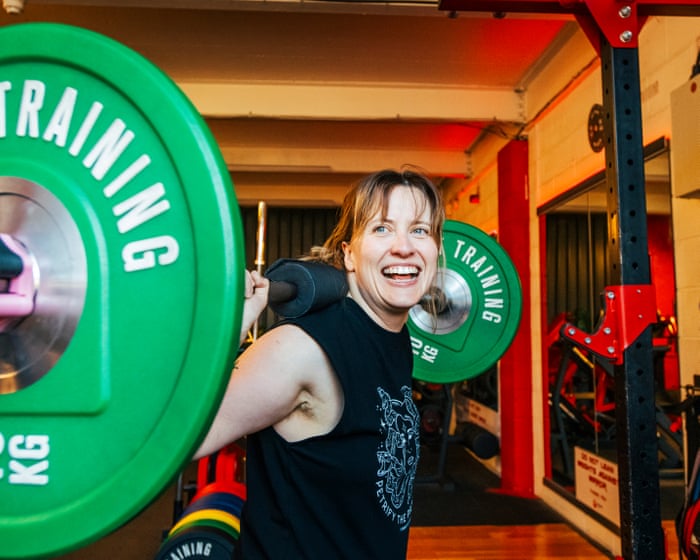
So we did. A program of deadlifts, squats, and bench presses, plus some extra exercises, and I started working toward some seriously heavy weights. Weights that seemed impossible at first—but with just one hour-long session a week, I kept getting closer. Within months, I was deadlifting 80kg, then 85kg, then 90kg. At first, just one rep, but a month later, five, then ten. My body was changing too—not as a side effect of having a baby or eating too much cake, but as a direct result of what I was pushing it to do. It felt strange and exciting.
Even more important, the measurable, step-by-step progress made my competitive side light up in a way no other exercise had. When I finally hit my 100kg goal, it felt like winning a trophy—but there were plenty of other rewarding moments, many outside my training sessions. I could swing my toddler over my shoulder and into a back sling. (I tried it a few weeks ago, now that she’s almost seven, and yes, I can still do it. Strong-arm emoji.) I could carry my own IKEA order from the car. Heck, I could carry it up the stairs and build it all by myself. I didn’t need a man to move something for me. Often, I could move things for them.
Now, when I think about fitness, it’s an end in itself. In the gym or out on my paddleboard—yes, a second form ofExercise is something I genuinely enjoy now – sport no longer feels like a place where I don’t belong. I’ve gone from feeling like a passenger in my own body to feeling in control of it, C-section scars and all. Laura Evans’s debut novel, Little Wild, comes out on June 25.
Do you have thoughts on the issues raised in this article? If you’d like to submit a response of up to 300 words by email for possible publication in our letters section, please click here.
Frequently Asked Questions
Here is a list of FAQs based on the statement The one change that actually worked was this I saw a woman lift 100 kilograms and thought I want to do that too
1 What does the statement mean
It means the person was inspired by seeing another woman achieve a big fitness goal and that simple moment of inspiration was the real trigger for their own success
2 So the change wasnt a diet or a new routine
Exactly The change was a mental shift Instead of focusing on a specific plan they found a powerful personal reason to startwanting to be able to do what they saw someone else do
3 Why does this work better than just deciding to get fit
Because its specific and emotional I want to lift 100 kg is a clear measurable goal that excites you Get fit is vague and boring Seeing someone like you do it makes it feel possible
4 Im a beginner Can this work for me too
Yes You dont have to start with 100 kg The key is to find a real person doing something you genuinely think is cool and say I want to be able to do that
5 What if I dont know anyone who lifts weights
Look on social media for women lifting heavy weights Search for women powerlifting or female weightlifter 100kg Seeing diverse body types succeed helps a lot
6 Is this just about weightlifting
No The principle works for any goal running a 5K doing a pullup learning a skateboard trick or even a career change The key is finding a specific inspiring example
7 What if I try and fail to lift 100 kg
Thats okay The goal isnt to do it tomorrow The goal is to have a clear target Youll break it down into smaller steps The inspiration keeps you going through the hard parts
8 How do I actually start after being inspired
1