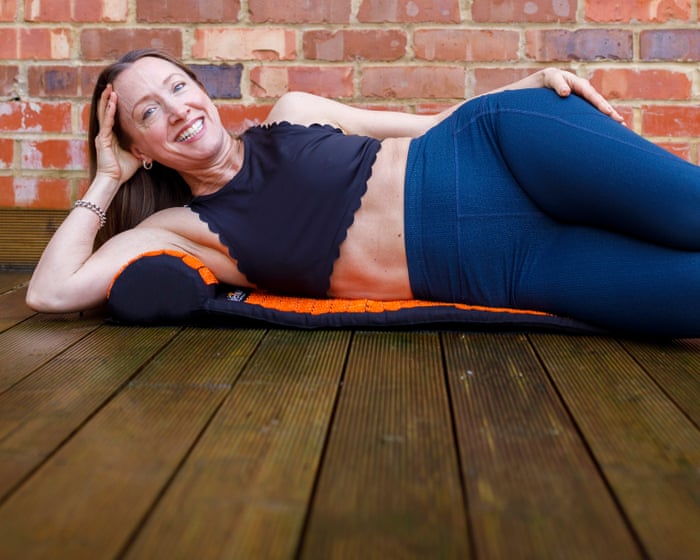
Keith, a 39-year-old from Kansas, has been living with nearly constant pain in his mid-back and shoulders since a car accident in 2023. Over-the-counter treatments didn't help, and he didn't want to use opiates. "After trying everything with solid scientific backing and finding no relief, I turned to acupressure," he says. He bought an acupressure mat—a lightly padded fabric covered in tiny plastic spikes—to lie on and was surprised to find it actually eased his pain.
Acupressure mats, also known as Shakti mats, draw inspiration from the beds of nails used by Indian gurus for meditation and healing over a thousand years ago. While today's mats have the polished look of a luxury wellness product, the spikes are serious. In fact, you can find plenty of images online showing red, marked skin after use—though serious injury is unlikely. Although these mats have been widely available for more than a decade, mainstream interest has recently surged. You may have seen them heavily advertised on social media, with the most prominent brand, Shakti Mat, made in India and costing up to £99 for its premium model. Amazon is full of acupressure mats and pillows, and Lidl recently sold a mat and pillow set for just £10. Still, there is no strong evidence that they relieve stress, pain, sleep problems, or other health issues.
Keith uses his mat and pillow for about 45 minutes at a time. "It's not a cure-all, and I have no scientific explanation for it, but I find relief when I use the mat," he says. Out of curiosity, he checked his blood pressure before and after sessions, even comparing it to rest periods without the mat. He says, "My blood pressure tends to be lower after using it." As someone with diabetes and high blood pressure, this has been a valuable bonus—though he wouldn't recommend it or claim it works for everyone. "This is purely anecdotal," he notes.
Many others also report benefits, as seen in posts on the IsItBullshit subreddit. One user says it makes them "relaxed AF" and improves their sleep metrics. A contractor writes that he uses it three times a week for stiff back and neck, calling it "a magic wand at times." Another often falls asleep on their mat. Most acknowledge the evidence is largely anecdotal and aren't concerned with the ancient philosophy behind acupressure—they just say it works for them.
Sahar Hooti, an acupuncturist and author of The Pocket Guide to Perimenopause, has never used an acupressure mat but explains that the many tiny spikes mean some will inevitably hit acupuncture points, which are also acupressure points. Indian Ayurvedic medicine focuses on points similar (though not identical) to those in traditional Chinese medicine, which Hooti practices and is most common in the UK. "Acupuncture points are strategically placed on our nerve pathways, so the mat stimulates these points, along with others in between—essentially stimulating the skin's surface for relaxation, like giving yourself a massage."
She adds that three thousand years ago, fish bones were used as the first acupuncture needles in China. "Then came stones, and so on. Every culture has..."Acupuncture has its own unique approach. Think of it like a massage, where the therapist's hands stimulate the nerve endings in your back. The spikes on acupressure mats offer a similar path to healing, but with an added strategic benefit—when they hit an actual acupuncture point, which is a nerve ending that sends a specific message to your brain to trigger a particular function. In Chinese acupuncture, the points on the back are believed to support direct organ rejuvenation, which is why they are often used for systemic health issues.
The mats look like they’re just waiting to cause pain, but when I first lie down, I’m almost surprised by how little it hurts. I’d heard that using the mat is painful at first, then you relax into it—similar to a cold plunge. So I borrowed a friend’s mat and neck pillow to try. Both are covered in plastic discs with 4mm spikes around the edges and shallower 3mm ones in the middle. Despite their intimidating appearance, the initial contact is barely uncomfortable. Relaxing onto it is much easier than stepping into freezing water. There’s a slight prickling sensation, followed by warmth and a continued mild tingling. Since the small of my back naturally arches away from the floor, when I lift or hug my legs to flatten my back, the intensity increases, creating a stronger sense of tension and release. I have to admit, it does feel more active than simply lying on a mattress—something confirmed by the deeply dimpled, red skin and lingering itchy, stinging sensation afterward. But it’s hard to say whether it’s actually more beneficial.
Some people claim the discomfort from the mats stimulates endorphin release, though this hasn’t been proven. It certainly creates an injury response, according to Hooti: “The brain thinks, ‘Oh my God, something’s happening,’ and rushes blood to the area to heal it. Temporarily, that’s a good thing—it rejuvenates you.” She recommends using the mats for no more than five minutes at a time. “Prolonging that injury response could be risky, especially for pregnant women, as it might stimulate points that shouldn’t be activated.”
Humans often think that if something is good, more of it must be better. But Hooti advises moderation: “If you don’t have severe health conditions, it’s safe and beneficial short-term, but everything in moderation.” She adds that learning to apply acupressure to yourself—like pressing the webbing between your thumb and forefinger to relieve stress—can be even more effective. “But overall, anything is better than nothing. We need stimulation. In today’s world, stagnation—what we call sluggish blood circulation from excess cortisol—is common. We’re a nation of wired and tired people, so bringing a little blood to the surface probably doesn’t hurt.”
There isn’t much scientific evidence supporting the benefits of spiky mats, but one small study was conducted in 2023 by Benjamin Schöne, a psychology professor at the Norwegian University of Science and Technology. “It was a student project,” he says, “done mostly for fun. I thought it was a good learning opportunity, and I had a personal interest because I use one of these mats to relax and fall asleep.”The aim was to test the mats daily for three weeks, measuring perceived stress and physiological markers like heart rate, blood pressure, and pain tolerance—the latter assessed by how long someone could keep their hand in cold water. Similar to Keith’s personal trial, there was a control group that relaxed on a mat without needles.
The researchers hypothesized that regular use of the mats would improve pain tolerance, consistent with claims that the mats help with neck or back pain. They also wanted to see if users felt better and slept better.
However, the lead researcher, Schöne, says they “found nothing” statistically significant enough to justify further funding for his team. Participants’ blood pressure, heart rate, and pain thresholds didn’t change meaningfully, though subjective stress decreased—as did subjective wellbeing, oddly. Sleep quality and concentration improved slightly. There was no notable difference between the acupressure mats and the regular mats; both had some positive effects, but the acupressure mats performed no better than simply lying down and relaxing.
Schöne notes that the slight drop in wellbeing for both groups likely doesn’t mean the mats had a negative effect. Testing took place during the term when students were more stressed, which may have influenced results, or perhaps asking about wellbeing made people more aware of it.
He points out that the study only involved healthy participants, not people using the mats for specific issues like chronic pain or high stress. Further research focusing on those with particular health complaints, such as tension pain, could be valuable. For example, the mats might help lower blood pressure in those with hypertension—a possibility his study doesn’t rule out.
At the very least, the study showed that resting—with or without an acupressure mat—reduced perceived stress by about 7%, which Schöne considers substantial over three weeks. He suggests the mats could be a useful way to encourage relaxation or create an evening ritual before bed, though more research is needed.
As a scientist, Schöne has mostly stopped using his mat due to the lack of strong evidence, though he admits it helped him fall asleep during a stressful time. In today’s always-on culture, it may feel easier to rest if you feel you’re still actively doing something—like engaging in a self-improvement activity that challenges you. The mats do provide a subtle, massage-like sensation, though it feels fairly surface-level to me. Personally, I’d rather do some yoga and then rest on a smooth mat.
Gyakran Ismételt Kérdések
GYIK Akupunktúrás szőnyegek
Kezdők Általános kérdések
1 Mi is pontosan egy akupunktúrás szőnyeg?
Ez egy párnázott szőnyeg, amelyet több száz apró műanyag tüske borít. Célja, hogy nyomást gyakoroljon a test bizonyos pontjaira, hasonlóan az akupunktúra vagy akupresszúra elveihez, de tűk nélkül.
2 Hogyan működik?
A tüskék stimulálják a bőr idegvégződéseit és nyomáspontjait. Úgy gondolják, hogy ez fokozza a véráramlást, endorfinokat szabadít fel, és megnyugtatja az idegrendszert, ami csökkentheti a fájdalmat és a stresszt.
3 Fájnak a tüskék?
Általában egy kezdeti intenzív érzés tapasztalható, ami az első 1-5 percben szúrós vagy éles lehet. Ez általában elmúlik, ahogy a test hozzászokik és endorfinok szabadulnak fel, majd mély relaxáció vagy melegség érzésévé alakul. Ez egy "jó fájdalom" kell, hogy legyen, nem éles fájdalom.
4 Milyen főbb előnyökre számítanak az emberek?
A három leggyakoribb cél: izomfeszültség és hát/nyaki fájdalom enyhítése, stressz és szorongás csökkentése, valamint alvásminőség javítása vagy álmatlanság elleni küzdelem.
5 Biztonságosak a használatuk?
Igen, a legtöbb egészséges felnőtt számára. Nem invazívak és gyógyszermentesek. Azonban nem ajánlottak bizonyos állapotokkal rendelkezőknek, például cukorbetegeknek, érrendszeri betegségekben szenvedőknek, bőrproblémákkal küzdőknek vagy terhes nőknek. Mindenképpen konzultáljon orvosával, ha egészségügyi problémái vannak.
Használat Gyakorlati tippek
6 Hogyan kezdjem el a használatát?
Kezdje lassan. Kezdetben csak 5-10 percig feküdjön rá, ha érzékeny, vékony felsőruházat viselve. Helyezze szilárd, sík felületre, például a padlóra vagy az ágyára. Koncentráljon a mély, nyugodt légzésre, hogy segítse a testét a relaxációban az érzésbe.
7 Hová helyezzem a szőnyeget?
A leggyakoribb területek a felső hátsó rész/vállak és a derék. Használható a lábfeje alatt, a lábikrákon vagy a nyak hátsó részén is. Kerülje a csontos területeket és az arcát.
8 Meddig és milyen gyakran használjam?
Céluljon 15-30 perces ütemekre. A következetesség kulcsfontosságú – a napi vagy másnapos használat gyakran hozza a legjobb eredményeket krónikus problémák (pl. stressz, hátfájás) esetén. Sokan