The UN refugee agency estimates that up to 3.2 million people in Iran have been temporarily displaced since the start of the US-Israeli military campaign, a number expected to rise as the war enters its third week.
While many Iranians have fled Tehran and other major cities for rural areas or northern mountains, millions remain in their homes in the capital despite regular airstrikes. Nafise, a 30-year-old jewelry designer, is among them. For privacy, she and others interviewed are referred to by first names only.
Nafise says her online business has slowed, first due to January’s internet shutdown during anti-government protests and now because of the war. Together with her husband, Farhad, 33, she has renovated their apartment, stripping old wallpaper and repainting the walls. Picture frames from holidays and trips now hang throughout, alongside Persian rugs.
It’s a cozy home in central Tehran, close to metro stations and shops, filled with warm light. Once a quiet spot in the bustling capital, it now echoes with the near-constant sound of explosions.
Last summer, Nafise and Farhad briefly left Tehran when Israel bombed Iranian military and nuclear sites. They would likely leave again, Nafise says, if not for their cats, Sam and Yal. “The trip was hard for them. They were terrified,” she explains, sitting on the sofa with Sam purring on her lap.
Instead, the couple now spends most evenings with friends, moving between apartments across the city. “Every night at eight, we gather at someone’s house. Everyone brings food or dessert to share. It helps keep our spirits up.”
Like many in her circle, Nafise says she hopes the regime will lose power but is equally clear about what she does not want. “We don’t want this war. We want change, but not like this,” she says, adding, “We’re against the Islamic Republic, but we don’t want the monarchy back either. When people protested in January, it wasn’t because we supported Pahlavi.” She refers to Reza Pahlavi, the US-based exiled son of Iran’s last shah, who has said he would be prepared to lead a transitional government if the Islamic Republic fell.
For a brief moment after the death of Supreme Leader Ali Khamenei, Nafise says many around her believed the system might finally unravel. But when his son, Mojtaba Khamenei, was chosen to succeed him, that hope quickly faded. “The system is deep and complicated,” she adds. “Even if it changes one day, it won’t happen overnight, and it won’t happen with this war.”
Amir, 40, lives in Karaj but travels to Tehran daily for work. He owns a small shop in southern Tehran distributing brake pads. “The war and economic conditions directly affect my work,” he says. “My biggest concern is a prolonged war. But even if the war ends, many countries are not cooperating with Iran. If sanctions were lifted, the country could make significant progress. Our economy holds great potential.”
Abbas Agha works with Amir in the shop. Both have stayed in the city, saying their main worry is a prolonged war and its impact on the already struggling economy.
So far, at least 1,444 people have been killed in Iran and nearly 19,000 injured, according to the country’s state news agency.Iran has responded with strikes on US targets in the region, but a direct communication channel between US special envoy Steve Witkoff and Iran’s foreign minister, Abbas Araghchi, has been reopened in recent days, according to Axios.
The bombing of Tehran is now in its third week. The conflict has driven oil prices above $100 a barrel after Iran effectively closed the Strait of Hormuz to the US, Israel, and their allies. It has also revealed deep divisions within NATO, with the UK and European governments making clear they do not want to be drawn into the war.
Civilians in Tehran have no choice but to endure the situation, said Vincent Cassard, head of the International Committee of the Red Cross in Tehran. “I am seeing the heavy strain that the recent escalation of hostilities has placed on people in Iran, who fear for their lives, the safety of their loved ones, and their livelihoods,” he added. “The heavy loss of life is alarming. Civilian infrastructure has been affected, and many homes have been severely damaged by the hostilities. Daily life in Tehran has been profoundly disrupted: children are not attending school, and many businesses have temporarily closed as a precaution due to the ongoing strikes.”
Mojtaba, a 30-year-old documentary filmmaker, has chosen to stay in his basement office and home in Tehran since the war began, feeling it is the safest place. He no longer ventures out, even to visit family on the city’s outskirts, due to the danger. Sitting cross-legged on a wooden bench in his small basement patio, cigarette in hand, he says the war has been stressful and smoking helps calm his nerves.
“Right now, not even residential homes are safe from attacks. We feel the shockwaves of blasts throughout the city,” Mojtaba says. “These days, I work late into the night, until I fall asleep. I’m usually woken up by an explosion. It makes my heart race. I try to guess the direction of the blast and whether it happened nearby or far away.” Still, he remains hopeful: “Iran has seen many invasions throughout the centuries. We will make it this time too.”
Moen, a 14-year-old student, told the Guardian he mostly stays at home, passing time by reading or watching television. “It’s boring. I can’t see friends or go outside. I want to return to school,” he said. “I was in class when the war started, and we were sent home. Everyone was afraid, and nobody knows when school will resume.”
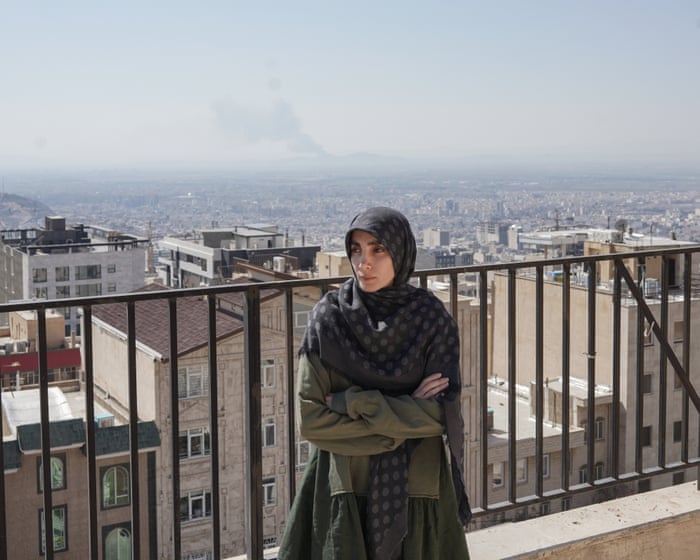
Asal, a 35-year-old clothing designer who runs her own atelier, stands on her rooftop overlooking the city. She worries about the future and her job but is determined to stay in Tehran. “This is my home, and I’m not leaving, whatever the circumstances,” she explains.
Tehran is also home to a large foreign population. There are 1.65 million Afghan refugees across Iran, and as of late 2025, nearly 60,000 foreign students from 101 countries were studying at Iranian universities, many of them in the capital, according to the Tehran Times.Ali, 36, is a PhD student and teacher in Tehran. A Palestinian-Syrian man, he has lived there for the past ten years, working toward his doctorate in art research while teaching at the university. Though no stranger to war, he prefers not to speak of his past. He says that witnessing so much conflict has, in a way, left him numb. “It’s frightening, but I feel like I’ve become a wall,” he explains. “That’s what war can do to you.”
Frequently Asked Questions
FAQs We want change but not like this Life in Iran Under Air Attack
Beginner Definition Questions
1 What is this article about
This article describes the daily reality for ordinary Iranians living under the threat or occurrence of military air strikes exploring the tension between their desire for politicalsocial change and the trauma of being attacked
2 Who is saying We want change but not like this
This quote reflects the sentiment of many Iranian citizens interviewed They express a desire for reform or a different government but not at the cost of war bombardment and the suffering of civilians
3 What kind of air attacks are happening
The context typically refers to crossborder strikes such as those between Iran and Israel or involving other regional actors These can involve missiles drones or airstrikes targeting military or infrastructure sites often causing fear disruption and sometimes civilian casualties nearby
Benefits Deeper Context
4 What benefit is there in sharing these personal stories
It shifts the focus from geopolitical headlines to human cost It reminds the world that international conflicts directly impact everyday peopletheir mental health safety and hopesand complicates simplistic narratives of good vs evil
5 How does this perspective challenge common narratives
It shows that populations are not monolithic It highlights that citizens can be critical of their own government and opposed to foreign military intervention simultaneously rejecting the idea that external force is a preferred or clean solution
Common Problems Daily Life
6 What are the main daily life problems described
Constant Anxiety Living with the fear of sirens explosions and not knowing if your neighborhood will be hit
Disruption Sleep deprivation interrupted work and school and the psychological toll on children
Economic Strain Damage to infrastructure can affect jobs services and the cost of living
Feeling Trapped Civilians feel powerless caught between their governments actions and the retaliatory strikes from abroad
7 Are civilians directly being targeted
While official targets are often military or strategic the nature of modern warfare means strikes can cause collateral damage The proximity of military sites to residential areas puts civilians at constant risk making them feel like targets
Examples Scenarios