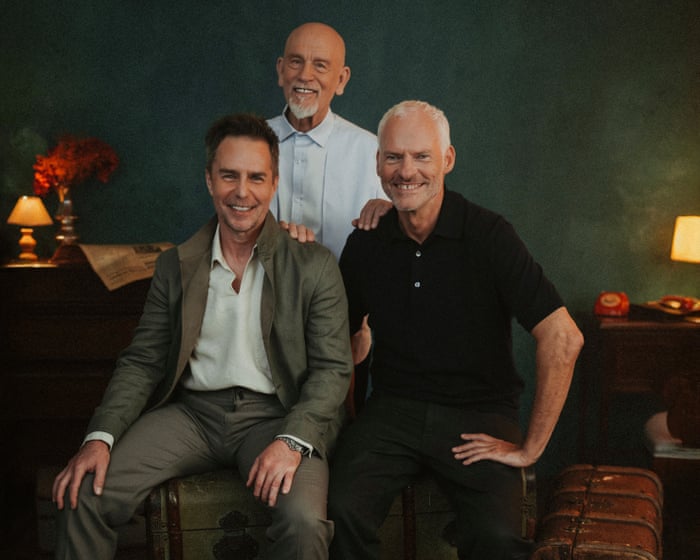
“Earmuffs!” says Sam Rockwell, stopping his enthusiastic tribute mid-sentence and turning to face John Malkovich on the couch. Rockwell loves Malkovich and has been talking about his work at length. Malkovich, he says, is charismatic and dangerous, half masculine, half feminine—a unique combination and the perfect sparring partner. He’s one of the world’s finest actors and annoyingly modest on top of it. “Earmuffs!” says Rockwell, turning back to me. “He hates hearing all this. That’s why I keep saying ‘earmuffs.'” Malkovich frowns. “I don’t mind it,” he says. “Hates it,” says Rockwell. “He truly hates all this stuff.”
In Martin McDonagh’s Wild Horse Nine, Malkovich and Rockwell play bickering CIA agents who may also be the best of friends. Chris and Lee have just finished plotting the 1973 coup in Chile and are stuck spinning their wheels on Rapa Nui, surrounded by crashing waves and moai statues. They’ve seen too much and sinned too greatly, and now Chris has cancer, which isn’t helping his mood. So he takes Lee aside and asks for one last big favor.
Ahead of the film’s premiere, the production team takes over suites at a lavish Venice hotel and hands out hats and T-shirts to each new arrival. The lobby turns into a sea of merchandise. The overwhelmed concierge has to raise his voice to be heard. He says: “Second floor for the Six White Horses press interviews.”
McDonagh makes films that are playful and unpredictable, loaded with violence and spiced with absurdist black comedy. Wild Horse Nine echoes In Bruges and The Banshees of Inisherin with its odd-couple antics and explosive asides. But its mood is more mournful, haunted by death, with one eye on the past. McDonagh—once the upstart enfant terrible of London theater—is now a silver-haired 56-year-old who approaches life from a different angle. “I’m getting older,” he says. “Maybe this is my first old-man movie.”
When he sat down to write Wild Horse Nine, the filmmaker wrote GUILT and REGRET at the top of page one, as though setting his course with a compass and sextant. His film opens in Santiago before moving to the South Pacific. From there it focuses on Malkovich’s CIA veteran, a leaky repository of Cold War horror with his memories of the Bay of Pigs and Dealey Plaza. Chris is likely dying and wants to go out with a bang. He claims he knows who killed JFK and is about to spill the beans.
The Kennedy assassination is the God particle of conspiracy theories. It marked the loss of US innocence, or the start of the rot of disinformation and fake news. McDonagh knows the official version and remains breezily unconvinced. “I definitely think there was something going on,” he says. “I’m definitely a believer in the conspiracy. Exactly what that was, we’ll never really know. Was Lee Harvey Oswald involved? More than likely. Was he the lone gunman? I don’t believe that for a second.”
Martin McDonagh says CIA has ‘done awful things all around the world’
He’s made several pictures with Woody Harrelson. Wasn’t Harrelson’s father once rumored to have been involved in the killing? McDonagh sits up and mimes zipping his lip. “I know nothing,” he says.
Wild Horse Nine was never intended as a comment on the present-day United States. Except that history has a tendency to repeat itself, and the shoot coincided with Donald Trump’s strike on Venezuela. Operations like that used to be more covert, conducted via proxies, whereas now they seem brazen, the equivalent of a smash-and-grab raid. “But I don’t think Trump is the worst president that we’ve had,” he says. “I don’t even think he’s the worst in the past 60 years. Nixon was more of a fascist pig. George W Bush probably kikilled more people than Trump. And if you look at Vietnam, there’s Johnson. The difference is that with old-fashioned fascism, you at least had to keep it secret. These days you don’t have to hide it anymore. Is that more messed up? Or is it more honest?”
McDonagh sits behind one closed door; Rockwell and Malkovich behind another. On-screen or off, the two actors have different energies, different speeds, so that the interview feels like a private performance: the Energizer Bunny versus the all-seeing Sphinx. One of these men has left his sunglasses on the floor. Inevitably it is Rockwell, who is altogether more bouncy and heedless. “My Guccis,” he cries. “Oh man, I would have stepped on those.”
On location … the director Martin McDonagh with John Malkovich and Sam Rockwell in Rapa Nui. Photograph: Diego Araya Corvalán/Searchlight Pictures
Rockwell won an Oscar for playing the bumptious small-town deputy in McDonagh’s Three Billboards Outside Ebbing, Missouri. Malkovich may well follow suit thanks to Wild Horse Nine, which goes on to receive a rapturous 13-minute ovation at the premiere. The 72-year-old is on fabulously flavourful form as Chris, a tragicomic monster who is simultaneously melting down and seeing the light, lashing out and making amends. The character plays to the actor’s natural strengths, mining his innate theatricality and enigmatic air. But he explains that the role required some heavy lifting as well. Endless rehearsals and hours of line-readings, he says. “Sam and I did each scene at least a thousand times.”
A thousand? Malkovich is so self-contained and unblinking, it’s hard to know when he’s joking.
Rockwell chips in. “Yeah, about a thousand times. We ran it on the weekends. John’s a workhorse.”
“You are, too,” Malkovich says. It’s good to have a co-star to rehearse with, he adds, although every good actor has their own way of working. Clint Eastwood, for instance, prefers to hit the ground running. “You have to be a slick talker to get more than two takes out of Clint. You have to be pretty convincing, because he doesn’t take that lightly. As I know from experience.”
They were on Rapa Nui for six weeks, which helped with the process. “I have two granddaughters, so it was a long time away from them,” he says. “I don’t like being away from my grandchildren. But it’s a great place to shoot because there’s nothing else to do. You can swim with the turtles but that’s about it. Your work days are long. You’re always prepping for tomorrow. If it weren’t for a movie, I’d probably go nuts.”
Rockwell enjoyed it. “We had a great time,” he says. “Every night we had a little Chile wine and some rum. And there was a drink made with sugarcane, what the hell was it called? They put an egg-white in it.”
You can handle the truth! Why cinema suddenly loves conspiracy theories
Read more
His partner, the actor Leslie Bibb, has materialised in the doorway. “Pisco sour,” she says.
“Pisco sour!” He’s delighted to see her and glad of the intel. Bibb has swung by to check when Rockwell breaks for lunch. He introduces her to me and indicates Malkovich on the couch. “But you can’t miss John,” he says. “Look at him, he’s beautiful.”
Marooned on his island, Chris plans to write his memoirs and come clean. His bosses are terrified he’ll mention “the Dallas parts” of his story. Some secrets, they feel, must be taken to the grave.
Malkovich has played heroes and villains. He’s been Tom Ripley, Biff Loman and the Vicomte de Valmont. But his career has been long and he’s covered this particular topic before. In 1994, he adapted and directed a stage version of Libra, Don DeLillo’s novel about Lee Harvey Oswald. He studied the Zapruder footage of JFK’s final moments and wandered down several conspiracy rabbit holes. The Warren Commission’s findThings, he concluded, were either flawed or a lie. And if that makes him a crank, he’s hardly alone. “Well, I think 60% of the American public don’t believe it,” he says. “Could the official story be true? Yeah, I guess. So could Keebler elves. The government tells us all kinds of things. Some of them may be true, but not most of them, in my experience.”
I’ve read that he hasn’t voted since the 1972 presidential election, when the liberal George McGovern lost in a landslide to Nixon. He nods; it’s true. “I’m not a believer,” he says.
Not a believer in what? Democracy? Malkovich shrugs. “In the whole thing, really. As they say in France: ‘Je ne pratique pas’ — I don’t practice.” I remember the night McGovern lost. I was talking to my father on the phone and I said: ‘Well, I’m done.’ He said: ‘My God, John, you can’t be done.’ I was 19 years old, but that was it. I was done. I focus on what I can create and leave it at that.”
What about Rockwell? Is he still practicing? “Yeah, well, I vote,” he says glumly. “I vote with faint hope. Hoping Obama will come back.”
The publicist pokes her head around the door. She says lunch is almost ready, which means we’ve reached the last question. Rockwell perks up. “No pressure,” he says.
Let’s finish with death. That’s where the whole film is heading. Chris decides he wants to die on Rapa Nui. Then he changes his mind and chooses Venice instead. If a death could be scripted like a film, where in the world would be the ideal place to bow out?
Malkovich thinks for a moment. “Probably on stage,” he says. “About 15 years ago I toured with a new opera based on Casanova’s memoirs. It started with Casanova chasing a chambermaid around the stage, as he was known to do, and then he has a heart attack. The play stops, people come out with a stretcher, and then everyone breaks into song. Before the performance, I always made sure to tell all my friends: ‘It’s just the beginning of the play. I fake a heart attack. Don’t pay any attention.’ But I forgot to tell my agent at the time, and I don’t think she’s ever forgiven me.”
A few nights later, he made the exact same mistake. “I have a friend, Barbara Sturm, who is a knee doctor in Düsseldorf. She came to see me and I suddenly realized I hadn’t warned her either. So I tried to text from the dressing room, but of course she already had her phone switched off, being a well-mannered person. And so blah-blah-blah, the whole thing happened again.”
The production was pure chaos, but it was also rather funny. Every night he’d fake a coronary and watch panic sweep through the audience like wildfire. “As many as 20 people would run up to the stage. You’d have doctors and a stretcher, and then everybody starts singing.”
Rockwell is laughing. “That’s good acting,” he says.
“Well, no, it’s terrible,” says Malkovich. “But still, it wouldn’t be the worst way to go.”
Wild Horse Nine is released in the US, UK and Ireland on 6 November and in Australia on 5 November.
Frequently Asked Questions
Here is a list of frequently asked questions based on the article and interview regarding Martin McDonagh John Malkovich and Sam Rockwells film Wild Horse Nine
What is Wild Horse Nine about
It is a dark comedy film written and directed by Martin McDonagh It focuses on two hitmen played by John Malkovich and Sam Rockwell who are waiting for a target in a remote location
Who stars in the movie
The film stars John Malkovich Sam Rockwell and Martin McDonagh is the writer and director It is based on a play by McDonagh called A Behanding in Spokane
What does the quote Fascism used to be kept secret Now you dont have to hide it mean
It is a line from the film The actors and director explain that it reflects how extreme political views which were once hidden are now often expressed openly in public
Why did Martin McDonagh choose this topic for a comedy
McDonagh often uses dark humor to explore serious or uncomfortable subjects He uses comedy to show how absurd and dangerous these extreme views can be
Is the movie based on a true story
No it is a fictional story It is based on Martin McDonaghs own stage play A Behanding in Spokane
What is the tone of the film
It is a dark comedy It mixes funny dialogue with tense and violent situations which is a common style for Martin McDonagh
How did John Malkovich and Sam Rockwell prepare for their roles
They worked closely with McDonagh on the script They focused on the rhythm of the dialogue and the strange relationship between their two characters
Does the film have a political message
The film is not a political documentary but it does comment on modern society The quote suggests that people today feel less need to hide their extreme or fascist beliefs
What is the main conflict in the story
The two hitmen are waiting for a target The conflict comes from their conversations their different personalities and the tension of the situation they are in
Why is the film called Wild Horse Nine
The title is a reference to a song by the band The Pogues McDonagh often uses specific cultural references in his work