It’s been less than a month since Aryna Sabalenka told the world she felt like quitting tennis. The world No. 1 had just had a massive meltdown. Sabalenka is known as much for her on-court explosions as she is for her fierce playing style. But this time, it was on another level.
She had been playing brilliantly at the French Open, one of tennis’s four biggest tournaments. She hit winner after winner from the back of the court, and when she pushed her opponents back to the baseline, she’d trick them with the softest drop shots. In the round of 16 against Naomi Osaka, she looked unbeatable. Then came the quarterfinal. By then, all her main rivals were out. The 28-year-old had a clear path to winning her fifth Grand Slam singles title. Again, she was playing well against the world’s No. 25, Diana Shnaider. Sabalenka won the first set easily, 6-3, and was up 5-3 in the second set. Victory seemed certain. And then it happened. She lost one game. Then another. And another. The wind picked up, playing conditions got worse, and the organizers didn’t close the roof. Sabalenka started hitting shot after shot out of bounds.
By then, Sabalenka was fighting herself as much as her opponent and the wind. She screamed at her coaching team in frustration, like she often does. But the way she criticized herself was even harsher. Eventually, she lost 10 games in a row to a player that few non-tennis fans had heard of. Shnaider won the last two sets 7-5 and 6-0. When she finally spoke to the press, Sabalenka was still in shock. “I just want to quit tennis right now,” she said, admitting she had fallen into a “deep, dark hole.”
In the same tournament, the world’s No. 1 men’s player, Jannik Sinner, had a similar experience, but he was physically sick. This was different. It was one of the biggest collapses in tennis history. But maybe the most surprising thing was that it wasn’t totally unexpected. We’ve learned to expect the unexpected with Aryna Sabalenka. Meltdowns, outbursts, offensive comments, rocky relationships, accusations of gamesmanship, claims of undermining women’s tennis, and then friendly on-court dances—the Belarusian is always just a few shots away from the next controversy.
Today, she’s in Berlin, and we chat over video link ahead of Wimbledon, the next Grand Slam on the calendar. The Paris meltdown is still fresh, but it’s not a topic she wants to avoid. If anything, she’d rather talk it out and get it off her chest. The funny thing, she says, is that she waited a long time before talking to the press to make sure she had calmed down. She grins. “I actually took an hour and a half before that press conference, and I thought, okay, I’m better now. And then I went in and said, ‘I want to quit tennis!’”
Did she leave thinking, “Oh my God, what did I just say?” Another smile. “No. Actually, I thought I did pretty well.” Really? “Yes. What do you expect me to say if you ask how I feel at a moment like that? ‘I feel great, I feel fantastic’?” Of course not. Sabalenka is Sabalenka. She’s always going to be honest. “I went in and said the facts. Why would they keep the roof open when the conditions are crazy? When it’s almost like a hurricane and the tennis was ugly? I said everything that made sense. I respected my opponent. I wasn’t rude to her or anything. I didn’t want to go in and say something ridiculous like I did last year.”
Ah, last year. Another meltdown—and another outburst. This time, it was in the final of the French Open against American Coco Gauff. She was up one set against the American but ended up losing two sets to one. The real drama happened after the match, again in the press conference. Sabalenka said it was the “worst final I ever played,” adding, “I think she won the match not because…”She played incredibly. It’s just that I made all those mistakes.” It was ugly, rude, and disrespectful.
Sabalenka tells me it was much worse than anything that happened in Paris this year. She felt ashamed of herself. “That was tough. Once my emotions settled, I went to my team and said, ‘Guys, can you believe I said that?’ I felt so mean, and I didn’t feel like myself.” So what did she do? “I waited a bit, then messaged Coco to apologize and told her that of course I respect her. Coco’s such a nice girl. I got lucky because she understands that. I feel like if she ever loses it on me, I’ll be like, ‘Girl, go ahead. I get it. You’re good.'”
When you see me for the first time, you’ll probably think I’m a bitch because of my face.
I didn’t expect to warm to Sabalenka. It’s not that I dislike short-tempered tennis players who sometimes act out. Serena Williams, who had plenty of on-court confrontations, is one of my heroes. But Sabalenka is always breaking rackets, yelling at her team, or saying she’s been wronged somehow. In person, though, she’s completely different—smiley, funny, and aware of her own flaws.
Her reconciliation with Gauff showed her at her best. Sabalenka has always loved to dance. Sometimes her dancing is funny (like playful dance-offs with Novak Djokovic), sometimes showy, and occasionally joyful. That was the case here. She and Gauff showed off their moves to Bob Sinclar’s “Rock This Party (Everybody Dance Now).” Sabalenka captioned her TikTok: “TikTok dances always had a way of bringing people together.”
How did the dance come about? “We just scheduled the practice. And I was like, ‘Girl, don’t you think it would be fun to do a dance and lighten things up a bit, so people in the tennis community understand we’re good?'” They did the dance a month after the fallout. Did it take much practice? “No. I knew the dance, and Coco’s so talented she picked it up really quickly. It took two tries, and we had it. It was very cool. It was fun.”
Fun isn’t necessarily a word you’d associate with Sabalenka because she’s so intense in matches. She also understands why people might have preconceptions about her. Sabalenka tells a story about her best friend in tennis, Spain’s Paula Badosa, who can also seem intimidatingly cold on court. “When we met, I was like, ‘Oh, I thought you were a bitch!’ And she was like, ‘I thought you were a bitch, too.’ I was like, ‘Well, I guess that’s not true, so we can be friends.’ She was like, ‘Yeah, we’re actually quite similar.’ I guess it’s just the attitude we carry on court.”
Sabalenka says there’s another reason people think she’s unfriendly. Her face. “When you see me for the first time, you’ll probably think I’m a bitch because of my Slavic face. That doesn’t help.” What does she mean? She exaggerates her natural features, and suddenly she looks stern, unsmiling, with a long, sour expression. You wouldn’t mess with her. “When I’m walking around with this flat face and no emotions, I can look very aggressive. So I understand why some people think I’m a bitch. When you get to know me better, you realize it’s just something I was born with.”
Sabalenka grew up in Minsk, the capital of Belarus, a country that gained independence when the Soviet Union collapsed in 1991. She came from a sporty family. Her grandfather was a boxer, and her father, Sergey, briefly played professional ice hockey before retiring at age 19.After a serious car accident, he went on to make a living in the auto repair business, while her mother studied economics and worked in the corporate world.
Young Sabalenka was strong and full of energy. As a little girl, she says her parents were determined to find her an activity to keep her out of trouble. “I was a really active kid. I wouldn’t do the random stuff other kids did back then, like smoking. Kids in Belarus were rough. They wanted me to live a healthier life. One day when I was six, my dad was passing by some tennis courts and thought, ‘Why not?’ So I tried it.”
Was he a good player? “In tennis? No. But he encouraged me. He wasn’t the type of parent who jumps in and tries to be my coach.”
I ask her what it was like growing up in Belarus, a country of 9 million people led by the authoritarian Alexander Lukashenko, who has been in power for 32 years. “I think people there are the kindest. You can let your kid stay outside until late and nothing bad will happen. It’s beautiful. It’s super green, and I loved growing up there.” She pauses. “It can be tough in some ways.” Another pause. How? “Coaches can be really hard on you. You have to be almost perfect for them to even give you a compliment.” What did they criticize her for? “I was hitting the ball too hard and couldn’t find my targets. They called me stupid. But if I’m stupid and they were coaching me, what does that make them? Still, overall, the people who live there are super kind and will always help you.”
Was she good at school? “I was clever!” She laughs, a little embarrassed. “It sounds so funny to say ‘I was clever.’ But I was very, very good at school. I had the highest grades until I started training more and skipping some classes. My grades dropped, but they were still close to the top. I was really smart in math and physics. But I shifted my focus to tennis.”
She loved the game from the start. “I love that you can change anything at any time. You have to win 24 points to win a set, and it’s two sets. If something goes wrong, you still have the third set. I love that everything is in your hands. It’s not like rhythmic gymnastics, where they rate your performance and winning depends on judges. I love the competition. I love to win. I love the feeling of improving, of winning the trophies I’ve dreamed of, and the life I’m living. I love it, and I’m definitely not quitting.” Point made.
“Whenever I feel like I’m holding too much, I just throw the racket, yell something, and let it go.”
It’s typical of Sabalenka to say you have to win 24 points to win a set. Twenty-four points is the minimum needed to win a set, and it’s incredibly unlikely (you’d have to win 6-0). But this says everything about her mindset. You get the sense she really does go out expecting to win every single point. And the fact that she doesn’t win every point (let alone game, set, and match) is at the heart of her frustrations.
She turned professional at age 17 in 2015 and won her first WTA tournament in 2017 at the Mumbai Open. Two years later, her father died suddenly at 43 after contracting meningitis. She was devastated. In the Netflix tennis series Break Point, she said they shared a dream: that she would win two Grand Slam titles by the time she was 25. It became an obsession. She felt she had to do it for him. On screen, she said, “Now I’m 24 and there is zero in my pocket.” She was starting to panic. Sergey was her biggest motivation; without him, she wouldn’t be here. But in 2023, at 24, she won her first major—the Australian Open. And a year later, she successfully defended that title. She also won the US Open the same year and repeated that feat in 2025.
From the very beginning, Sabalenka’s strength was her strength.She’s 6 feet tall, broad-shouldered, and incredibly powerful. She can overpower opponents from the baseline, dominating rallies with flat, skidding groundstrokes that often match or exceed the ball speeds of top male players. When she won the US Open in 2024, her average forehand was 80 mph—faster than Carlos Alcaraz, Jannik Sinner, and Novak Djokovic at the time. Her fastest serve, at 133 mph, is the second fastest in women’s tennis history and just 3 mph slower than Alcaraz’s quickest.
In Break Point, before her first Grand Slam win, she said her emotions had ruined her game. “I would just start overreacting to everything… I didn’t want to be an emotional child on court anymore. I had to learn how to keep my head in it, because when I lost my cool, my opponents could see what was going on in my head and they would step in and play better.”
I ask her how she feels about that quote now. “I think it’s always going to be an ongoing battle with my emotions. Life throws things at you that you’ve never experienced before, and you’re going through different things for the first time. You don’t even know how you’ll react, and you’re always fighting. And I have to say, since that series was recorded, I’ve improved a lot. I’m definitely much better on court right now.”
Now I’m in better control, but of course, I still do things I’m not proud of.
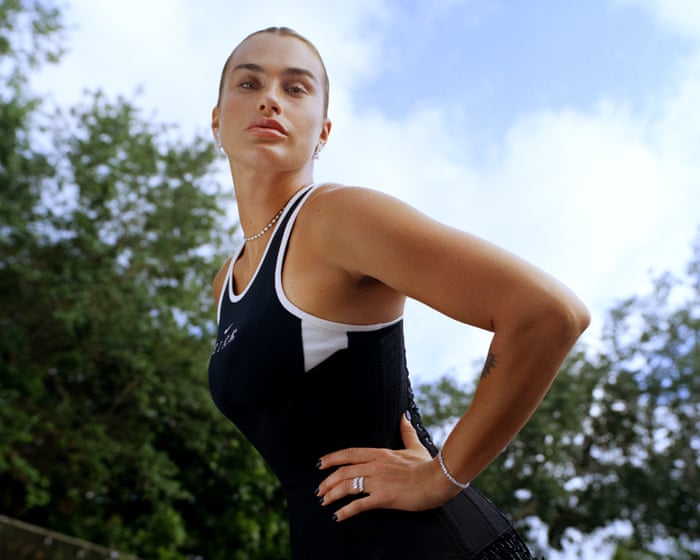
[Image description: Full view of the player in a stylish outfit. Stylist: Roberto Johnson. Hair: Leah Caso at The Wall Group. Makeup: Jojo Marchevsky at The Wall Group. Clothing credits: Vest top: Nike. Corset: Christian Cowan. Shorts: AKNVAS. Jewellery (main and third image): Material Good. Jacket: Ferrari. Shorts and sweater: Adrian Cashmere. Ring and earrings (second and final image): Dinosaur Designs. Watch: Audemars Piguet. Shoes: Nike. Photograph: Emmie America/The Guardian]
What has changed most is her attitude toward her emotions. Now, she’s more accepting of them. She says it’s simply part of who she is. “Even if sometimes you see me getting emotional or yelling at my box, it’s something I need. It’s something we talked about with my team—that whenever I feel like I’m holding too much, just throw the racket, yell something, let it go. Now I’m in better control, but of course, I still do things I’m not proud of.”
Tennis is seen as one of the most refined and upper-class ball sports. But it might actually be one of the most grueling. While most popular ball games are team sports, in singles tennis you’re out there alone. Every rally ends with a point won or lost. Over the years, tennis has broken many players mentally. John McEnroe threw tantrums to cope with the pressure, Serena Williams once threatened to shove a tennis ball down a lineswoman’s throat, and Alexander Zverev hit the umpire’s chair multiple times with his racket. Last October at the Wuhan Open, Sabalenka hurled her racket across the court toward the player benches, narrowly missing a ballboy. It happened during another meltdown—she had been leading Jessica Pegula 5-2 in the final set before losing 7-6.
I tell her I interviewed Björn Borg, the tennis great whose samurai-like refusal to show emotion on court eventually destroyed him. He walked away from the game at his peak and had a breakdown that lasted decades. Her green eyes light up, and she nods passionately. “See. Everyone says, ‘You have to be in control, you have to keep your emotions flat, don’t show anything.’ And I found it was destroying me from the inside. You’re just holding so much. So I asked my team to be okay with me yelling at them—like, just throwing this aggression at someone who can handle it, so I can keep fighting on the court.”
In real life, I try to avoid any conflict. I like to spread joy. In real life, I’m a different person.Her screaming—whether at her box, herself in frustration, or in delight after hitting a winner—has been measured at 100 decibels, the level where prolonged exposure can cause permanent hearing damage. She’s been accused of using it as a weapon to throw off her opponents, something she’s always denied. I ask if she’s a screamer in everyday life. If you were stuck in a traffic jam, I say, really frustrated, would you let out one of those 100-decibel shrieks?
“No!” she says, looking horrified. “I think it’s really hard to get into a conflict with me. You’d have to do something really, really painful. You’d have to betray me. In real life, I don’t like conflict. I like to spread joy and feel joy around me. I’m a different person.”
But she thinks that’s partly because tennis gives her the perfect outlet for her aggression. “I’m throwing everything onto the court. So when I retire, I’ll have to find something where I can let it out. Maybe boxing.” Seriously? “Yes. I’ve done a little boxing, but it can be tricky because you might get injured. Maybe after tennis, I’ll become a boxer and a model.”
As she talks, I’m looking at a huge owl-like diamond sitting on a delicate band. It’s her engagement ring, estimated to be worth $1 million. “It’s a rock,” she says. I then look up at her face and see two more rocks hanging from her ears. Are they matching? “No, they’re four-and-a-half carats each. The ring is 12 carats.” Around her neck, she’s wearing a gold tennis racket dotted with pink, yellow, and green diamonds. She looks like she just raided Tiffany’s.
Another classic Sabalenka moment came in one of her happier post-match interviews after winning the Brisbane Open this January. From the center of the court, she looked up at her boyfriend, Brazilian businessman Georgios Frangulis, and said: “Thank you to my boyfriend… Hopefully, soon I’ll call you something else, right? Let’s just add a little extra pressure.” Sure enough, she got what she wanted. Two months later, he proposed before the Indian Wells Open in California and gave her the oval-cut engagement ring. She was so thrilled with the ring that she wore it during matches. “I got a little scar after playing. So since then, I haven’t played with the ring on.” Frangulis, who founded the acai chain Oakberry, is estimated to be worth between $75 million and $100 million. Sabalenka has won almost $50 million in prize money and is worth an estimated $22 million.
Her off-court life has made almost as many headlines as her tennis. When she started a relationship at age 23 with ice-hockey star Konstantin Koltsov, who was 17 years older, his wife and mother of his three sons, Yulia Mikhailova, reportedly tagged Sabalenka in a family photo on Instagram with a caption loosely translated as: “An appeal to all girls hanging on other people’s husbands with babies in the family! It’s vile!”
In March 2024, Koltsov took his own life in Florida at the start of the Miami Open, where Sabalenka was playing. She issued a statement saying: “Konstantin’s death is an unthinkable tragedy, and while we were no longer together, my heart is broken.” They are believed to have split a few weeks earlier. Mikhailova issued a statement saying she had forgiven Sabalenka, that her earlier post had been “dictated by emotions,” and that the tennis player was a “nice girl.” She said: “Sabalenka treated my children well, so I have a normal attitude toward her.” When Sabalenka and Frangulis went public with their relationship in 2024, his wife, Isabella Armentano, suggested they had been having an affair for a while.
Not all the controversies in Sabalenka’s life have been her own doing. Ukrainian tennis playersShe won’t shake hands with her (or other Russian and Belarusian players). It makes for awkward viewing. Sometimes, Sabalenka has waited at the net for a handshake that never came. Some have suggested she did it on purpose to draw attention to the tension, but Sabalenka insists she just forgot.
Does she feel punished for being from Belarus, a country that has supported Russia in its war against Ukraine? “I understand why they’re doing that. But I just hope we can work through it together, because nobody wants war. Like, nobody. No one voted for war to happen. Everyone wants peace and for it all to stop.”
Does she think it’s right to bring the war onto the court? “No. I don’t think it’s right. I feel like shaking hands shows respect for another person as an athlete, not as someone from a certain country. But I can’t blame them. They’re fighting for peace in their country. I just hate when politics gets mixed up with sports.”
But many of the controversies have been entirely her own doing. Take last December’s Battle of the Sexes match against Australian “bad boy” Nick Kyrgios (who, besides his frequent bad behavior on court, has admitted to assaulting an ex-girlfriend). It was promoted as a replay of the historic 1973 match where Billie Jean King beat retired player and self-proclaimed “male chauvinist pig” Bobby Riggs. Many sports writers advised against the Sabalenka-Kyrgios match, pointing out that times had changed, the fight for equal pay was mostly won (women earn the same at grand slams, though not always at smaller tournaments), and there was nothing to gain and everything to lose. At the time, Kyrgios was out of shape and ranked 671st in the world. Sabalenka said she would do her best “to kick his ass,” but she failed badly, losing 6-3, 6-3.
I ask if she thinks the critics who predicted it would be a letdown and hurt women’s tennis were right. She shakes her head. “No, I don’t think so. For some people, you’re never good enough. Growing up in Belarus taught me not to give a damn about that. But there are also people who understood what we were doing. We wanted to show you can have fun and bring more attention to tennis. The viewership numbers were huge.”
That’s not quite true. While 30,000 people watched the King vs. Riggs match live, and an estimated 90 million watched on TV worldwide, the “replay” was watched by about 6,000 people in a Dubai arena that holds 17,000, and no broadcast viewing figures have been released.
I ask Sabalenka how she responds to people who say it hurt women’s tennis to see the world’s number one female player beaten by a man ranked 671st. This is when I really see Sabalenka, the fighter. “It’s so ridiculous to say that. The guy played in grand slam finals. He was coming back from injury and had been in the top 10. He was the biggest server, the biggest showman on court. How can you compare a regular 600-something ATP player to Nick Kyrgios?”
She has a point, but again, it’s not quite accurate. Kyrgios’s highest singles ranking was 13th, and his biggest serve is 143 mph, 20 mph slower than the world’s fastest. Still, Sabalenka sure knows how to defend herself. She smiles when I say that. “It was just a ridiculous comment from someone outside the tennis world. I hit back.”Last year. Photograph: Tom Jenkins/The Guardian
Sabalenka loves her fighting talk. In the press conference after her meltdown in Paris, she was asked what she planned to do next. “You know those rooms where you just go in and smash everything?” she replied. “Probably I’ll spend a whole day tomorrow there, destroying stuff.” Did she actually do that? No, she says disappointedly, because by then it was too late. “That’s the best therapy. But I wasn’t in the mood to go looking for something to smash.” She suggests that, in the future, tournament organizers should provide a room where players can go for a good smash-up.
Great idea, I say—they could just leave, say, 50 rackets in the room to smash. Her green eyes light up again. “Or we could do it Greek style. With plates.”
Sabalenka has a tiger tattoo on her left forearm that’s just as noticeable as the 12-carat rock on her finger. I ask when she got it. “When I was 17. I was born in the Year of the Tiger. I tried to stay away from tattoos for so long, but then I started dreaming about tigers nonstop. It’s a reminder that, no matter what, I have to get stronger and fight until the very last moment.”
Does she think she could still become one of the all-time tennis greats? Well, she says, she’ll have to get moving and win a few more grand slams to join the elite of the elite. At 28, she’s in her prime, and if she focuses (or rather, doesn’t overthink things), she could be the dominant force in women’s tennis for the foreseeable future.
She’s still thinking about what happened in Paris and how best to process it as Wimbledon is about to start. “It was a slap in the face,” she says. Does she think she had some kind of panic attack? “No, I don’t want to call it something that big. It was just that I forgot how to do everything. I strongly believe everything happens for a reason. Maybe later, I’ll see the reason and look back and say, ‘Oh, thank you.’ Sometimes you need to get slapped in the face.”
Frequently Asked Questions
Here is a list of FAQs based on the provided headline and context about Aryna Sabalenka
BeginnerLevel Questions
1 Why does Aryna Sabalenka scream when she hits the ball
Its a natural part of her rhythm She says it helps her breathe out and put maximum power into her shots Many tennis players do it to stay focused
2 Is Aryna Sabalenka actually a mean person
No She openly admits she understands why people might see her that way because of her intensity on court But off the court she describes herself as a kind shy and emotional person
3 What are exhibition matches in tennis
They are nontournament matches played for fun charity or entertainment The stakes are lower and players often joke around try new shots or interact with the crowd
4 Why does she play exhibition matches
She plays them to stay sharp between tournaments to give fans a good show and to enjoy the game without the pressure of a Grand Slam final
5 Does she think her screaming bothers other players
Yes she knows some players and fans dislike it But she explains its not done to be rudeits just her natural way of playing at full power
IntermediateLevel Questions
6 How does Sabalenka handle the negative reputation of being called a bitch
She says she understands why people think that because of her loud grunting and intense stare However she has learned to separate her oncourt persona from her reallife personality
7 Has she tried to stop screaming on court
She has mentioned in the past that she tried to quiet down but it threw off her timing and power She decided it was better to be authentic than to change her game for others
8 What does she mean by I get why some people think Im a bitch
She means she takes full responsibility for how she looks on court She knows the screaming and aggression can seem intimidating or unfriendly and she doesnt blame people for that first impression
9 How does her offcourt personality compare to her oncourt behavior
On court she is a fierce competitor