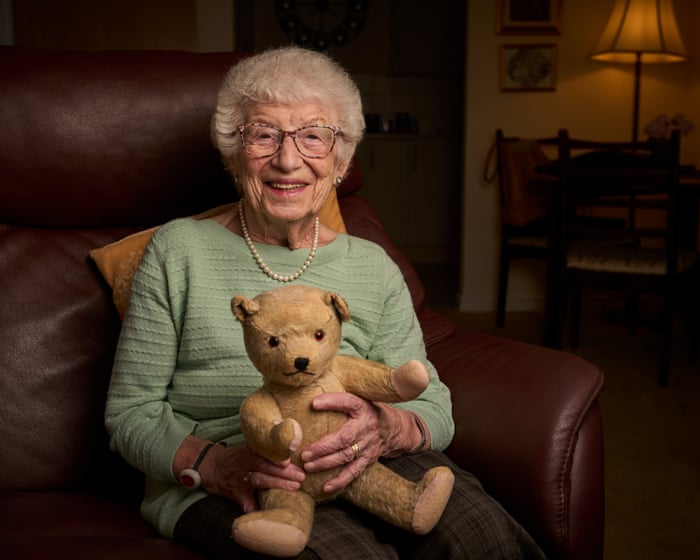
Gabriele Keenaghan still remembers the day in April 1939 when she said goodbye to her grandmother at a Vienna railway station for a Kindertransport to Britain – tears were strictly forbidden.
“I was apprehensive and worried because Nazis in black uniforms were on the platform,” she said. “I was only 12 years old, so I think they were frightening … terrifying.
“People had been told there were to be no emotional scenes; they didn’t want anyone to show emotion. I tried not to cry. It was very difficult. My grandmother … she smiled.”
This week, Keenaghan will mark her 100th year by returning to Vienna’s Westbahnhof, a place that changed, if not saved, her life – and there might be tears.
“I haven’t thought about how I’ll feel – I probably will feel emotional.”
Keenaghan, a retired head teacher, is speaking at her home in North Shields before what will be an epic trip to Vienna with several generations of her family.
The plan, put together for her centenary, was nearly ruined when Lufthansa cancelled routes from Newcastle. Fortunately, a good Samaritan came to the rescue, offering the use of a private jet, and the family admit they have been overwhelmed by the generosity.
Keenaghan is 99, but you would never guess it.
She was awarded the British Empire medal for her services to Holocaust education, telling her remarkable life story in the hope it might bring “kindness, tolerance and acceptance of diversity” to others.
Keenaghan, an only child, said she didn’t even know she was Jewish until after the Nazis invaded Austria.
Her mother, Hildegard, was a Catholic who died suddenly in 1935. Her father, Josef, was Jewish and manufactured heating stoves.
The young Gabriele was a boarder at a Catholic convent school run by nuns when the Nazis came and told the pupils they would all be moving.
“The authorities came into the convent to tell us which schools we had to go to. We were all standing in the hall, and names were called for this school, that school. At the end, I was the only one left standing. And I thought: ‘What’s happening to me?'”
She was told she would have to go to a Jewish school, and a yellow Star of David was sewn onto her coat. “I hadn’t realised that my father was a Jew. I didn’t know. I don’t think I even knew what being a Jew meant.”
It was bewildering, and people treated her horribly, she said. “They called me a ‘dirty little Jew,’ and I was a sensitive girl. It was upsetting.”
Keenaghan never saw her father again. He was deported to Łódź in Poland and was almost certainly murdered in an extermination camp.
Her grandmother, also called Gabriele, made arrangements for her granddaughter to be taken out of Austria on a Kindertransport – the scheme that brought about 10,000 Jewish children to Britain as refugees.
Alone and scared, but also probably excited, she remembers leaving with 150 other children, taking the train to the Netherlands and then a boat to Harwich.
Keenaghan was a good student and quickly picked up the language. One of her first jobs was as a nanny to an affluent family in Woldingham, Surrey.
She has vivid memories of VE Day, as all the village’s nannies – there were many – were given the day off and went to London to join the celebrations.
“It was really euphoric,” she said. “I’ve never experienced such excitement and joy. People were dancing in the street. They were climbing trees.
“We were in front of Buckingham Palace, and out came the king and queen and theTwo princesses, Elizabeth and Margaret. Princess Elizabeth was the same age as me — she would also have turned 100 this year if she were still alive. Keenaghan went on to train as a teacher in the north-east, where she met her husband, Ken, and raised a family in Wallsend. She became a middle-school head teacher and clearly looks back fondly on her career and the children and teachers who were part of it. She has returned to Austria every year to visit relatives, especially her grandmother, who passed away in 1974. The one place she and her family have never visited is the station.
Keenaghan’s actual official birthday falls in November, when Vienna would be far too cold. “I’m going to be like Queen Elizabeth. I’m going to have two birthdays,” she said. Family members will be on the plane, including Keenaghan’s two daughters, Pat and Christine. Others will travel separately. Both daughters have vague memories of their great-grandmother, even though they were very young at the time. “The story goes that I used to call her Noddy Grandmother because I didn’t realize she couldn’t speak English,” said Christine. “I would talk to her all the time, and she just nodded a lot.” Keenaghan has spoken to children many times about her experiences. “I hope they have learned something from it,” she said. “But do we ever learn? Look at the world, look at the state it’s in now.”
Frequently Asked Questions
Here is a list of FAQs based on the article about the 100yearold Kindertransport survivor
General Background Questions
1 What is the Kindertransport
The Kindertransport was a rescue mission that took place between 1938 and 1940 It brought around 10000 mostly Jewish children from Nazioccupied Europe to safety in Great Britain The children were placed in foster homes hostels and schools and most never saw their parents again
2 Who is the woman in the article
The article is about a 100yearold survivor named Ruth who was part of the Kindertransport She is preparing to return to the location in Germany where she was separated from her family as a child
3 Why is she going back now
After 100 years she wants to confront her past and honor the memory of her family It is a final journey to bear witness to history and to find closure before she passes
4 Where is she returning to
She is returning to the specific train station or border crossing point where the separation happenedoften a place like the Dutch border or a German city station where children were loaded onto trains to leave their families behind
5 Is this a common thing for survivors to do
Yes many Holocaust survivors and refugees return to their childhood homes or departure points to pay respects However it is becoming rarer as the generation of survivors ages
Emotional Personal Impact Questions
6 Why does she say she will probably get emotional
She is returning to the exact spot where she said goodbye to her parents for the last time She knows that being there physically will bring back painful memories of fear loss and love
7 Did she ever see her parents again after the separation
In most Kindertransport cases the children never saw their parents again as the parents were often deported to concentration camps The article likely implies she did not see them again
8 How has she managed to stay strong for 100 years
She likely built a new life in Britain focusing on her family and career Many survivors suppressed their trauma to survive and only now at the end of her life is she ready to face the deep grief