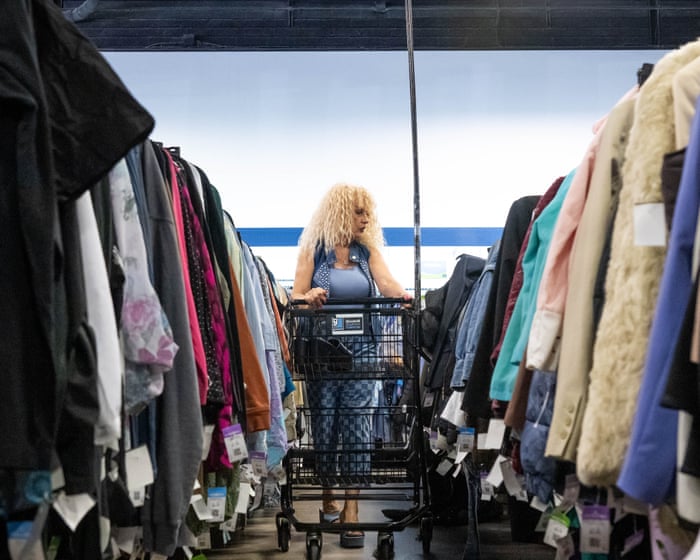
Vintage boutique owner Janelle Best has been digging through thrift store bins since the 1990s. When she started, she says, there was a stigma around it. “People thought you were either a weirdo or broke — and I was a weirdo.”
At first, she did it to find stage outfits while playing in psych-rock bands. Then, in 2005, she started casually reselling on eBay. Ten years later, she was running Desert Stars Vintage at street markets, and by 2023, she had opened a showroom in her Williamsburg apartment, specializing in high-end silk dresses. Even just a few years ago, she says, she still spent time at places like Goodwill. The bins, she recalls, “were a goldmine. There were so many amazing finds.” But then thrifting became a social media trend, she says, “and the floodgates opened for high school students. Twelve people per bin. Everyone fighting. Suddenly, everyone’s a reseller, and instead of these kids instinctively knowing what’s good, they’re on their phones trying to figure out if it’s valuable.”
Secondhand clothing has never been more popular. On TikTok, teenage girls post thrift haul videos, happily showing off big bags of clothes they got for under $100. Meanwhile, at the top of the fashion world, billionaires wear rare vintage pieces to show off their status and taste.
Many credit the huge rise of secondhand clothing to Gen Z, who are reportedly more environmentally aware and entrepreneurial than older generations. But the real change is technology, with platforms like Depop, the RealReal, Vestiaire Collective, Vinted, ThredUp, and Poshmark making buying and selling secondhand easier than ever.
The turning point was the pandemic, when screen time skyrocketed and buying and selling online felt like a rare way to “hunt for a dopamine hit,” as writer and dedicated thrifter Linnea Pejcha describes her own Depop habits back then. Thrifting grew globally by 28% between 2021 and 2022, and it’s kept growing since. Revenue isn’t limited to apps: Goodwill, North America’s largest thrift chain with 3,400 stores across the US and Canada, reported a record $7 billion in revenue last year, with plans to open 50 to 100 new stores across North America. ThredUp predicts the market will reach $367 billion by 2029 — growing 2.7 times faster than the overall global clothing market.
In theory, a boom in reused clothing should be great news, given the mountains of fabric sent to landfills each year. But many who have been thrifting for decades are disappointed by the changes in some parts of the industry as it has exploded.
“I think every generation for a long time has thought they’re discovering [thrifting],” says Jennifer Le Zotte.
For starters, it’s not just scrappy rockers selling vintage anymore. Even some oligarchs are resellers. Client advisors for top fashion brands — the people who work with shoppers spending hundreds of thousands each year — say that some customers have so many clothes that they unofficially help them list their wardrobes on secondhand apps as a sales tactic, so they can buy new pieces. If they help them “get rid of some of their wardrobe,” says analyst Claudia D’Arpizio, Bain & Company’s global leader of fashion and luxury, “they unlock a lot of potential new buying.”
A new report by Bain found that half of luxury shoppers check an item’s price on the secondhand market before deciding whether to buy it new. In high-end vintage, certain brands may be out of reach for all but the wealthiest collectors, says Best. Cavalli pieces, in particular, have shot up in price — “probably five times in value in four years.” A few years ago, she says, “all of these rich people…”People started hoarding brands like Cavalli and Blue Marine.
Maybe none of this is new. According to Jennifer Le Zotte, author of From Goodwill to Grunge and a professor at the University of North Carolina, Wilmington, every generation thinks they invented thrifting, just like they think they invented sex. In the past, there was a lingering stigma around secondhand clothes. Le Zotte links this to antisemitism and germ theory from the early days of used clothing, when Jewish peddlers sold clothes from pushcarts in the 19th century. Back then, thrifting felt like “a resource for rebellion, part of an alternative mindset.” That’s how Le Zotte felt when she started thrifting during the grunge era, and it was the same for the surrealists in the 1920s, and for the Rolling Stones and Jimi Hendrix in the 1960s. “I think every generation for a long time has thought they’re discovering this treasure trove of fashionable possibilities.”
But this vintage boom is different. While it’s been great for business in some ways—and has seen celebrities like Madonna wearing her clothes—Best says it’s still harder to make a living now, with rising gas and shipping costs. Not to mention the fierce competition for popular items. Sometimes, she says, vintage hunting feels like “a nepo baby sport.”
Best also has to deal with tariffs. She says the US market is now “really dry,” so she mainly sources from Italy and France. But she has to pay 15% on all imports after Donald Trump removed the tariff exemption on imports worth less than $800. She thinks prices will only go up: “Because vintage is finite—only so many pieces were made at a certain time, and everyone’s looking for it.”
At the cheaper end of the secondhand market, shoppers are widely complaining about prices. Many say they’ve become too high for the low-income shoppers who rely on these stores the most. A lot of those clothes are low-quality, poorly made fast fashion. Videos calling out inflated prices, with titles like “Goodwill what crack are you smoking??” have become common. One Reddit community, ThriftGrift, collects examples, some of which are frankly upsetting: a Carhartt hoodie covered in stains for $12, a $6.99 shirt that might seem like a bargain until you notice the wasp’s nest attached to the collar. Some items still have their original tags, so you can see, for example, that a pair of peach pleated pants priced at $8.99 at Goodwill were originally sold new for $7.99. Last month, Goodwill’s western and northern Connecticut branch seemed to confirm its ambitions by launching a Thrift Tour. For $75, it offers a “private bus” to three stores, 30 minutes of exclusive early shopping, lunch, a custom T-shirt, a 20% off coupon, and the chance to “meet new thrifting besties.”
Though the thrift shop workers I spoke to for this article said some price increases are due to inflation—costs for labor, rent, cleaning, and display supplies have all gone up—much of it is also driven by awareness of the booming resale market. Managers have put cheat sheets of brands to watch for on the walls in backrooms. They use resale prices on eBay or Depop to figure out value, and with the image-searching app Google Lens, they’re more likely to find similar items. The days of finding a bargain at the bottom of a bin might be over.
People sift through used clothes sold by the pound at a Goodwill outlet center in Hackensack, New Jersey.
The secondhand fashion ecosystem is huge. It ranges from high-end consignment shops, which authenticate, market, and sell clients’ items for a share of the profit (the RealReal is one example; current items include a grey leather Her…A Birkin bag for $32,000, or a donated pair of jeans for a few dollars at a small-town thrift store. In between are vintage stores—”vintage” usually means clothes at least 20 years old—which can also get very pricey, especially in fashion-focused cities like New York, where you might find rare Y2K pieces like 2000s Jean Paul Gaultier or Dior. Online, there are many for-profit sites that focus on high street brands, like ThredUp, which sends you a bag to fill with clothes and sells them for a commission. Other sites, like Poshmark, Depop, and eBay, let sellers keep more of the profit if items sell, but they also have to do more of the work. There are independent thrift stores that operate for profit, some buying items from customers as well as selling them, or donating all or part of their profits to charity. There are also small chains that run as both non-profit and for-profit, and large thrift store chains. The biggest for-profit thrift chain in North America is Savers, backed by private equity, with over 300 stores in the US and Canada, and plans to open 26 more this year. But the giants of thrift clothing are non-profits: Goodwill and the Salvation Army, which has 887 stores in the US.
These big thrift players have their critics. Many people angry about high prices call Goodwill “Greedwill” online. Some call it a “corporate thrift store,” despite its mission to help people find jobs, and say it acts more like a for-profit business than a charity. A main complaint is that CEOs and other executives—there are hundreds, since Goodwill isn’t run centrally but as 150 separate regional operations—earn big salaries, usually around $300,000 to $700,000. In a statement to the Guardian, Goodwill said that in 2025, it helped “nearly 2 million individuals with job training, placement and other support services.” Some of those jobs were at Goodwill itself, but that’s also controversial: in 2013, it came out that Goodwill was using a loophole from 1938 to pay disabled workers as little as 22 cents an hour. Goodwill has said that while this was legal under section 14(c) of the Fair Labor Standards Act, which allows some people with disabilities to be paid under a special minimum wage certificate, it believes “the responsible approach” is to stop using that certificate in its stores.
Some people frustrated with the increasingly professional thrift economy blame individual resellers entirely for rising prices. Sheri Pavlović, a sustainable fashion expert who shares tutorials on upcycling clothes as Refashionista Sheri, says this can get ugly in stores. “I’ve been in thrift stores and seen twenty-somethings pulling stuff off racks and saying, ‘We could sell this on Poshmark,’ and then older people go up to them and say, ‘You’re the reason it’s so expensive!’ And it’s like, are you kidding me? These little girls have nothing to do with corporate prices!” Instead, Pavlović blames the “suits” running big thrift chains who “are getting a whiff of this being popular, trending.” So they raise prices because they think they can, she argues, not because they have to.
Robert, who runs a small family thrift store in Monterey, California, serving people with lower incomes, says he has only raised prices about a quarter of the inflation rate since the pandemic, despite soaring costs, “because the most important thing for us is customer retention.” He believes that…Large chains have the scale and brand recognition to charge higher prices, and they are aggressively competitive. One recently placed a donation bin near his shop, which has affected donations to his business.
It’s not just resellers skimming items that could be sold for profit. Many thrift stores have multiple ways of doing the same thing. The practice of “picking”—where antique and vintage dealers come in to buy the best items—is well known in the industry, and now many organizations do it for their own websites.
[Image: Men’s clothing for sale inside a Goodwill location in Florida. Photograph: Jeff Greenberg/Universal Images Group/Getty Images]
On the issue of pricing, David Eagles, executive vice president and chief operating officer of Goodwill Industries International, said: “Goodwill does not have one national pricing policy. Prices are set by local Goodwill organizations.” He added: “It’s also important to keep the pricing conversation in perspective. We estimate the average retail price per item across the Goodwill network remains below $5. While average item pricing has gradually changed since the pandemic, these changes have stayed lower than the broader inflation rate.”
“What is good stuff to you is not good stuff to me. I don’t give a damn about the label.” — Sheri Pavlović
The problems with “peak thrift,” as this era might be called, go beyond price. According to Le Zotte, people who donate clothes have felt a sense of virtue since the early days of the secondhand clothing market. When Goodwill launched at the turn of the century, its model was designed for a time of high immigration and wealth inequality. Much like ThredUp today, Goodwill would drop burlap bags at middle-class homes to encourage people to part with old furniture and clothes, which they could then replace “without being wasteful.”
In the age of fast fashion, though, that sense of virtue seems to ease our guilt about buying new clothes. A recent Yale University study found that buying secondhand often leads to buying new clothes, rather than replacing them. While 37.2% of people said they donated more clothing between 2020 and 2024, there was also a 38% increase in new clothing purchases. This goes against the “moral social buy-in” that Le Zotte says many people feel when shopping secondhand: “They think that buying clothes once they enter the secondhand market means they’re not being complicit. I’m not saying that’s completely wrong, but it’s exaggerated.”
[Image: Shoppers at Vintage Vintage Vintage in Washington DC. Photograph: The Washington Post/Getty Images]
Still, true believers remain. Liisa Jokinen, who runs Gem, an app that gathers secondhand clothing, insists that “not everything is expensive—but you need to be patient.” She recommends visiting yard sales, clothing swaps, and places where you can still find fill-a-bag sales and shop-by-the-pound stores in person.
Pavlović has stopped thrifting for now due to rising prices, and instead alters her existing clothes to create new items. But she still disagrees with the common idea that all the “good” stuff is gone from thrift stores. “What is good stuff to you is not good stuff to me. I don’t give a damn about the label.” She suggests forgetting the brands that shop assistants are trained to look for—like Zara and Levi’s—and focusing on personal taste. “When I was thrifting regularly, I was always looking for stuff from the 60s and 70s.”
[Read more: Say less to the dress: why I’m cutting back on secondhand clothes shopping]
Pat Noecker, owner of Other People’s Clothes, which has four locations in New York City, earned what he calls his “double PhD in thrifting” when he was…During his time as a musician in the US in the 1990s and 2000s, playing with bands like Liars, he says he was “hitting every thrift store in every town.” He keeps his prices low for the area—for reference, Zara items sell for $15.98 to $21.98. His business is “profitable, but no one’s buying yachts.” Since the store also buys clothing, he explains, “we price things to move, otherwise we’d need a store the size of a football field.”
He says his customers range from low-income locals in nearby Williamsburg to celebrities, including the band Geese and New York City’s first lady, Rama Duwaji, who both sells and shops there. Her taste is “impeccable. She’s super into it. We absolutely love her.” Once, she dropped off a pair of the mayor’s shoes (Chelsea boots), which Noecker has kept: “I don’t wear them, but I keep them in my office as a reminder that we have a really awesome mayor, and I send him good luck through those shoes.”
Frequently Asked Questions
Here is a list of FAQs based on the statement Secondhand fashion has gotten so expensive that its turned into a sport for nepo babies
BeginnerLevel Questions
1 What does nepo baby mean in this context
A nepo baby is someone who benefits from nepotismusually a celebrity kid with famous parents In this case it refers to wealthy wellconnected people who can afford to spend thousands on vintage clothes that used to be cheap
2 Is secondhand fashion really that expensive now
Yes for certain items Highdemand vintage pieces can cost hundreds or even thousands of dollars especially from trendy resale apps or curated vintage stores
3 Why would a rich person buy used clothes
Its often about status and uniqueness Wearing a rare vintage piece shows you have the money to hunt it down and the taste to find something no one else haslike a fashion flex
4 I just want affordable used clothes Can I still find them
Absolutely Thrift stores in less trendy areas garage sales and online marketplaces like Facebook Marketplace or eBay still have cheap finds The expensive part mainly applies to hyped curated vintage
5 What does turned into a sport mean
It means hunting for rare vintage items has become a competitive timeconsuming hobbylike a treasure hunt People line up at drops set alerts on apps and pay resellers to find specific pieces
Intermediate Questions
6 How did secondhand fashion get so expensive
A mix of factors social media influencers made thrifting cool celebrities started wearing vintage on red carpets and apps like Depop and The RealReal created a marketplace where supply is limited and demand is high Resellers then jacked up prices
7 Who are the nepo babies driving up prices
Famous examples include Kendall Jenner Hailey Bieber and other celebrity kids who wear rare vintage and make it aspirational Their fans then compete for similar items
8 Is this a bad thing for regular shoppers
It can be It pushes prices out of reach for people who rely on