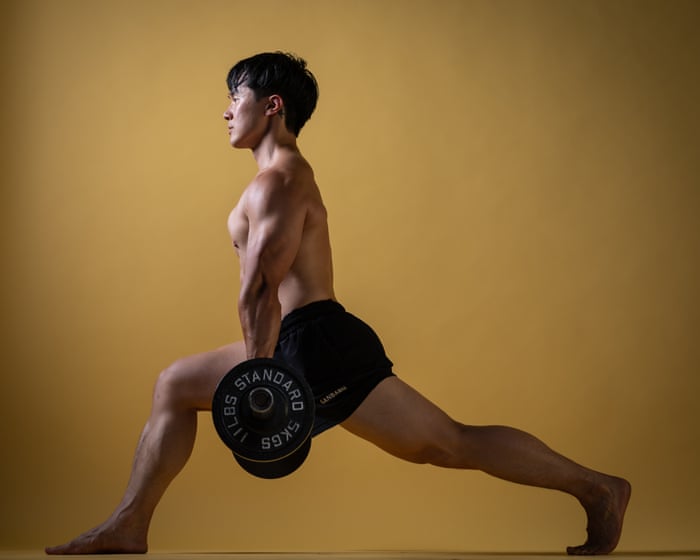
Eugene Teo, 34, started weightlifting at 13 in search of validation. “I was short, skinny, and I thought it would give me confidence,” he says. “Bodybuilding became the ultimate expression of that.”
Now living on Australia’s Gold Coast with his partner and daughter, the fitness coach trained and competed from ages 16 to 24. At his peak, he lifted weights for up to four hours a day, striving to become as muscular and lean as possible. His ideal? “If you pinch your eyelid and feel that skin,” he explains, “that’s the thinness you want on your glutes and abs.”
That pursuit grew into an obsession: “How could I push myself to these extremes, then do it again and again, and be better than last time?” He followed unsafe methods promoted by bodybuilding gurus to make his muscles stand out, dangerously dehydrating himself before competitions. He ate six to ten times a day, limiting his diet to foods the community then considered “clean”: sweet potato, brown rice, broccoli, and boiled chicken breast. For years, he skipped his own birthday to avoid straying from his meal plan and even brought a scale to Christmas dinner to weigh his turkey. “I had a lot of dysmorphic associations with food,” he admits.
His body became a project—one that consumed his entire life, leaving little room for flexibility, let alone enjoyment. “The driving force behind my bodybuilding was negative body image and confidence issues,” he says. “I alienated myself. I lost friendships. I lost partners.”
His mother often asked him, “Why can’t you eat what I eat? Why won’t you have my cooking?” Alone at home, he saw his body as a harsh critic. Even at his most muscular, he focused only on flaws. “I couldn’t even put on clothes without thinking, ‘How do my shoulders look in this? How do my arms look?'”
The realization came gradually to Teo, but his body was crying out for change. “I could lift a lot of weight. I looked impressive,” he says. “But I’d get out of breath from simple tasks.” Walking across the gym with clients gave him lower back pain. Even tying his shoes required effort. “My body’s sheer size wasn’t supporting all its systems properly,” he reflects.
Teo changed his training, shifting focus from muscle size alone to mobility, power, and cardiovascular endurance—adding running, stretching, jumping, and cycling to his routine. He began to question whether his extreme mindset was making him happy, acknowledging that “this is now an obsessive trait in my personality, and it’s not bringing me joy.”
A decade later, his priorities are his relationships and his work as a YouTube fitness coach and app developer, rather than his physique. He no longer works out every day and, while he still eats well, he’s more relaxed about it. “If I’m out with my daughter and she wants an ice cream, I’ll have one with her.”
His body has changed. “It’s definitely smaller,” he says, having lost about 15 kilograms of muscle. “But in terms of performance and how I feel—it’s night and day better. I can move better. I’m more athletic with my daughter.” He can jump twice as high as before and run 5 kilometers in 22 minutes. (During his competing days, he couldn’t even finish a 5k run; his first attempt took 40 minutes.)
“Ten years ago, my body could turn heads on the street,” he says. “That was fun—but it was the only thing it was good for.” Now, he adds, it’s built for function. Eugene Teo is @coacheugeneteo on YouTube and the founder of the fitness app Ganbaru Method.
Frequently Asked Questions
FAQs I Looked Amazing But I Was Gasping for Air The Bodybuilder Who Embraced Mindful Movement
Basics Definitions
Q What does mindful movement mean in this context
A It means paying full attention to how your body feels during exerciseyour breath muscle engagement and alignmentinstead of just pushing for maximum weight or reps
Q Who is the bodybuilder in this story
A It refers to any strength athlete or fitness enthusiast who prioritized appearance and heavy lifting but later shifted focus to include awareness control and sustainability in their training
Q Is mindful movement the same as yoga or tai chi
A Not exactly While those practices are forms of mindful movement here its about applying that same focused awareness to traditional strength training cardio or bodybuilding exercises
Benefits Reasons for the Shift
Q Why would a bodybuilder switch to mindful movement
A Common reasons include avoiding injury improving performance efficiency reducing chronic stress enhancing mindbody connection and sustaining longterm health beyond just aesthetics
Q What are the main benefits of adding mindfulness to training
A Better breathing control improved exercise form reduced risk of injury greater enjoyment of workouts less burnout and often better longterm results
Q Can mindful movement still build muscle
A Yes By improving mindmuscle connection and control you can often stimulate muscles more effectively with less weight leading to quality muscle growth and better symmetry
Common Problems Challenges
Q Im used to pushing to failure Wont this make my workouts too easy
A Not at all It challenges you differentlyfocusing on precision and control can be intensely difficult and revealing Its about working smarter not just harder
Q How do I deal with ego or feeling like Im going backwards by using lighter weights
A Reframe your goal youre advancing your skill and body awareness not just your numbers Progress is measured in control quality of movement and how you feel not just the weight on the bar
Q I get bored easily How do I stay focused on my breath and form
A Start small Try being mindful for just one set per exercise or the first 5 minutes of