The courtroom was silent but tense, with only the whir of camera lenses breaking the quiet as dozens of journalists focused on the bench. An unusual press conference had been called after a documentary aired late last year, claiming that the top levels of Romania’s justice system were riddled with corruption.
Seated at the bench in the Bucharest Court of Appeal was its president, Liana Arsenie, flanked by her two vice-presidents. Behind them, about 30 judges stood in support.
Then, Raluca Moroșanu, also a judge at the court, entered the room and asked to speak before the press conference began. “We are simply terrorized,” she said in a steady voice, breaking ranks with the leadership beside her. “I can’t describe the atmosphere here, how toxic and tense it has become.”
Her statement made, she swept out of the court in her robes to a smattering of applause and the stony expressions of her fellow judges.
Moroșanu’s intervention was in support of a colleague who had been targeted after appearing in the documentary by Romanian outlet Recorder. The film alleged that a network of senior magistrates and politicians had “captured” Romania’s justice system. “Everything he said is true, and if anyone contradicts him, it is a lie,” she said in her address. Last month, her colleague was referred for disciplinary proceedings over statements made in the documentary.
The film used rare testimonies from prosecutors and judges to claim that the network used administrative tactics to delay convictions in high-level corruption cases until they expired under the statute of limitations.
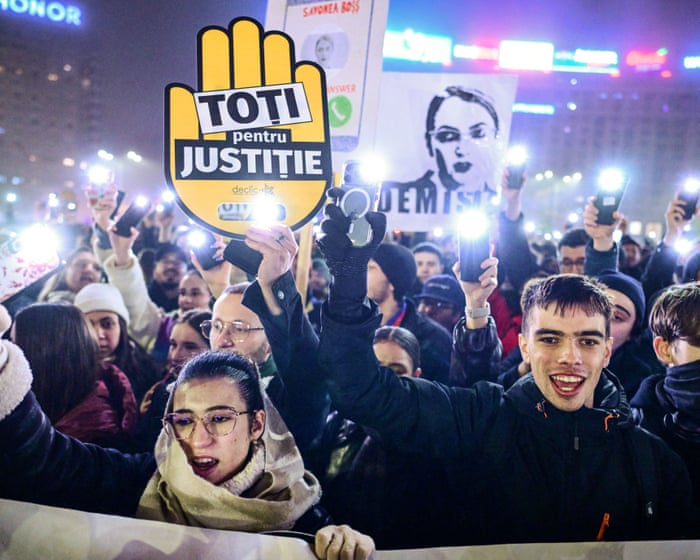
The fallout was immediate: thousands of Romanians took to the streets, and nearly 900 judges and prosecutors signed an open letter warning of “profound and systemic dysfunctions.” But six months later, meaningful reform has yet to happen, and the allegations keep piling up.
Last month, investigative outlets Rise Project and PressOne alleged that Lia Savonea—now head of the supreme court—had acquitted a convicted gangster of a seven-year robbery sentence while co-owning land with his uncle during her time as head of the Bucharest Court of Appeal 12 years ago. This was an alleged conflict of interest she did not disclose. She has denied the allegations, calling them part of an “obvious defamation campaign” against her, “based on forced associations and speculation about people and situations that have no real connection.” She said the allegations had been “subjected to verification” and no wrongdoing was found.
Earlier this month, Romanian President Nicușor Dan deepened public disillusionment with the justice system by approving a controversial series of prosecutor appointments, despite objections from the judicial regulator and civil society.
Among those appointed was Marius Voineag, a former head of the national anti-corruption directorate—a figure Dan had criticized on the campaign trail and whom prosecutors in the Recorder documentary accused of interfering in sensitive investigations. Voineag denied wrongdoing and declined to comment.
The crisis is unfolding against an already unstable backdrop. In 2024, Romania’s constitutional court annulled a presidential election over alleged Russian interference, a decision that deepened public mistrust in the country’s institutions.
The cumulative toll is visible in polls. A survey this year found that seven in ten Romanians do not trust the justice system, and more than half believe the law is not applied equally.
For Moroșanu, none of this is surprising. In an interview with the Guardian, she was frank about the scale of the crisis.As she sees it. “We are now in the worst moment the Romanian justice system has been in my 26-year career,” she said. “Most judges are fair, competent, and hardworking. What we’re seeing isn’t widespread corruption—it’s corruption at the top of the system.”
Moroșanu has worked as a judge for over 25 years and spent 19 of those at the Bucharest Court of Appeal, one of the country’s most important courts. It handles many final decisions in high-level corruption cases.
In recent years, several major corruption trials involving politicians and businessmen have fallen apart because the statute of limitations expired. This happened due to repeated delays in court proceedings, even when there was strong evidence—including wiretaps where suspects seemed to admit wrongdoing.
“The justice system is in a deep crisis because groups have formed within high-level courts and taken over administrative management,” said Laura Ștefan, an anti-corruption expert at the Romanian think tank Expert Forum.
Andreea Pocotilă, one of the documentary’s authors, claimed that court leadership repeatedly reassigned cases to new judging panels just before rulings. This forced proceedings to restart and evidence to be reheard until the cases became time-barred.
Members of the Superior Council of Magistrates—the guardian of judicial independence that oversees judicial careers—have been accused of being complicit. “But who is supposed to protect us from the guardian?” said Andrea Chiș, a former council member and retired judge.
In a statement, the council rejected the allegations, saying Romania’s judiciary had faced “an unprecedented assault” aimed at destroying its reputation through false claims of systemic corruption. It added that an internal inspection had found no evidence to support the claims in the Recorder documentary.
Chiș argued in a 2023 study that justice reforms concentrated power in the hands of court leadership by expanding their authority and weakening oversight, creating a pyramid-like power structure. Despite criticism, the reforms led the EU to lift its rule-of-law monitoring mechanism.
“It was a mistake to lift the mechanism,” said Chiș. “It wasn’t good for our justice system, and it removed the pressure on those in power.”
Observers say successive reforms have left no effective way to prosecute corrupt judges, and accountability efforts have resulted in almost no convictions in recent years.
“It’s a silent agreement between politicians and senior judges to block accountability for corruption within the justice system, while politicians, in turn, get impunity,” said Ștefan.
As president of the Supreme Court and former head of the Council of Magistrates, Savonea has been accused of being a key part of this alleged power structure.
In a statement, Savonea said the allegations were “part of an orchestrated campaign of defamation and reputational harm, through serious distortion of factual realities and the association of narratives lacking any evidence.”
She added: “I also emphasize that there is no finding or accusation regarding any interference in the administration of justice on my part. In reality, these accusations don’t rest on mere assertions—they rely on speculative interpretations that end up challenging the very institutional structure of the judicial system. This structure, however, has been built according to the most rigorous European standards, including regarding competition procedures and mechanisms for filling public positions, based on criteria of legality, transparency, and…”Arsenie, the head of the court of appeal, has also denied the accusations. She accused the journalists who made the documentary of “inciting against the constitutional order” – one of the most serious crimes in Romania’s criminal code, similar to sedition. She turned down an interview request from The Guardian.
The anger has spilled into the streets. Raluca Kișescu, a marketing consultant who joined the protests last year, believes trust is being damaged beyond repair. “A democracy without justice is a story with a tragic ending,” she said. “It feels like we’re mice in electric shock experiments: we get used to each new shock from a Recorder documentary, we talk about it with our friends, and then it fades away.”
Since speaking out, Moroșanu said she has been removed from two cases because other judges argued that her public criticism of Arsenie showed a lack of empathy.
Still, she doesn’t regret speaking out. “There’s still a chance that things might change if something happens this year,” she said, “but if nothing changes now, things will never change.”
Frequently Asked Questions
Here is a list of FAQs about the corruption allegations in Romanias justice system written in a natural tone with clear and concise answers
BeginnerLevel Questions
1 What does Its toxic mean in this context
It refers to the widespread public feeling that the Romanian justice system is poisoned by corruption making it impossible to trust that justice will be served fairly
2 What is the main allegation in Romania right now
The main allegation is that senior judges prosecutors and politicians are involved in a network of bribery influencepeddling and backroom deals to protect powerful people from prosecution
3 Who is accusing whom
Anticorruption prosecutors are accusing highranking officials in the judiciary and government In turn some of those officials accuse the prosecutors of overreach and political bias
4 Is this a new problem for Romania
No Corruption has been a longstanding issue in Romania but these specific allegations have caused a major political crisis because they directly target the people who are supposed to fight corruption
5 Why should I care about this if I dont live in Romania
It matters because Romania is an EU member A broken justice system can mean EU funds are misused laws arent enforced and it sets a bad example for the rule of law across Europe
IntermediateLevel Questions
6 What are the specific examples of toxic behavior in the justice system
Examples include judges accepting bribes to give light sentences to criminals prosecutors dropping cases against political allies and secret meetings between politicians and magistrates to plan legal strategy
7 What is the DNA and why is it in the news
The DNA is Romanias elite anticorruption prosecutorial body Its in the news because its the agency making the corruption allegations and some politicians are trying to weaken its powers in response
8 How are the allegations affecting Romanias government
They have led to mass street protests calls for resignations and a deep political divide between those who support the anticorruption fight and those who say its become a political weapon
9 What is a legal capture or state capture
Its when private interests take control of the justice system for their own benefit so