When the British government announced sweeping sanctions on trade with illegal Israeli settlements and condemned “ethnic cleansing” in the West Bank by state-backed “settler terrorists,” some EU diplomats hoped this dramatic shift in UK policy toward Israel would galvanize the rest of Europe. So far, it has not.
Although France and Canada joined the UK in pledging to ban goods from illegal settlements and impose sanctions on “those who facilitate them or profit from them,” there has not yet been a wider ripple effect.
A meeting of EU foreign affairs ministers on Monday is likely to showcase the bloc’s stagnation on Israel policy—a stalemate that conflicts with growing public criticism in Europe of Israel’s government.
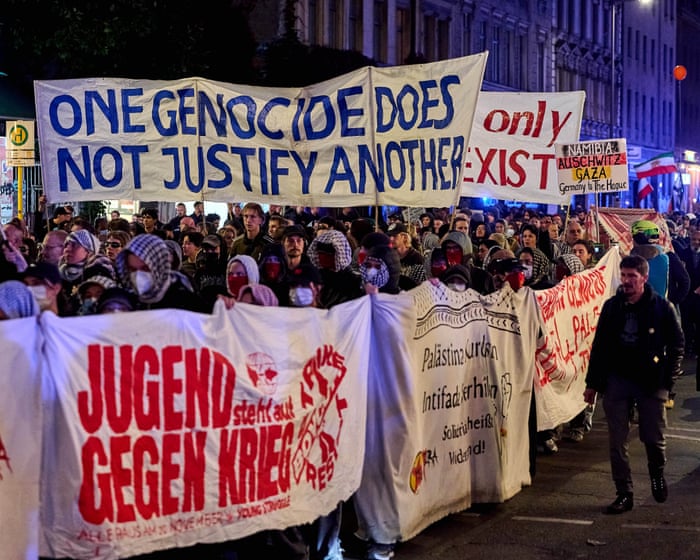
A survey of 10 European countries, including Spain, France, and Sweden, found that large majorities of people had a negative opinion of Israel. According to the Pew Research Center, views had grown more negative compared with the previous year, mostly after the start of the US-Israeli war on Iran, which triggered a new crisis in the Middle East and a global economic shock. In Poland, negative views jumped eight points to 70% of respondents; in Italy they rose by nine points to 75%; and in Germany they also rose by nine points to 73%.
View image in fullscreenBuildings destroyed in Israeli military strikes on Gaza City. Photograph: Jehad Alshrafi/AP
Israel is facing ever deeper isolation in the court of public opinion. Five countries chose to boycott this year’s Eurovision song contest over Israel’s participation, after organizers declined to exclude it over its conduct in the Gaza war and rising violence in the West Bank. Organizers have now decided that broadcasters will no longer be eligible to host the song contest if their state is involved in an armed conflict or sensitive geopolitical situation.
More than 74,000 people, including at least 21,200 children, have been killed in Gaza since Israel launched its war in retaliation for the Hamas attack of 7 October 2023, in which the terrorist group killed 1,209 people—including 36 children—and took 251 hostages, inflicting a nationwide trauma.
Gaza remains a humanitarian catastrophe, with people facing acute shortages of water, nutritious food, medical equipment, and medicines, while dealing with disease, unemployment, economic collapse, and the threat of death or injury. Israel’s airstrikes continue: the death toll includes 1,400 Palestinians killed since a ceasefire was declared a year ago.
View image in fullscreenA commemorative installation on the beach in Tel Aviv, Israel, to mark the third anniversary of Hamas’s 7 October attack. Photograph: Jack Guez/AFP/Getty Images
The EU talks on the Middle East will focus on the conflicts in Iran and Yemen, but ministers will also discuss the situation in Gaza and the West Bank in the context of Israel’s elections on 27 October and the first Palestinian legislative elections in 20 years, expected by late November.
The discussion is expected to expose familiar fault lines in the 27-member EU. One group of countries are vocal supporters of the Palestinian cause: Spain and Ireland were the first to call for a review of whether Israel’s conduct in the Gaza war breached the human rights requirements of its association agreement with the EU, which covers the €68bn (£58bn) trade relationship and cooperation on research, environment, and energy.
A second group consistently opposes targeting Israel’s government: Germany and Austria are close allies for historical reasons, while Czechia and Italy are ideologically aligned with Benjamin Netanyahu’s administration.
Among a third, larger group of countries in the middle are several, such as France and the Netherlands, that are increasingly critical of the Netanyahu government’s conduct in Gaza and its plans to build the vast E1 settlement, which threatens to critically damage the two-state solution.
View image in fullscreenBenjaminNetanyahu speaks during the 81st session of the United Nations General Assembly in New York last month. Photograph: Yuki Iwamura/AP
Martin Konečný, director of the Brussels-based European Middle East Project, believes the EU has a diplomatic role to play as Israel moves ahead with the controversial E1 plan. However, he sees no sign of action. “The EU is basically staying in its usual self-imposed irrelevance,” he said.
This view is not isolated. More than 500 former senior EU officials and diplomats issued a statement this week condemning the bloc’s failure to act on Israel’s actions in Gaza and the West Bank.
The signatories, including former prime ministers of France, Italy and Sweden, as well as Josep Borrell, the EU’s former chief diplomat, singled out Germany and Italy for the first time in stark, uncompromising language.
“Germany and Italy continue to systematically block the adoption of any EU measures, thus becoming de facto complicit in undermining both EU values and the two-state solution,” wrote the group, which includes a few dozen senior figures from those two countries.
Given their size, Germany and Italy have been crucial in preventing the EU from forging a weighted majority to impose trade sanctions and ban commerce with illegal settlements.
Michael Doyle, a former EU ambassador who co-organised the statement, told the Guardian the EU was not meeting its treaty obligations or international law.
“Unfortunately our often-proclaimed EU values are set aside when it comes to the EU’s collective response to the dire plight of Palestinians,” he said. The widespread unease explained “why we get so many signatures from people who don’t normally sign such calls for action.”
The statement was prompted by the absence of proposals from the European Commission, the guardian of EU law that initiates legislation for the 27-member bloc. The commission has declined to table proposals to ban trade with illegal settlements.
The refusal to act has exasperated numerous lawyers and trade experts, who argue the ban is necessary for the EU to comply with a landmark advisory ruling from the International Court of Justice in 2024 on the illegality of the settlements. It told other countries to “take steps to prevent trade or investment relations that assist in the maintenance of the illegal situation created by Israel in the occupied Palestinian territory.”
Ursula von der Leyen attends a joint debate before the EU summit in Strasbourg, France, later this month. Photograph: Pascal Bastien/AP
Ursula von der Leyen, the commission’s president and a German Christian Democrat who is not afraid to take political risks, has argued the EU cannot act when member states disagree. In her annual state of the union speech last month, she lamented: “When Europe is divided, it cannot change the course of events.” A year earlier she presented proposals to suspend preferential trade with Israel but never found sufficient support from member states.
Advocates of a stronger EU approach are not convinced she cannot act. Konečný said: “It is not guaranteed that the qualified majority would be reached. But once the commission tables the proposal [on banning trade with settlements], that changes the dynamic.”
Israeli flags outside the home and workplace of Mueyyid Hussein in Al-Lubban ash-Sharqiya, a village in the West Bank, 8 October 2026. Photograph: Issam Rimawi/Anadolu/Getty Images
The blocking European governments may be lagging behind public opinion. Large majorities in Italy (88%) and Germany (83%) say they do not have confidence in Netanyahu “to do the right thing regarding world affairs”, according to the Pew Research Center.The Center’s study. Meanwhile, the question of Israel-Palestine continues to stir conflict on the left. This week, the Green Party of England and Wales passed a motion equating Zionism with racism, which drew widespread criticism. The motion from a small UK political party was strongly condemned by the head of the Jewish Greens in England and Wales (“a very bad motion”) and the European Greens, who stressed the importance of being “absolutely unambiguous” in fighting antisemitism. Peace campaigners believe it makes their work harder. The motion “hands ammunition to those who want to paint pro-Palestinian activism as illegitimate,” wrote Yachad, an organization that seeks to build support among British Jews for a political resolution to the Israeli-Palestinian conflict.
Frequently Asked Questions
Here is a list of FAQs regarding the EUs stance on Israel and the concept of selfimposed irrelevance
Beginner Questions
1 What does selfimposed irrelevance mean in this context
It means the EU is making itself unimportant on the world stage By failing to take a strong united stand on issues like the conflict in Gaza the EU is losing its influence Other countries stop looking to the EU as a leader because they see it cant act decisively
2 Why is there growing public criticism of Israel in Europe
Many European citizens are upset by the high number of civilian deaths in Gaza the humanitarian crisis and what they see as Israels disproportionate military response Social media has made people more aware of the situation and they want their governments to do something about it
3 What is the EU actually doing about the conflict
Not much that is decisive The EU has issued statements calling for ceasefires and humanitarian aid and some member states have paused arms sales to Israel But the EU as a whole has not taken strong collective action like sanctions or trade penalties
4 Why cant the EU just agree on a position
Because all 27 member states have to agree Countries like Germany Hungary and Austria strongly support Israel for historical and political reasons Others like Spain Ireland and Belgium are much more critical When they cant agree the EU does nothing
5 What does failing to act actually look like
It looks like endless meetings that produce weak statements It means the EU talks about concern and international law but doesnt impose consequences Meanwhile the US China and regional powers like Turkey and Qatar take the lead in diplomacy
Intermediate Questions
6 Why do critics say the EU is selfimposed irrelevant
Because the EUs irrelevance isnt caused by outside forcesits caused by its own rules and politics The requirement for unanimity on foreign policy means one or two countries can block action for everyone The EU chose these rules and it refuses to change them
7 What are the benefits of the EU acting together on this issue
A united EU would have enormous economic and diplomatic weight It is Israels biggest trading partner and a major donor to the Palestinians If the EU spoke with one voice it could pressure both sides