A former Ukrainian soldier has gone on trial in Hamburg, accused of taking part in one of the most daring acts of sabotage in postwar European history: the 2022 attack on the Nord Stream gas pipelines between Russia and Germany.
Serhii Kuznetsov, a former special forces officer in the Ukrainian military, is accused by prosecutors of aiding war crimes by attacking civilian infrastructure, causing an explosion, damaging property, and disrupting public services.
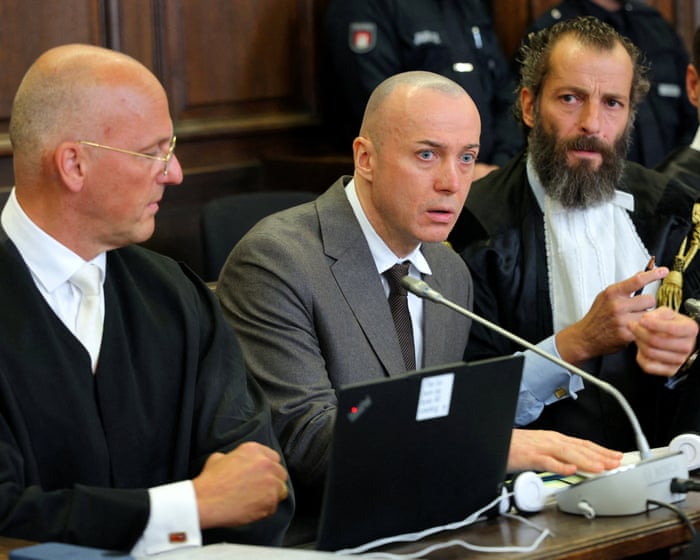
He appeared in court on Wednesday wearing a grey suit, white shirt, and black tie, flanked by his lawyers. Kuznetsov saluted as he entered the courtroom. He and his legal team listened in silence for 10 minutes as the federal prosecutor general read out the indictment, which was translated into Ukrainian at the same time.
Kuznetsov, 50, is alleged to have prepared and carried out the detonation of at least four explosive devices weighing up to 27kg each at a depth of about 80 metres under the Baltic Sea, near the Danish island of Bornholm.
He is believed to have had six accomplices, including four deep-sea divers, an explosives expert, and a ship’s captain. They are alleged to have used a rented yacht and timer-controlled explosives. Both Kuznetsov and his country deny any involvement in the attacks.
Kuznetsov’s lawyers argued on Wednesday that the trial should not be taking place at all. They told the court that the defendant, who they said has been held almost entirely in solitary confinement for 11 months, was being treated “like a pawn on a chessboard.”
They stressed that he cannot defend himself in the usual way because of his role as an army officer, which they said forbids him from speaking. This meant he had to defend himself “with his hands tied.”
The explosions took place on 26 September 2022, badly damaging the pipelines built to carry Russian natural gas between Vyborg in western Russia and Lubmin, near Greifswald in northern Germany.
The blasts caused the Nord Stream 1 pipelines – Russia’s main gas supply route to Germany before Moscow cut supplies in August 2022 – to burst. They also damaged Nord Stream 2, which was ready to carry gas but was never put into operation after Germany suspended its authorisation process just before Russia’s full-scale invasion of Ukraine.
The attacks happened as European countries were trying to move away from Russian energy supplies in response to the Kremlin’s aggression.
They exposed Europe’s dependence – and particularly Germany’s – on Russian gas, and highlighted the murkiness of underground operations during wartime.
Security observers initially blamed Moscow for the attack. Russia denied involvement and blamed the US, which denied it just as forcefully.
However, in July, German state prosecutors accused Ukrainian “state authorities” of ordering the attack, arguing: “The aim was to permanently halt gas supplies via the pipelines and prevent Russia from using the revenue from natural gas trade to finance its war effort.”
Ukrainian president Volodymyr Zelenskyy has denied his country was involved.
Kuznetsov was arrested in August 2025 on a family holiday in Italy, with Italian police reporting that he surrendered without resistance. He had been travelling on a false passport. He was extradited to Germany last November after legal efforts to prevent this failed.
Another suspect, Volodymyr Zhuravlyov, an air conditioner installer and hobby diver, was arrested on a European warrant in northern Croatia in August. He is fighting his extradition to Germany after applying for asylum in Croatia. He denies any role in the sabotage.
The Nord Stream riddle: echoes of mistrust ripple through Europe
Read more
Aware of how potentially incendiary the trial could be, with Ukraine effectively in the dock for a crime committed against its ally – and one oOne of its most loyal wartime allies, the German government, has refused to comment on the case. On Wednesday, protesters gathered outside the court waving Ukrainian flags and holding placards. One of them, a Ukrainian man living in exile in Germany, said: “It’s a scandal that a Ukrainian is being accused of a war crime here today, when Russia is constantly committing war crimes in Ukraine.” The far-right, pro-Kremlin Alternative für Deutschland party, which is surging in the polls, has latched onto the Nord Stream plot to push its argument that German aid to Ukraine must stop and the pipeline must be restored so cheap gas can help ease the cost of living crisis. The pro-Ukrainian protesters who came out on Wednesday stood just a few feet from a group of supporters of the far-left BSW party, which shares the AfD’s position on Russia and also wants the pipelines restored. They held placards calling for a parliamentary inquiry into the political motives behind the Nord Stream attack. Nord Stream was already controversial before the attack, involving Russia’s leader, Vladimir Putin, who, along with then German chancellor Gerhard Schröder, managed to bypass Ukraine as a transit country with Nord Stream 1. After Schröder left the chancellery, Putin appointed him chair of the supervisory board of Nord Stream AG. Schröder was seen last week at Putin’s birthday celebration. View image in fullscreen Former German chancellor Gerhard Schröder, pictured at Vladimir Putin’s birthday party last week, was appointed chair of Nord Stream AG’s supervisory board by Putin after he left the chancellery. Photograph: Kremlin.ru/Reuters A Russian request to join the Hamburg trial as co-plaintiffs was rejected by the court. Gazprom, which owns the Nord Stream 2 pipeline, had argued it had the right to do so because of what it called the severe economic consequences of the attack. The court said that while repair costs for the pipelines would be high, restoring them would not be economically impossible. According to reports, Kuznetsov, whose military ID shows he was on active service when the pipelines were blown up, is expected to keep his right to remain silent during the trial. His legal team is expected to submit affidavits from two of his military superiors to support the argument that he is barred from revealing details of his actions as a soldier. He is reported to have allegedly taken orders from a man considered the mastermind behind the attack and one of those who has sworn in his favour. The trial will resume on 27 October. Sixteen trial dates have been scheduled at Hamburg’s Hanseatic higher regional court through 17 December, with more hearings likely in January and February.
Frequently Asked Questions
Here is a list of frequently asked questions regarding the trial of a Ukrainian soldier for the sabotage of the Nord Stream gas pipelines
Beginner Questions
Q What are the Nord Stream pipelines
A They are a pair of gas pipelines that run under the Baltic Sea connecting Russia directly to Germany They were built to transport natural gas
Q What happened to them
A In September 2022 several large explosions damaged three of the four pipelines The damage caused major gas leaks into the sea No one was killed
Q Who is the Ukrainian soldier on trial
A He is a serving member of the Ukrainian military Prosecutors in Germany accuse him of being part of a team that planted explosives on the pipelines
Q What is he accused of doing exactly
A He is accused of being a coconspirator in the attack Specifically he allegedly helped transport and place the explosives that damaged the pipelines
Q Why is this a big deal
A It is a big deal for three reasons First it was a major attack on critical energy infrastructure Second it happened during the war between Russia and Ukraine Third it strained relations between Ukraine and its allies like Germany who were supporting Ukraine
Q Is he in jail right now
A Yes He was arrested in Germany and is currently in custody while the trial takes place
Q Where is the trial happening
A The trial is taking place in Germany because the pipelines were connected to German territory and the damage affected German energy security
Q What does the soldier say
A Reports indicate he denies the charges His defense team is likely arguing that he was not involved or that his actions were part of a military order though this is a complex legal argument
Advanced Questions
Q What is the specific legal charge he is facing
A He is facing charges related to conspiracy to commit a serious act of sabotage and causing an explosion In the German legal system this can carry a significant prison sentence
Q What evidence does the prosecution have