Revered by some and reviled by others, Ferran Adrià changed cooking forever during the 28 years he ran El Bulli, a small restaurant in a remote corner of Catalonia. Now he is the subject of Gènesi (Genesis), a six-part TV drama airing on Catalan television and set for worldwide release later this year. It tells the story of El Bulli from the day he arrived there in 1983 as a kitchen hand with no background at all in haute cuisine.
“No one knew what to call what we were doing, and if something doesn’t have a name, they don’t know how to talk about it,” Adrià told the Guardian. “Journalists called it molecular cuisine. I preferred the term ‘techno-emotional.'”
Adrià quickly rose to become head chef. He was relatively inexperienced—before starting as a line chef at El Bulli, he had worked as a dishwasher in a hotel and then as a cook during military service. But despite this, he says he never experienced impostor syndrome.
“In 1995, it was unthinkable that a chef who wasn’t French would be on the front pages,” he says. “Then I was on the cover of Time, which described me as one of the 100 most influential people in the world. But we weren’t interested in being famous.”
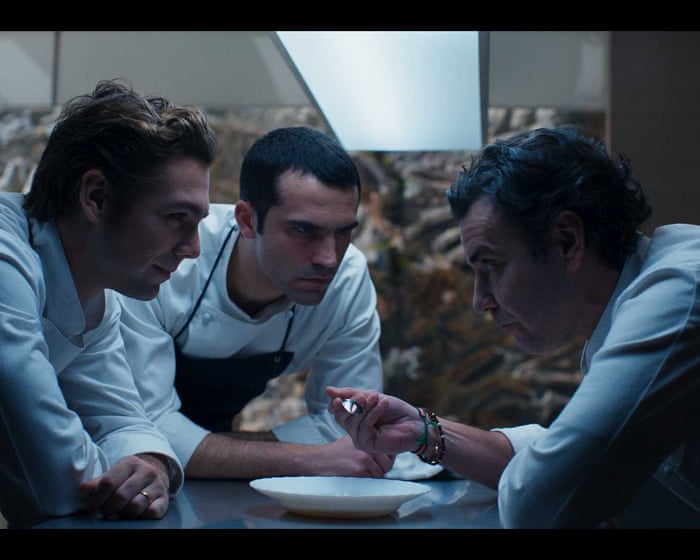
View image in fullscreenMiquel Fernández as Adrià in Gènesi, the TV dramatisation of the history of El Bulli. Photograph: 3Cat
While much of Gènesi, which was partly funded by the Catalan government, has the look of a travel promotion, both El Bulli’s kitchen and 70 of the 1,846 original dishes it produced are lovingly recreated, including the famous moment when Adrià makes a tortilla de patatas with crisps.
Some cooking scenes are oddly frantic, given that Adrià was not a shouty chef à la Gordon Ramsay, nor even slightly in the rock’n’roll mode of Anthony Bourdain. His kitchen was a place of calm, nothing like the TV series The Bear, in which the chefs work in a state of perpetual nervous collapse.
Business really took off in 1996 when Joël Robuchon, the doyen of French cuisine, called Adrià “the best chef on the planet.” After that, El Bulli would regularly receive over a million requests for its 8,000 available seatings each season.
Its foams, liquid nitrogen and molecular madness were key to its image in the cultural sphere, but for those fortunate enough to obtain a reservation and able to afford a menu that never quite covered its costs, eating at El Bulli was an unforgettable experience. Each dish was a surprise, the meal an entertainment and a show, but with food that was utterly original and exquisite.
View image in fullscreenA scene from Gènesi. Photograph: 3Cat
Situated at the end of a windy road on the Costa Brava and with almost as many chefs as diners, the restaurant was never profitable, and although it could have charged what it liked, Adrià says it was never supposed to succeed as a business.
“Avant-garde cuisine is true to itself or it doesn’t work,” he says. Heavily in debt, El Bulli closed in 2011. “When I say the most important thing is to conceptualise, I mean what matters isn’t creating dishes but exploring the limits of innovation of both the produce and the diners. We never valued produce in terms of what it cost; a lentil was worth the same as caviar.”
The essence of Mediterranean cuisine is to let the produce speak for itself, so subjecting it to a series of esoteric techniques was also a departure.
“I don’t really see a contradiction,” says Jordi Artal, chef at the Michelin-starred Cinc Sentits in Barcelona. “The important thing for me is whether the technique is being used for its own sake, or in the service of improving the ingredient.
“Ferran and El Bulli developed a whole new vocabulary of techniques and ways of looking at ingredients. You could change a texture, temperature or form without losing the identity of the product.
“He demonstrated that cooking could be a creative discipline, that a chef could question things and develop his own lanlanguage, to rethink what was perhaps previously just accepted as ‘the way’. “This gave all of us who followed the confidence to look beyond classical models and ask what our own cuisine could become.”
View image in fullscreen
Ferran Adrià. Photograph: Robin Townsend/EPA
Adrià says that before El Bulli, French cuisine dominated the world, but insists his approach was never a rebellion against the French. “I am who I am thanks to France, but that doesn’t mean French cuisine can’t be questioned. If all we do is reproduce canonical recipes, we’re just robots.”
Much of El Bulli’s legacy lies in the many chefs who have used the experience and prestige of working there to open restaurants of their own. Among them is Oriol Castro who, with two fellow El Bulli alumni, runs Disfrutar in Barcelona, voted best restaurant in the world in 2024.
Castro says one of the most important things was that El Bulli shared its techniques and recipes with the rest of the world.
View image in fullscreen
Miquel Fernández as Adrià in Gènesi. Photograph: 3Cat
“It was very exciting to work in a kitchen where we were breaking all the rules, trying to do something different. And there was a great atmosphere; it was like a family, really. It was magical.”
Adrià says “the most important thing about El Bulli is that it empowered everyone. It was a bit like Obama’s slogan, ‘Yes, we can.'” He adds: “El Bulli was always a controversial restaurant and still is, 15 years after it closed.”
Frequently Asked Questions
FAQs We Broke the Rules Why Chef Ferran Adri Is the Focus of a New TV Drama
Beginner Questions
Who is Ferran Adri
A Spanish chef from Catalonia He ran elBulli a restaurant on the Costa Brava that many called the best in the world
What is elBulli
A small restaurant open only about six months a year It served a fixed tasting menu of 30plus tiny experimental dishes It closed in 2011
Why is he called a rulebreaker
He treated food like a science lab He turned dishes into foams gels and spheres and served things like liquid olives that burst in your mouth
What is this new TV drama about
Its a scripted series inspired by Adri and elBulli showing how his team chased impossible ideas and changed fine dining forever
Why focus a drama on a chef
Because his story has everything TV loves a small team against the world huge risks failure and a wild creative vision that actually worked
Intermediate Questions
What is molecular gastronomy and was he part of it
Its the science of cooking studying what happens to food chemically and physically Adri is its most famous practitioner though he preferred the term deconstructivist cooking
What makes elBulli so important
It won the Worlds Best Restaurant title a record five times and trained a generation of chefs Its influence spread far beyond Spain
What common problems did his team face
Constant failure Most experiments flopped They also dealt with huge financial losses burnout and the pressure of serving only 50 diners a night
Did the restaurant make money
Barely It lost money for years and relied on a foundation and later sponsors It closed at its peak rather than fade away
What is deconstructivism in cooking
Taking a classic dish apart and rebuilding it in a new form like serving a tortilla as a foam instead of a solid omelet
Advanced Questions
Why did elBulli close if it was so successful
Adri said the model was unsustainable It ran at a loss and he wanted to turn it into a creativity foundation instead of a restaurant