Stewart Brand thinks on a grand scale, both in space and time. This is evident from the title of his famous Whole Earth Catalog and his Long Now Foundation, which focuses on the next 10,000 years of human civilization. He has always been fascinated by the future and the things that might accelerate our journey toward it, whether space travel, psychedelic drugs, or computing. In many ways, he served as a bridge between the 1960s San Francisco counterculture and today’s Silicon Valley. Steve Jobs highlighted this connection in his 2005 Stanford commencement speech, where he praised the Whole Earth Catalog and Brand’s philosophy, repeating its farewell message: “Stay hungry. Stay foolish.”
Brand has also lived a large and long life. Now 87, he is in the final chapters of an adventurous existence that has intersected with many pivotal events and figures of his time. He has been a writer, editor, publisher, soldier, photojournalist, advocate for LSD, event organizer, futurist consultant, and even a government advisor to California Governor Jerry Brown in the late 1970s. “There was a time when people asked me, ‘What do you do?’ I said, ‘I find things and I found things,'” Brand explains, meaning he sees himself as a founder. He is speaking from a library in Petaluma, California, where he likes to work, not far from his houseboat in Sausalito. “I’m always searching for good stuff to recommend, and good people.”
Given his epic life, Brand’s latest project might seem surprisingly ordinary at first glance: maintenance. He admits it’s “not automatically an exciting concept,” but once he began exploring it, he realized that almost everything can be viewed through the lens of maintenance, and doing so reveals a great deal. “Maintenance is what keeps everything going. It’s what keeps life going.”
His new book is titled Maintenance: Of Everything, Part One. It is the first of a planned 13 installments, focusing on the most tangible, material forms of maintenance. Future volumes will cover everything from buildings and communities to institutions, the human body, and planetary and environmental care. So, in a way, it’s another example of his long-term, big-picture thinking. “I fell into it realizing it was a tremendously ambitious thing, because I was going to be writing about a range of things I know nothing about,” he jokes.
In this first installment, Brand’s wide-ranging curiosity takes readers through industrial history, from round-the-world yacht racing and vehicle manufacturing to encyclopedias and the restoration of the Statue of Liberty. The military features prominently, “because the military is so maintenance-dependent and maintenance-aware,” he says, noting his own two-year service in the U.S. Army in the early 1960s.
Brand points out that wars have been won or lost based on maintenance. During the Vietnam War, for instance, the U.S. Army’s M16 rifle was lighter, more accurate, and more precisely engineered, while the Viet Cong’s AK-47s were cruder but easier to repair and less prone to failure. Many American soldiers died because their M16s jammed. Similarly, Russia’s full-scale invasion of Ukraine stumbled in its early days partly due to poorly maintained tires on long-stored trucks, reflecting a broader Russian approach of “treating equipment and soldiers as expendable,” in contrast to Ukraine’s more careful maintenance practices.One’s flexible, NATO-influenced maintenance culture.
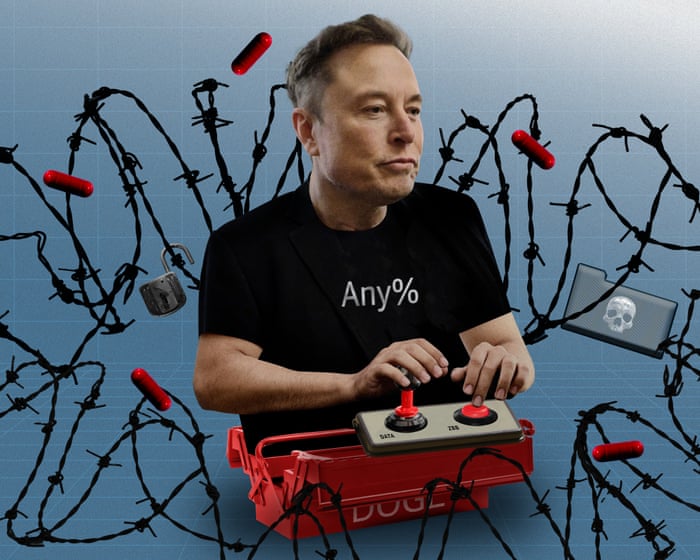
Surprisingly, perhaps, Brand expresses approval for Elon Musk. “What I find so admirable about Musk is that he keeps pushing the envelope of the possible in manufacturing,” he says. Just as Henry Ford revolutionized car manufacturing in the early 20th century with his Model T (which broke down a lot but was relatively easy to fix), so Musk’s Tesla has been a quantum leap, Brand argues. It catalyzed the electric vehicle revolution, which has had an invaluable environmental impact. But Tesla also devised an ingenious way to make the entire underbody of its Model Y cars out of just two pieces of cast aluminum, whereas conventional cars used hundreds of parts that had to be welded, bonded, and riveted together. Electric motors also have far fewer parts than internal combustion engines. Fewer parts means less to go wrong, which means less maintenance. This is how technology gets better, he says.
The flip side is, we now expect things to work all the time. “Most consumer products pretty much don’t require maintenance. You get an electric clock and plug it into the wall or change the batteries from time to time, and it’ll tell perfectly good time. You don’t have to do anything else. So there’s a getting out of the habit of expecting to do maintenance, and then when the thing has a problem, we’re offended: ‘Well, it’s not supposed to do that.’” For this reason, Brand is also a huge fan of YouTube, where you can find lessons and instructions on how to fix just about anything. “We have higher expectations of not needing to maintain things, and lots of good ways to find out how to maintain them when we encounter a problem. So that’s basically progress, as far as I’m concerned.”
Brand is now thinking about institutions in terms of maintenance, he says, and he has plenty of material. We’re speaking shortly after the Davos economic forum, where Donald Trump’s attempts to “acquire” Greenland came to a head, and the Canadian prime minister, Mark Carney, declared that there was a “rupture” in the “rules-based international order.” Rather than progress, we seem to be going in reverse here.
Like the electronic clock, perhaps we’ve become so accustomed to the global order working (at least for powerful western nations), that when it starts breaking we don’t know how to fix it. Brand is relatively relaxed, though. Some institutions might falter, others might prevail, or come back in a different form, he says. Davos is a good example of both: “Carney could say: ‘We’re having a rupture. And here’s a way to rethink ordering for the middle-level nations.’ So that was a great case of acknowledging an institution that’s in trouble – at an institution that was not in trouble: Davos.”
Brand has been trying to foster a similar vein of long-term thinking with the Long Now Foundation. He co-founded it 30 years ago “to get people comfortable with thinking about not just the next 10,000 years, but more importantly, the last 10,000 years: we’ve come a long way, baby. How did that happen?” The idea began with an email conversation with the computer scientist and inventor Danny Hillis in 1994. They were discussing the year 2000, which had long been considered “the future,” but was then just six years away. The plan became to create an artwork “that would help pop through this membrane of the year 2000 for people, and let them take on various degrees and sizes of future, and not just the next decade.” Hillis conceived the Clock of the Long Now – a mechanical timepiece that would chronicle the next 10,000 years (the name came from Brian Eno, anoth…He had approached many people with the idea, but, as usual, it was Brand who responded and said, “OK. Let’s build the clock.”
Improbable as it sounds, the clock is almost finished, buried a few hundred feet into a mountaintop in Nevada. The land and the money were donated by Amazon founder Jeff Bezos. It’s really a giant work of land art, Brand explains. “There’s a Statue of Liberty in New York, and this is kind of a statue of responsibility. It’s beautifully engineered and beautifully constructed and designed as an experience… it’s going to be a day in your life you’ll never forget.” And maybe it will inspire visitors to think as big and long-term as Brand does. “It would be nice to have an institution of thinkers and explainers that can last as long as the clock does.” The foundation’s other initiatives have included a series of seminars on long-term thinking (hosted by Brand), a library of “books you would want to restart civilization from scratch,” and a project to preserve all the world’s languages.
This benign global scope has always been a hallmark of Brand’s brand, combined, paradoxically, with a sense of entrepreneurship and individualism. The opening words of the first Whole Earth Catalog, for example, were: “We are as gods and might as well get good at it.” Born in Illinois in relative privilege, he came of age in a postwar America that felt it had largely figured out the “operating manual for spaceship Earth,” as the forward-looking designer Richard Buckminster Fuller put it at the time. Atom bombs, computers, vaccines, space travel—anything seemed possible.
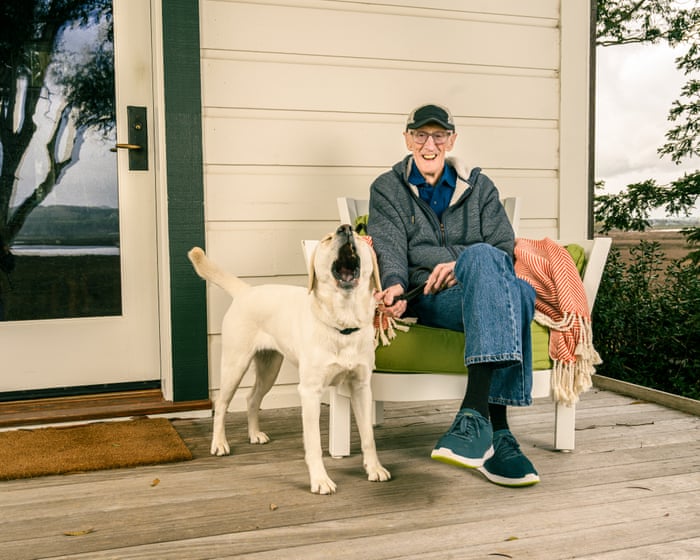
‘Maintenance is what keeps everything going. It’s what keeps life going’ … Stewart Brand at his home in Petaluma, California. Photograph: Winni Wintermeyer/The Guardian
Brand combined these grand ambitions with a human-scaled ethos of empowerment. The strapline of the Whole Earth Catalog was “access to tools,” and it was meant in the broadest sense. The huge, thick directory, first published in 1968, listed all kinds of literal tools for the budding commune-dweller—from seed drills to footwear, kayaks to macrame kits—but it also championed books on all manner of hippy-era interests: esoteric religions, sociology, architecture, philosophy, science, the occult, how to talk to dolphins, you name it. Ideas are tools too, Brand points out. As such, the Whole Earth Catalog offered access to a multitude of alternative lifestyles. “It opened doors for people in a way that invited them to consider, ‘maybe I could just build a guitar, or live off the grid.’ And so it had the impact of conferring agency,” he says.
The Whole Earth Catalog became a huge bestseller in the late ’60s and ’70s, which made Brand a lot of money—too much for his liking, in fact. In the early ’70s he wound the publication down and founded the Point Foundation, which gave grants to worthy causes, though he continued to publish books and periodicals in a Whole Earth spirit until the early 2000s.
One of the key schisms of the counterculture was a tension between the technologists and the environmentalists. The former embraced space exploration and computing; the latter condemned industrial civilization and consumer society as inherently destructive. Brand straddled both camps. He saw how they could complement each other. That NASA image of the whole Earth, for example, he points out, galvanized conservation movements such as Earth Day and Greenpeace, but it “was a direct result of something that environmentalists hated, which was the space program.”
Asking an all-important question, in 2009. Photograph: c Zeitgeist/Everett/Rex Features
Predictably, Brand was in on the ground floor when it came to computers. In 1968 he was a camera operator at what is now known as “the mother of all demos”—a seismic event put on by the Stanford Research Institute.At the Stanford Research Institute, they demonstrated what we now see as the foundations of personal computing: windows, hypertext links, video conferencing, and even navigation using a then-unheard-of “mouse.” In a 1972 Rolling Stone article, Brand called personal computing “good news, maybe the best since psychedelics.” “Actually quite a lot better,” he says today. “Because one of the things that soon became apparent was that psychedelics kind of levelled off,” while computers have seen “an exponential takeoff”: Moore’s law, the internet, and now artificial intelligence—we’re still on that trajectory.
Having witnessed the rapid rise and fall of the commune movement, Brand recognized the potential of online community early on. In 1984, he organized the Hackers Conference—back when “hacking” simply meant doing cool things with computers—where he coined the now-familiar phrase, “information wants to be free.” A year later, he co-founded the Whole Earth ‘Lectronic Link (The WELL), a proto-social media platform with discussion forums on various topics. Meanwhile, many of Brand’s Whole Earth colleagues went on to launch Wired magazine in 1993 (Brand appears in the first issue, interviewing Camille Paglia).
To his critics, Brand helped pave the way for the neoliberal, libertarian mindset of today’s Silicon Valley. But he was also a community-focused idealist and a lifelong environmentalist. That tension between technology and nature persists—which helps explain his apparent affinity with tech figures like Bezos and Musk. He remains ambivalent: “Finding anything that is an absolutely unmitigated benefit is pretty rare,” he says. But “I would say the benefits of personal computers and smartphones and the internet vastly reached beyond, in good terms, what we imagined at the time.”
In terms of physical health, Brand has always been active and outdoorsy—a keen sailor, he hiked mountains with a backpack full of rocks in his 60s, and started CrossFit at 75. “That built a pretty strong constitution,” he notes. Now, however, he has a progressive, incurable, and fatal respiratory illness. He’s stable and still exercises, but uses supplemental oxygen. “I’d be very surprised by making it into my 90s,” he says, seemingly without regret: “Imagine the luck, to get to be 87—it’s just fantastic!”
Brand has always been an optimist, he says, and taking the long view, he still is. “I find optimism in terms of being able to find a way to not only continue but keep getting better.” It might be hard to see a positive way forward right now, but that’s always been the case, he reflects. Brand brings up another of his ventures, the Global Business Network, a 1990s consultancy that mapped future scenarios to help clients plan ahead. “It’s harder to imagine how something might go well than go badly,” he says. But we don’t have to passively accept our fate as if we have no control. “If you like some scenarios better than others, you can be aware of the ones you don’t like and look for signs of them, and also look at signs of the ones you want to have come to pass, and lean differentially toward them. That’s how you negotiate your way into a future you were glad of. It’s done incrementally by, among other things, lots of individuals and some institutions, and that’s how we grapple our way, muddle our way forward.”
Maintenance of Everything, Part One by Stewart Brand is published by Stripe Press (£30).
Frequently Asked Questions
Of course Here is a list of FAQs about Stewart Brand his views on figures like Musk and Bezos and his life philosophy
About Stewart Brand His Philosophy
Who is Stewart Brand
Stewart Brand is an American writer futurist and cultural pioneer best known for founding the Whole Earth Catalog in 1968 which provided tools and ideas for selfsufficiency and was called the internet before the internet Hes a key figure in the environmental movement technology circles and longterm thinking
What is his famous quote We dont have to just accept our fate about
This quote embodies Brands proactive pragmatic optimism He believes humans have the responsibility and capability to use tools science and longterm planning to solve major problems rather than passively letting events unfold Its about taking control of our collective destiny
What is Long Now thinking
Its the philosophy of the Long Now Foundation which Brand cofounded It encourages thinking on a 10000year timescale to make better more responsible decisions today Their most famous project is the Clock of the Long Now a mechanical clock designed to tick for 10000 years symbolizing longterm responsibility
On Technology Billionaires
Why is Stewart Brand interested in figures like Elon Musk and Jeff Bezos
Brand sees them as modern toolbuilders on a massive scale He is interested in individuals who use engineering capital and ambition to tackle planetaryscale challengeslike space exploration and sustainable energywhich aligns with his belief in proactive largescale intervention
What does Stewart Brand think of Elon Musk
Brand generally views Musk favorably as a necessary force He appreciates Musks direct engineeringdriven approach to existential threats like making humanity a multiplanetary species with SpaceX or accelerating the transition to sustainable energy Brand likely sees Musk as a volatile but effective embodiment of the dont just accept fate mindset
What does Stewart Brand think of Jeff Bezos
Brand respects Bezoss extremely longterm thinking which directly mirrors the Long Now philosophy He has praised Bezoss 10000year vision for Blue Origin and his patient systematic approach to building infrastructure Bezoss