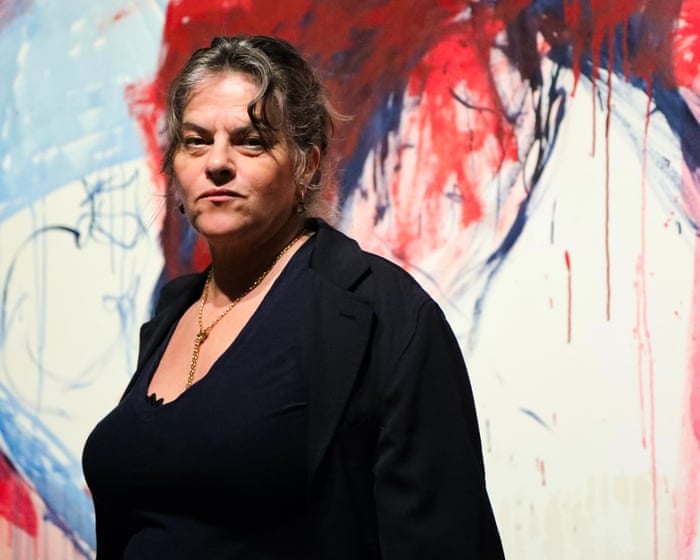
It feels like you’re intruding. Walking into Tate Modern’s vast Tracey Emin retrospective is like walking in on her crying, naked, sobbing and messy, as if you’ve stumbled into something painfully private.
That’s not an easy thing to achieve in the cavernous spaces of our leading contemporary art institution, but that’s what makes Tracey—it doesn’t feel right to call her Emin, she pulls you so close it’s like you know her, it’s Tracey, isn’t it?—such a special, important, era-defining artist.
She is an icon, the most famous artist in Britain. She shaped a generation, shocked a nation, and changed what art could be. Since the early 1990s, she has been making art so raw, so visceral, so emotionally honest that she forces you to feel what she feels.
Tracey symbolizes the height of the ’90s—its sex, drugs, and booze, successes and excesses—but this show isn’t about that. It’s about how she has put her life out there, laid herself bare, and pushed us all to come to terms with our own emotions in the process.
This isn’t a big, cold, white-walled celebration of her work; it’s far more intimate, dark, and claustrophobic. In the brutal, harrowing 1995 film Why I Never Became a Dancer, Tracey talks about leaving school at 13, having demeaning, abusive sex with older men, and walking around Margate as boys chanted “slag” at her. But by the end, she turns all this pain into something joyful. “Shane, Eddie, Tony, Doug, Richard, this one’s for you,” she says, and dances to Sylvester’s disco anthem (You Make Me Feel) Mighty Real. That’s our Trace—she lives, she feels, she loves, she suffers, and then she turns it all into art.
It’s a simple equation repeated over and over in different ways throughout her career. She turns cruel jibes into quilts, heartbreak into paintings, and slurs shouted at her mother—because she married a Turkish Cypriot man—into poetry.
An abortion the artist had in the early 1990s casts a huge shadow. In one film, she talks about the misery she endured and the way people treated her afterward. In the next room, there’s a shelf with her hospital wristband and a little bottle of pain-relieving mefenamic acid next to a display of children’s shoes. It’s almost too much, too agonizing.
Yet the abortion was her “emotional suicide,” a seismic moment that changed everything. She destroyed all her art school paintings, locked herself in a studio for three-and-a-half weeks, and started from scratch. That studio is recreated here, covered in scrawled paintings, empty cans of European lager, and dirty laundry.
My Bed is here too—how could it not be? But for something so iconic, it doesn’t feel monumental or grandiose, or like a piece that has dominated popular art discourse for decades. It just feels like being let in, like being given access to another private moment of pain. It was never meant to make headlines or change the world; it was just the truth—the reality of someone living their life.
Living that life has gotten harder recently. She was diagnosed with bladder cancer not long ago, and a dark corridor here is filled with photos of her bleeding stoma. There are no boundaries with Tracey; you get all of her, no matter what. Her recovery from cancer marks the second life of the show’s title, a rebirth.
The quilts, films, and installations are the most famous works here, but the show is full of paintings, too. Rough, chaotic self-portraits in black, red, and grey—Tracey’s body is splayed and bleeding, lying broken in bed or standing fragile and ghostly on the verge of collapse. Many of them are covered in diaristic half-poetry…They’re not all great paintings, but they’re affecting in all their messy, tempestuous rawness.
What is really not great is her sculptural work. Every bronze looks like a badly made metallic lump placed around the gallery. And I could happily go the rest of my life without ever seeing another of her neon signs, all of which look as if they belong in the lobbies of the worst hotels on Earth.
But even when she is bad, at least she is real and heartfelt. Parts of this show left me in pieces. The painting of her carrying her mum’s ashes completely broke me and left me missing my own mum, who died just before the pandemic. I was a teary wreck; it was overwhelming. It must be exhausting being Tracey. I couldn’t feel this intensely all the time—I’ve got to function and send emails and go to Tesco.
Don’t come here looking for a good time—you won’t find it. But come looking for pure, unapologetic, undiluted, full-frontal love, grief, heartache, and sadness, and you will end up feeling more than you’ve probably felt for years.
Frequently Asked Questions
Of course Here is a list of FAQs about the review titled Tracey Emin A Second Life review this raw exhibition of love heartache and pain left me in tears designed to cover a range of perspectives
General Beginner Questions
Q Who is Tracey Emin
A Tracey Emin is a famous British contemporary artist part of the Young British Artists group She is known for her deeply personal and confessional work that explores themes like love sex trauma and memory using mediums like neon text embroidery drawing and sculpture
Q What is A Second Life exhibition about
A Its a major exhibition showcasing Emins work from the past decade created after her recovery from major surgery for cancer The title refers to her renewed focus on life love and artistic energy though the work still grapples with her past pain and heartache
Q Why did the reviewer say they were left in tears
A The reviewer was emotionally overwhelmed by the raw honesty and vulnerability in Emins work The art directly communicates intense feelings of love loss and physical pain in a way that can feel very immediate and personal to the viewer
Q Is the exhibition suitable for someone who doesnt know much about art
A Yes absolutely Emins work is often textbased and deals with universal human emotions You dont need an art history degree to connect with feelings of heartbreak longing or joy The review suggests its power is in its direct emotional impact
Q What kind of art will I see there
A You can expect largescale bronze sculptures intimate embroidered blankets raw figurative paintings and her iconic neon signs with handwritten phrases about love and desire The materials and scale vary widely
Advanced Contextual Questions
Q The review calls it raw What does that mean in the context of Emins work
A Raw refers to the unpolished unfiltered and deeply personal nature of her art She doesnt hide her emotional or physical scars she presents them directly through frantic drawing lines confessional text and themes that feel private and exposed
Q How does this exhibition differ from her earlier more controversial work
A