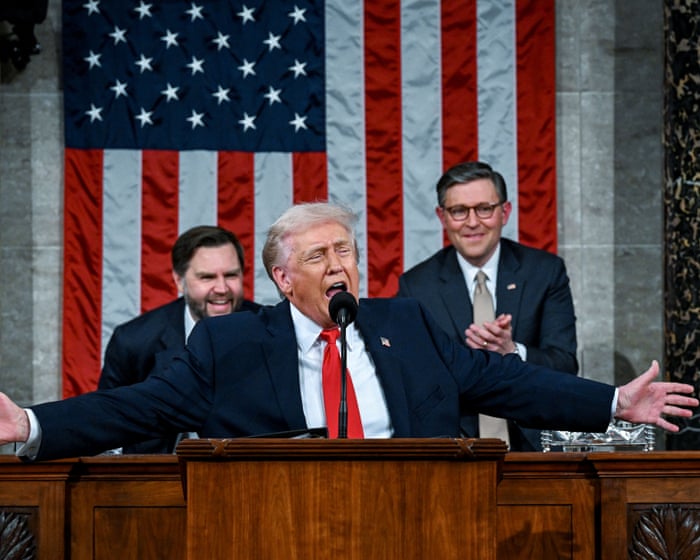
In his State of the Union address on Tuesday evening, Donald Trump declared his first year in office a success, despite facing low public approval ratings ahead of November’s midterm elections, where voters could shift control of Congress to his Democratic opponents.
The annual speech to a joint session of Congress followed months of turmoil for the Republican president, including a controversial crackdown on immigrant communities in Minneapolis that led to the deaths of two U.S. citizens, and slow progress on his campaign promise to lower the cost of living.
Even as Democrats walked out, held up signs, and engaged in verbal clashes in the chamber, Trump struck a triumphant tone, arguing he had rebuilt a country left in ruins by Joe Biden. Lasting just under two hours, his speech was the longest State of the Union on record, and he repeatedly introduced surprise guests as living symbols of what he called the nation’s greatness.
“Tonight, after just one year, we can say with dignity and pride that we have achieved a transformation like no one has ever seen before, and a turnaround for the ages,” Trump said. “We will never go back to where we were just a very short time ago. We’re not going back.”
Recent polls suggest many voters disagree. A Washington Post-ABC News-Ipsos poll released this week found only 39% view his presidency positively, with others showing him trailing on key issues like the economy and immigration.
Trump made no mention of these negative sentiments, instead listing his administration’s accomplishments in a speech filled with falsehoods and exaggerations but short on new policy ideas. He announced that Vice President JD Vance would lead a “war on fraud” and that he had negotiated a “ratepayer protection pledge” to shield households from higher electricity costs due to new data centers.
He falsely claimed a Ukrainian refugee was murdered in North Carolina by an immigrant—the suspect is actually a U.S. citizen—and insisted his administration “will always protect” Medicaid, despite signing the One Big Beautiful Bill Act, which mandates cuts expected to strip healthcare from millions.
Four Supreme Court justices attended the speech, three of whom—John Roberts, Amy Coney Barrett, and Elena Kagan—had recently joined an opinion blocking Trump from using executive power to impose tariffs on U.S. trading partners. As they sat alongside Justice Brett Kavanaugh, who did not join the opinion, Trump offered a relatively mild critique, calling the decision “unfortunate” and “disappointing.”
He was less restrained toward Democratic lawmakers, dismissing them as “crazy,” or Somali immigrants, whom he labeled “pirates who ransacked Minnesota,” referring to a contentious immigration operation there. While he has ordered a major military buildup around Iran, he revealed little about his intentions toward the longtime U.S. adversary.
“My preference is to solve this problem through diplomacy. But one thing is certain, I will never allow the world’s number one sponsor of terror, which they are by far, to have a nuclear weapon,” Trump said.
Much of the speech was devoted to honoring U.S. citizens seated in the galleries above the House floor. These included the men’s hockey team that recently won gold at the Winter Olympics and a National Guard soldier who survived a deadly shooting in downtown Washington, D.C. Trump also awarded the Medal of Honor, the highest military decoration, to a Korean War veteran.During a January raid intended to capture Venezuelan President Nicolás Maduro, a veteran and a helicopter pilot were wounded.
“Our country is winning again. In fact, we’re winning so much that we really don’t know what to do about it,” Trump said.
Democrats in attendance engaged in what one party leader termed “silent defiance,” largely refusing to applaud and remaining seated throughout the speech. They only stood occasionally to clap for topics with bipartisan support, such as the release of Israeli hostages taken by Hamas and a proposal to ban lawmakers from trading stocks.
Several Democrats chose to skip the event entirely. Some participated in alternative gatherings elsewhere, including a “People’s State of the Union” organized by liberal groups.
At the speech’s outset, Democratic Representative Al Green of Texas—who was removed from the House chamber last year for heckling the president and later censured—held up a sign reading “Black people aren’t apes!” This referenced Trump sharing a racist video depicting Barack and Michelle Obama. After confrontations with Republicans, Green appeared to be escorted out.
Lawmakers also shouted back at key moments during Trump’s barrage of claims. Ilhan Omar, the Democratic congresswoman from Minnesota, yelled, “you have killed Americans,” referring to the deaths of Alex Pretti and Renee Good in her state.
Other Democrats stayed for portions of the speech but left early. Virginia Senator Mark Warner stated, “Walked out of the State of the Union because I couldn’t sit through hours of Trump’s lies.”
Reviews from those who remained were equally critical. In a statement, top House Democrat Hakeem Jeffries said, “For nearly two hours tonight, Donald Trump spewed lies, propaganda and hatred. Instead of presenting the nation with a positive vision for our future and the economy, the president blamed others for his failures.”
The speech nonetheless marked a key moment ahead of the November midterm elections, where Trump’s Republican allies are defending their narrow control of the Senate and House. After failing to prevent Trump’s return to the White House in 2024, Democrats have been encouraged by recent successes in off-year and special elections, suggesting voters may be ready to deliver them victories in key races that could decide control of Congress.
The official response to Trump’s speech was delivered by Virginia Governor Abigail Spanberger, who won a decisive victory last year that secured Democratic control of the southern state.
In a 13-minute speech criticizing much of Trump’s policies—from his tariffs to his widespread deployments of federal agents to detain suspected undocumented immigrants—Spanberger asked, “Is the president working for you?” She answered, “We all know the answer is no.”
Frequently Asked Questions
FAQs Trumps 2020 State of the Union Address
Here are some frequently asked questions about President Donald Trumps 2020 State of the Union address which was noted for its length and its focus on touting achievements and targeting political adversaries
BeginnerLevel Questions
1 What was the main purpose of this State of the Union address
The main purpose was for President Trump to present his administrations accomplishments over the past three years and to outline his policy priorities and vision for the future directly to Congress and the American public
2 Who were the familiar adversaries he targeted
He primarily targeted political opponents including Democrats in Congress socialist policies and media outlets he often criticizes as fake news
3 What were some key achievements he highlighted
He highlighted a strong prepandemic economy with low unemployment the passage of the USMCA trade agreement conservative judicial appointments military funding increases and efforts to restrict immigration and build the border wall
4 Why was this address considered lengthy
At about one hour and 18 minutes it was one of the longest State of the Union addresses in modern history allowing for a detailed recitation of his policy wins and a more confrontational tone toward opponents
5 Were there any memorable moments during the speech
Yes notable moments included Speaker of the House Nancy Pelosi visibly reacting the surprise awarding of the Presidential Medal of Freedom to conservative radio host Rush Limbaugh and the emotional reunion of a soldier with his family
Advanced Analytical Questions
6 How did the tone of this address compare to previous State of the Union speeches
The tone was notably more campaignstyle and confrontational than traditional addresses which often strive for a more unifying presidential tone It functioned as much as a reelection rally speech as an official report to Congress
7 What was the political context surrounding this speech
The speech was delivered just days after Trumps impeachment acquittal by the Senate This fueled a highly partisan atmosphere with the address serving as his first major platform to respond to the impeachment process and frame it as a partisan attack