Donald Trump has a unique talent for exposing how outdated many long-standing traditions have become. During presidential election years, his loud, boastful speeches on stage make the practice of bringing candidates together seem pointless. When in power, by ignoring facts in policymaking and relying instead on myths and self-serving schemes, he renders entire fields of expertise irrelevant and powerless.
When he lies in public and insists that his fantasies and distortions should guide government action, it makes those of us in journalism question whether there is still any purpose in gathering and reporting the truth.
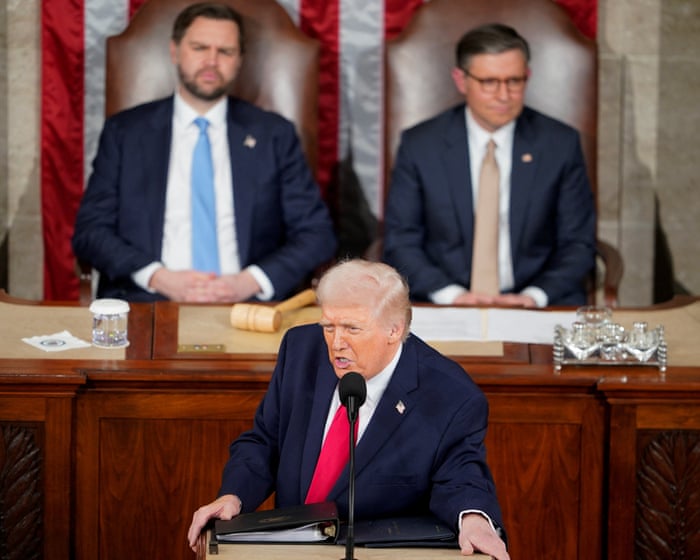
Similarly, many Americans watching the State of the Union address on Tuesday night might have wondered what the point of these speeches is anymore. The Constitution requires the president to periodically update Congress on the state of the country, but it does not call for the kind of in-person, televised address that has become an annual tradition in the age of mass media. Certainly, the Founding Fathers could never have imagined the speech Trump delivered on Tuesday night: a rambling, nearly two-hour address filled with falsehoods, ad-libs, and digressions that often seemed like attempts to fill time—and remarkably lacking in substantive policy.
Throughout the speech, Trump appeared tired. He struggled to read from the teleprompter, gripped the podium with an almost desperate tightness, and by the end, his voice was noticeably hoarse. He showed his age. The speechwriters, too, seemed exhausted.
The address touched on Trump’s usual themes: the supposed criminality and inferiority of immigrants, the dishonesty of his opponents, and his own virtues and grievances. But the president offered few new policy ideas, contradicted himself on key issues, misrepresented relevant facts, and barely addressed what polls show are the nation’s most pressing concerns.
He frequently paused to honor veterans in the audience, awarding them medals as stunts for the television broadcast. He went on a long, strange tangent about the U.S. men’s hockey team’s recent Olympic gold medal win, with many team members parading into the House chamber wearing their medals. A decade ago, Trump embodied a trend in American politics by openly merging governance and entertainment. But Tuesday’s long-winded and dull spectacle showed that he has even lost the ability to entertain.
Of course, he hasn’t lost the ability to offend. Trump lied about lowering healthcare costs, even though his attacks on Affordable Care Act subsidies have significantly increased premiums for many Americans in just the past two months. He made a nonsensical digression to attack the rights of transgender children. With vulgar boldness, he claimed that his kidnapping of Venezuelan leader Nicolás Maduro and his administration’s subsequent economic blackmail of Venezuela were creating new opportunities for the Venezuelan people.
He falsely claimed that Democrats’ withholding of funding from the Department of Homeland Security over abusive immigration enforcement was hindering snow removal efforts after this week’s East Coast blizzard, even though DHS does not handle such tasks. Even his filler lines reeked of hypocrisy. “We are building a nation,” he said, “where every child has a chance to build higher and go further.” This sentiment brought to mind Liam Ramos and all the other children imprisoned in ICE’s detention camps, whose education, promise, dreams, and freedom have been sacrificed to the administration’s racism.
In typical fashion, Trump spent much of his speech attacking immigrants, using language reminiscent of the algorithm-driven social media where he spends so much of his time. He claimed thatReckless driving was blamed on immigrants who couldn’t read English road signs. He accused them of crime, dwelling on graphic details of injuries and deaths caused by undocumented immigrants—tragedies his administration has been quick to use for political gain. Perhaps most offensive was his claim that immigrants, especially Somali-Americans in Minnesota, are bringing corruption into the United States. “There are large parts of the world where bribery, fraud, and corruption are the norm, not the exception,” Trump said, echoing a racist argument previously made by his vice president, JD Vance, that corruption is an inherent cultural trait immigrants carry to America.
Yet it is Trump, not any Somali immigrant, who has repeatedly invented weak excuses to accept large sums from wealthy individuals and companies with interests before his administration. If Donald Trump wants to find the source of corruption in America, he need only look in the mirror.
It’s telling that Trump could only offer such weak material in such a lukewarm and unconvincing performance—his poll numbers are collapsing. His approval rating has hit a new low: a CNN compilation of recent polls shows it at a startlingly weak 38%. Economic opportunities are scarce, inflation hasn’t dropped as he promised, and tariffs have burdened consumers. Trump appears intent on pushing forward with these tariffs even after the Supreme Court struck them down last week, leaving ordinary Americans once again to bear the cost.
Trump and his allies often boast about a booming stock market, but a huge portion of U.S. economic growth seems tied to speculation in the AI industry—investments that could vanish if the technology fails or reduce consumer purchasing power if it succeeds. Either way, American workers feel squeezed and struggling. Meanwhile, Trump’s speech breezily insisted everything is fine, offering them nothing.
The most memorable moment of an otherwise forgettable evening came when Trump attacked the Democrats. Pointing at them in the House chamber, he called them “crazy” and said, “We’re lucky we have a country, with people like this. Democrats are destroying our country, but we stopped it, just in the nick of time.” Republicans stood and applauded, while Democrats remained seated, politely enduring the insults. Why did they just sit there and take it? Why attend at all? Trump has revealed yet another thing that seems outdated: civility.
Moira Donegan is a Guardian US columnist.
Frequently Asked Questions
Of course Here is a list of FAQs about the statement Trump can no longer entertain but unfortunately he still knows how to offend
General Understanding
Q What does Trump can no longer entertain mean
A It suggests that for many people the novelty of his unconventional political style has worn off The shock value dramatic rallies and constant media storms are no longer seen as amusing or surprising but rather as exhausting or predictable
Q What does he still knows how to offend refer to
A It points to his continued use of provocative language personal insults derogatory nicknames for opponents and comments on sensitive topics that many find deeply hurtful divisive or inflammatory
Q Is this saying his behavior has changed
A Not really Its more about the publics reaction to his behavior The entertainment factor has faded for many but the capacity to cause offense with his words remains just as potent
Deeper Analysis Context
Q Why did people find him entertaining in the first place
A During the 2016 election and early presidency his break from political norms unfiltered speeches and constant creation of news cycles were seen by some as a refreshing dramatic realityTV style of politics that was unpredictable and engaging
Q If hes not entertaining anymore why is he still so prominent
A Because his ability to command attention set news agendas and provoke strong reactionsboth positive and negativeis undiminished Being offensive or polarizing is still a powerful tool for rallying a dedicated base and dominating media coverage
Q Whats an example of the shift from entertaining to just offensive
A Early on a nickname like Lyin Ted might have been seen by some as a brash political jab Now repeated use of such tactics alongside more serious personal attacks or comments seen as mocking marginalized groups is often received not as entertainment but as corrosive rhetoric
Q Does this mean his supporters are no longer entertained
A Not necessarily His core supporters often do not view his statements as offensive but as telling it like it is or fighting back against political correctness The phrase reflects a perspective common