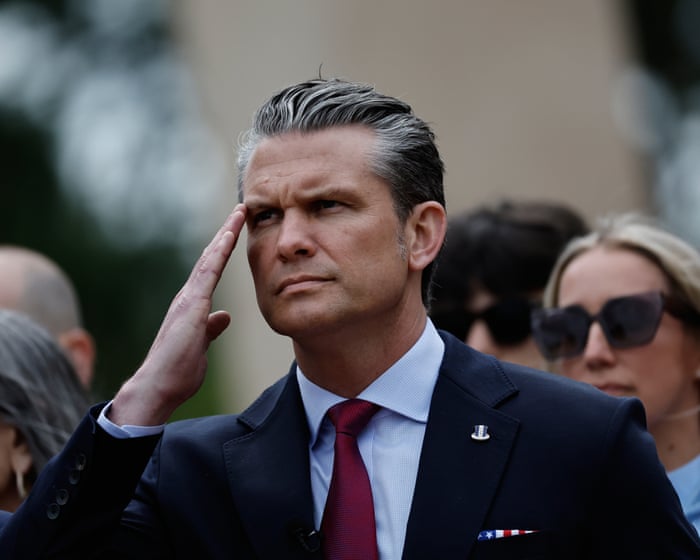
When news broke that US Defense Secretary Pete Hegseth would travel to Normandy for the D-day anniversary, some residents of the small seaside village of Langrune-sur-Mer—where the afternoon ceremony was planned—felt they had to speak out.
“We couldn’t believe they would send someone with views and values that go against democracy, human rights, peace, and Europe,” said Chantal Richard, a local resident. For her, the contradiction felt deeply personal. “We grew up attending D-day ceremonies. Some of us had grandparents or parents whose lives were shaped by this war.”
This feeling led Richard and about 40 other members of Langrune en Commun, a residents’ association, to sign a 179-word statement. Published just days before the 82nd anniversary of the D-day landings, it called for Hegseth’s visit to be canceled.
“The honor of Langrune, of France, and the memory of the young Allied soldiers—American, British, and Canadian—who died on our beaches in the name of democracy demand that this individual’s visit be canceled,” the statement read.
Few in the association, which aims to build community among residents and promote environmentalism, expected their statement to have much impact. Preparations for the ceremony had been underway for a long time, turning the village of about 2,000 people into an international host. Flagpoles were carefully set up, the podium was in place, and more than 400 high-ranking officials from around the world were expected to arrive.
For the association, though, the hope was to encourage people to think about the deeper meaning of the D-day anniversary, said member Julia Breen. “We celebrate it as a historical moment, but what does war mean today? What does it mean that we are safe while people are being bombed right now?”
The short statement gained new attention after Hegseth sparked global outrage by using his D-day speech to criticize immigration. The villagers’ protest quickly went viral, with media around the world noticing their unique effort to stand up to the US defense secretary.
“It snowballed into something we honestly never expected,” said Richard. In the days since, the association’s website has been flooded with hundreds of emails from around the world. “We’ve been getting messages, mostly from the US, from people saying, ‘Thank you for speaking out, we support you,'” Richard added.
Some messages have been especially moving, like one from a US veteran, said Breen. “He told us, ‘I’m going to find a bottle of French wine and toast to you because you’re defending the values we fought for.'”
This was a big change from the mixed reactions they got after first publishing the statement. At the time, some in the village, including elected officials, accused them of exaggerating about Hegseth and trying to turn the wartime liberation of Europe into a political issue, said Richard.
Those concerns turned out to be unfounded, Richard added. “The person who turned the commemoration into a major political issue wasn’t Langrune en Commun, but Pete Hegseth,” she said. “He didn’t come to celebrate freedom, democracy, and peace. He came to push his far-right, anti-immigrant, and warmongering rhetoric.”
Hours before the ceremony in Langrune-sur-Mer was set to begin, Hegseth spoke at the US military cemetery in Colleville-sur-Mer. Against the stark backdrop of rows of white crosses, he told the crowd that Europe was facing a different kind of “invasion” on its shores.
“Sadly, today, different European beaches are stormed by different, dangerous ideologies,” he said, in remarks that led a prominent historian to accuse him of “grotesque stupidity.”That was his only public appearance of the day. Earlier, he had told organizers he wouldn’t attend the afternoon ceremony in Langrune-sur-Mer, but didn’t give a reason for his absence.
Remains of US soldier killed in WWII returned to Pennsylvania after 80 years
Read more
In Normandy, the Socialist party group in the regional council noted that it had only taken a few hours for the villagers to be proven right. They called the remarks a “desecration” in a statement to the newspaper Ouest France. “The men buried in Colleville did not die so we could close off beaches; they died to free a continent from an ideology based on human hierarchy and racism. Twisting their sacrifice into an argument for hatred betrays their commitment.”
In the US, Republican House member Michael McCaul called Hegseth’s comments “inappropriate” in an interview with ABC News. “There’s a time and place for immigration issues. That wasn’t the day, not on the anniversary of D-day. Out of respect for the veterans—and I’m the son of a D-day veteran—those remarks were out of line.”
Criticism also came from Langrune-sur-Mer, where Breen described the remarks as “absurd, contradictory, nonsensical, and racist.” For Richard, it showed that the association had been right to speak up, even if they were the only ones to do so.
“I think our statement helped people come out of the woodwork,” Richard said. “If it gave others the courage to speak up and say they feel the same way—that they’re not okay with the ideology of the Trump administration—that’s a good thing.”
Breen agreed, saying she was proud to be part of an association that had become a small “point of resistance” against those who used protocol as an excuse to stay silent in the face of someone who “promotes rhetoric that is bellicose, racist, supremacist, and imperialist.”
But she was quick to add that what they did in Langrune-sur-Mer was far from extreme. “It’s crazy that resistance today is just about reminding the world of its values,” she said. “And that doing so seems like a radical stance.”
Frequently Asked Questions
Here is a list of FAQs about A Point of Resistance The Normandy Village That Said No to Pete Hegseth based on the reported situation
BeginnerLevel Questions
Q What is A Point of Resistance
A Its a specific reference to a small village in Normandy France that publicly refused to allow a visit or event by Pete Hegseth a former Fox News host and current US Secretary of Defense nominee due to his political views
Q Why did the village say no to Pete Hegseth
A Local officials and some residents objected to Hegseths past comments about NATO European allies and his political stance They felt his presence would disrespect the villages history of unity and resistance during World War II
Q Where exactly is this village
A Its a small commune in the Normandy region near the DDay beaches The exact name is often kept vague in reports to protect the village from political backlash but its a real place with a strong WWII memory
Q Is this a protest or a formal ban
A It was a local informal refusalnot a legal ban The mayor and town council voted to deny permission for a planned event or visit citing the villages values
AdvancedLevel Questions
Q What specific comments by Pete Hegseth triggered the villages objection
A Hegseth has publicly criticized NATO as outdated questioned Frances role in the alliance and made remarks perceived as dismissive of European security The village which lost many residents in WWII saw this as an insult to the sacrifices made by Allied forces
Q Does this village have a history of political resistance
A Yes Like many Normandy towns it was a site of fierce resistance against Nazi occupation The local memorials honor both French Resistance fighters and Allied soldiers Saying no to a controversial American figure is seen as a continuation of that spirit
Q How did this affect Hegseths plans or reputation
A Hegseths team reportedly canceled any scheduled appearance after the refusal The incident was widely covered in French and American media highlighting the cultural divide over NATO and US foreign policy in rural France