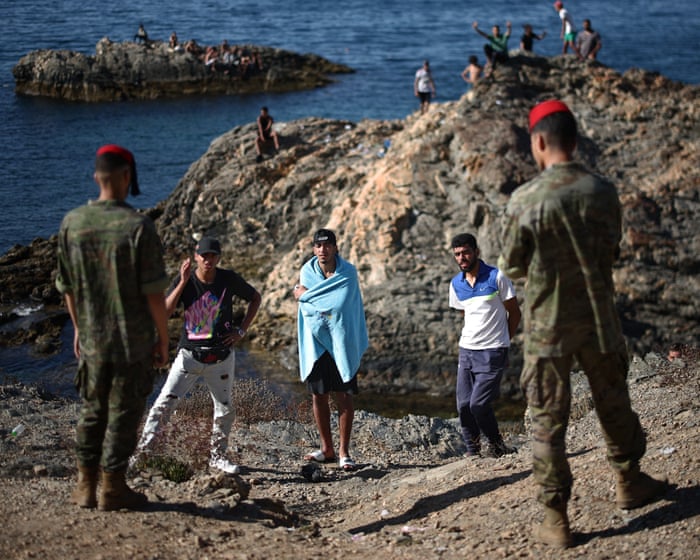
For Europe’s hard right and the White House, it seemed almost too good to be true: left-leaning Spain getting hit with a migration crisis of its own making. The outrage came right on schedule. As thousands of mostly Moroccan citizens streamed into Ceuta, Spain’s tiny enclave on the northern tip of Africa, the far-right party Vox condemned a migrant “invasion,” blaming Prime Minister Pedro Sánchez’s regularization policies and leftist politics. The Trump administration echoed that line. A senior Israeli diplomat taunted Madrid over its “colonial” territories, while Italy’s Prime Minister, Giorgia Meloni, called for Spain to be suspended from the Schengen area. Denmark and Finland backed Italy’s move, and by the weekend, 22 EU leaders had signed a letter implicitly criticizing Madrid for failing to “relentlessly combat illegal migration.”
But what these self-appointed guardians of border control refuse to see is that their own panic and political games over migration are what got us here.
Ceuta is hardly a shining example of Spain’s otherwise liberal migration policy. In fact, since the 1990s, it has been the model for Europe’s relentless border security efforts. Drones, heat sensors, motion detectors, digital watchtowers, Moroccan Auxiliary Forces: Ceuta’s border is so heavily militarized that it puts even Trump’s wall-building—let alone that of Greece, Poland, or Finland—to shame.
The irony, as civil guards told me during my last visit in 2023, was that this militarization meant giving up control. “Rabat knows it can destabilize Spain with migration,” one chief said, reflecting on the mass entry of Moroccans in 2021, after Madrid angered its partner by taking in Brahim Ghali, the leader of Western Sahara’s Polisario movement, for urgent medical care. The heavily fortified fences have become the perfect stage for creating a migration crisis.
While Morocco usually stays tight-lipped about its intentions, its ministers have at times bluntly said it won’t act as Europe’s “policeman” unless its partners back its economic and political goals. The quiet at the border since 2021 had little to do with the aggressive security hardware and everything to do with Madrid’s 2022 endorsement of Rabat’s plan for occupied Western Sahara. So why the latest crisis? While the facts and motives are still being sorted out, it’s unlikely to be a coincidence that Sánchez recently announced a “new phase” in relations with Algeria—Rabat’s arch-rival and a supporter of Polisario.
Sánchez blames the mass entry on people smugglers and misinformation about a recent Spanish supreme court ruling that stops authorities from immediately deporting migrants who try to swim by sea to Spain’s territories in Africa. But blaming criminal groups makes little sense: most of those who crossed were quietly sent back within a day—unthinkable if they had spent their life savings on smugglers. Morocco’s government officially says the surge was due to “criminal organizations” and that cooperation with Spain remains “exemplary.” Social media rumors did mobilize people to cross, but crucially—according to Spanish intelligence—Moroccan law enforcement stopped controlling the border, and its intelligence services failed to alert Spain about the online campaigns. Video clips and accounts from border crossers in various media outlets further suggest that law enforcement actively encouraged people to cross.
Anyone who knows the Ceuta border understands that nothing dramatic happens there without the Moroccan authorities allowing it. Yet Spain can’t call out Morocco because it desperately depends on it. Instead, both Madrid and Brussels show…Rabat has been praised this past week, but this highlights the corner the EU has backed itself into: relying on repressive, undemocratic regimes that use migration threats to get what they want. This tactic has been used for years along the EU’s external borders, from Gaddafi’s threats to Turkey’s maneuvers. It’s especially tempting for these regimes because Europe is so fixated on stopping unwanted migration—the more Europe cares, the more leverage they have.
The geopolitical situation doesn’t look good for the EU. Since the Abraham Accords in 2020, Morocco has boosted its international standing by aligning closely with the Trump and Netanyahu administrations. Both of those governments see Spain as a key rival in Europe. In January, Morocco deepened military ties with Israel. In April, a US House committee claimed that Ceuta and Melilla, Spain’s other enclave, are “in Moroccan territory.” Israeli and Republican figures have been making similar statements more often. Recently, Morocco named a highway through Western Sahara after Trump.
Why is Ceuta a migration flashpoint and how did so many people cross from Morocco? Read more.
This doesn’t necessarily point to a big conspiracy. Rabat might have just tried to seize an opportunity and then lost control. But it does suggest that what happened in Ceuta was a geopolitical game using people as pawns, leaving over 70 dead.
European leaders are so focused on “security” that they’re missing what’s in their own best interest. Notably, Denmark—one of the governments threatening to suspend Schengen—should understand geopolitical blackmail against Europe. Evidence shows that coercive migration pressure works best when destination regions are divided and arguing among themselves. That’s exactly what far-right and government leaders are doing now, nervously blaming Spain and warning of another 2015-style crisis.
By showing their cards to both “partner” states and hostile regimes, these leaders are making it clear which buttons to push for maximum effect. Through their reactions, EU politicians aren’t just undermining European unity—they’re actively encouraging more crises, while helping anti-European forces in the White House and beyond.
We need a different approach to migration politics—one that calms panic instead of fueling it, prioritizes honest diplomacy over one-sided “combat,” and reduces the power of strongmen and smugglers. European leaders could start changing this dynamic by not playing into their hands at the first chance.
Ruben Andersson is a professor of social anthropology at the University of Oxford and author of Age of Security: The Rise of a Global Obsession (William Collins), out August 13th.
Do you have an opinion on the issues raised in this article? If you’d like to submit a response of up to 300 words by email for possible publication in our letters section, please click here.
Frequently Asked Questions
Here is a list of FAQs based on the articles themes written in a natural tone
General Definitional Questions
1 What is the main argument of the article
The article argues that the political right in Spain is exploiting the migrant arrivals in Ceuta to push a hardline agenda This exploitation creates a crisis spectacle that in turn justifies the same harsh border policies that cause the problem in the first place Its a selffulfilling prophecy
2 Who is Ruben Andersson
Hes an anthropologist and professor at the University of Oxford who studies migration borders and the security industry Hes the author of Illegality Inc a book about the migration industry in West Africa and Europe
3 What exactly is the migrant crisis in Ceuta
It refers to the periodic mass crossings of migrants and refugees from Morocco into Ceuta a Spanish enclave on the African continent These events often involve hundreds or thousands of people swimming or climbing the border fence at once often overwhelming border guards
4 What does the article mean by the rights exploitation of the crisis
It means that farright and rightwing politicians use these dramatic border events to stoke fear and anger among voters They use the images to push for more walls more police and tougher immigration laws framing migrants as an invasion rather than people fleeing hardship
5 Why does the author say this exploitation guarantees it will happen again
Because the rightwing response is to make the border more violent and securitized This pushes migrants to attempt more desperate mass crossings to get through The resulting chaos creates the exact images the right needs to justify even more securitization creating a vicious cycle
Advanced Analytical Questions
6 What is the border spectacle the author talks about
Its the idea that borders are not just physical lines but are also performances The hightech fences the guards and the dramatic images of people running or swimming are all staged for a political audience This spectacle is used to create the impression of a state under siege which justifies extreme measures
7 How does the article link the crisis to the EUs external border policy
The article argues that the EUs policy of