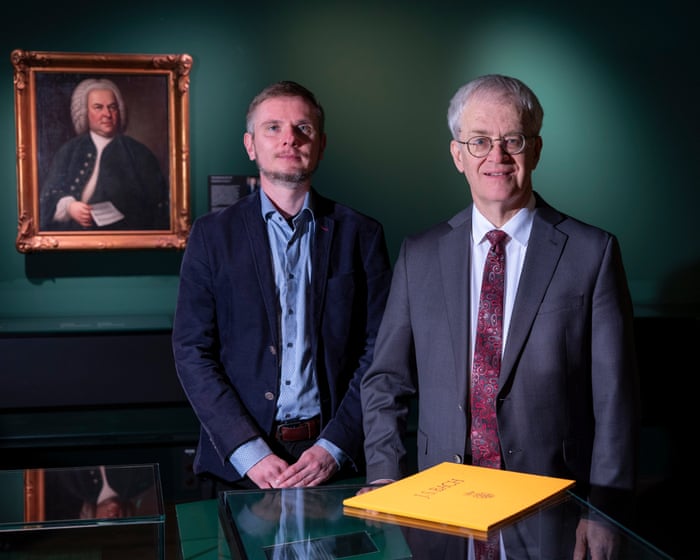
The best fictional detectives are known for their intuition—the ability to notice subtle, almost indescribable inconsistencies. Peter Wollny, the musicologist responsible for last week’s “world sensational” discovery of two previously unknown works by Johann Sebastian Bach, felt a similar hunch when he stumbled upon two intriguing sheets of music in a dusty library in 1992.
His journey from a simple suspicion to uncovering a secret would span half his lifetime. Now 65 and the director of Leipzig’s Bach Archive, Wollny was a Harvard graduate student when his PhD research brought him to the Royal Library of Belgium in Brussels. There, he found two 18th-century scores with no credited composer.
Two long-lost organ pieces by J.S. Bach were performed for the first time in 300 years.
“I have to admit, I didn’t even think they were by Bach at the time,” Wollny said recently, just days after the two pieces—Chaconne in D minor BWV 1178 and Chaconne in G minor BWV 1179—were performed for the first time at Leipzig’s St. Thomas Church.
“The handwriting on the score fascinated me, and I had a vague feeling that these pages might be important someday. So I made photocopies and kept a file with me for 30 years.”
Although he has dedicated his life to studying the greatest composers of the Baroque era, Wollny said he didn’t seriously consider the works might be by Bach himself until about two or three years ago.
Born in Issum, North Rhine-Westphalia, Wollny studied musicology, art history, and German studies at the University of Cologne before pursuing his PhD at Harvard, focusing on the music of Bach’s eldest son, Wilhelm Friedemann Bach. After earning his doctorate in 1993, he joined the Leipzig Bach Archive as a researcher and became its director in 2014.
His colleague and co-researcher Bernd Koska remarked, “Peter Wollny is someone who carefully weighs his thoughts before reaching a conclusion. That’s just how he works.”
To a trained musicologist, the two works stood out from the start. Both are chaconnes, originally a Spanish dance that evolved into a distinct musical form around 1700. Their defining feature is a short bass line, called an ostinato, repeated throughout the piece.
In nearly all organ chaconnes from that period, each ostinato bass motif has a fixed length of six, seven, or eight bars—never longer or shorter. But in the Chaconne in D Minor that Wollny found in Brussels, the composer began with a seven-bar ostinato and then expanded it to eight, twelve, and finally sixteen bars.
The anonymous composer made other bold choices, such as repeating the bass melody in a higher register with a one-bar delay, creating a canon. They also transformed the ostinato bass into a four-part fugue, a technique used to weave a single theme throughout the music.
Wollny describes these unique touches as the musical equivalent of “hapax legomena”—words that appear only once in a text. “These works didn’t fit the mainstream composition style around 1703 at all,” he said.
The only other known composition from that early period using similarly daring techniques is Bach’s Passacaglia in C Minor BWV 582.
In-depth study of Bach, famous for embedding mathematical riddles and puzzles into his music, is known to inspire obsession. Sinister Bach enthusiasts appear in Lars von Trier’s Nymphomaniac films and in the novels of recent Nobel laureate László Krasznahorkai, as well as in the 1991 film The Silence.In The Silence of the Lambs, Hannibal Lecter chews off a prison guard’s face while listening to the Goldberg Variations.
“If you listen to a lot of Bach, he becomes a part of you,” said John Butt, a music professor at Glasgow University. “Throughout history, many musicologists have believed they had a more personal connection to his works than anyone else.”
Because of this, efforts to authenticate or date Bach’s works based only on musical style have had mixed results. “There have been a lot of red faces,” he added.
Wollny, however, had a special skill that aided his research. “I want to be careful how I say this,” he noted, “but I may have a talent for recognizing handwriting.”
After finding two anonymous works in Brussels, he felt an “inner duty” to identify the author. He spent hours studying the unique details of the notation. “You begin by looking at the treble and bass clefs, because they show a lot of individuality,” he explained.
He noticed that the writer had a distinct way of drawing the C clef at the start of a staff—the bottom line curled backward, similar to how Bach drew his C clefs. “It’s fairly complicated; you need about ten strokes to get it right,” Wollny said.
Having studied Bach’s handwriting in depth, he knew the Brussels scores weren’t written by Bach himself. Before mechanical reproduction became common and affordable, composers often had students copy their works—either to share the music or, if the composer was famous, to sell copies for profit.
In Bach’s case, these “copyists” or their families often paid him for the opportunity to work for him. They would transcribe his original manuscripts from German organ tablature into standard musical notation as a way of learning.
Over time, Wollny found 20 more documents with matching handwriting in archives in Leipzig, Berlin, and Winterthur, Switzerland, dating from 1705 to 1715. While the two chaconnes only had words on the title pages, others included lyrics and introductory texts. “A profile began to emerge. I started to understand the copyist’s role and interests,” Wollny said.
Still, he didn’t have a name. For years, he mistakenly thought the score was written by one of Bach’s cousins. Then, in 2012, his colleague Koska discovered a 1727 job application letter from a man named Salomon Günther John, who was seeking work as a church organist in Schleiz, Thuringia.
Not only did the handwriting match the documents Wollny had collected, but the letter also mentioned that John had studied under an organist in Arnstadt—the same town where Bach began his career as an organ teacher. “Suddenly, things started to click into place,” Koska said.
Could the two works have been composed by the young student rather than his famous teacher? The researchers ruled this out because there were too many small errors in the notation, such as incorrect octave layers.
Even so, Wollny wasn’t completely certain. “I asked myself: Am I seeing Bach in this music only because I want to, or is it really his? If a doctor makes a mistake, it’s not such a big deal. But as a musicologist, if I make an error, it could stay in books for hundreds of years.””It will sit in books in libraries for hundreds of years.”
By chance, the final piece of the puzzle emerged from the archives in 2023. A court document written by John in 1716, from a feudal estate in Oppurg, Thuringia, had been lost during the Second World War. Now cleaned up and made publicly accessible, its handwriting matched the Brussels chaconnes with absolute certainty.
Wollny says he doesn’t remember how he celebrated the breakthrough. “I’m not someone to punch the air in delight. I just sat there with a grin and contentedly turned the pages,” he said.
“Perhaps artificial intelligence means that what I spent 35 years on will be accomplished in just a couple of days or hours in the future. Maybe it will be easier and provide even more certainty. But that’s okay.”
Frequently Asked Questions
Of course Here is a list of FAQs about a 35year mission to uncover Bachs lost organ compositions
General Beginner Questions
Q What exactly are Bachs lost organ compositions
A They are pieces of music for the organ that Johann Sebastian Bach is believed to have composed but the original written manuscripts have been lost or destroyed over time
Q Why is finding them such a big deal
A Bach is considered one of the greatest composers ever Finding a lost piece by him would be like discovering a new masterpiece by a legendary painterit adds to our understanding of his genius and enriches our cultural heritage
Q How do you uncover a lost piece of music
A Researchers dont usually find the original paper Instead they hunt for clues in old archives personal letters copies made by Bachs students or even by analyzing the style of anonymous pieces to see if they match Bachs unique musical fingerprint
Q Who would undertake a 35year mission like this
A Typically it would be a dedicated musicologist a historian or a worldclass organist who has a deep passion for Bachs music and a relentless drive to solve one of classical musics great mysteries
The Mission Process
Q What does a typical day look like on this kind of mission
A It involves a mix of detective work spending hours in libraries or digital archives studying old manuscripts traveling to churches across Europe to examine their records and analyzing musical patterns on a computer or at the organ keyboard
Q What are the biggest challenges in a search like this
A The main challenges are the passage of time incomplete historical records manuscripts that were misattributed to other composers and pieces that were simply never written down
Q Has any lost Bach music been found before
A Yes For example the Weimarer Orgeltabulatur manuscript was rediscovered in 2007 containing early copies of Bachs music including some previously unknown pieces These discoveries give researchers hope
Q What keeps someone motivated for 35 years on one project
A A profound sense of purposethe belief that they are preserving a priceless part of our cultural history Small clues occasional breakthroughs and the sheer love for Bachs music provide the fuel