In late October, just ten kilometers from the front line in Donetsk, eastern Ukraine, the occupants of a repurposed ambulance are utterly lost. While pulling out a phone to check a map might seem like the obvious fix, that would be a very bad idea here: Russian drones are circling overhead, searching for any signals.
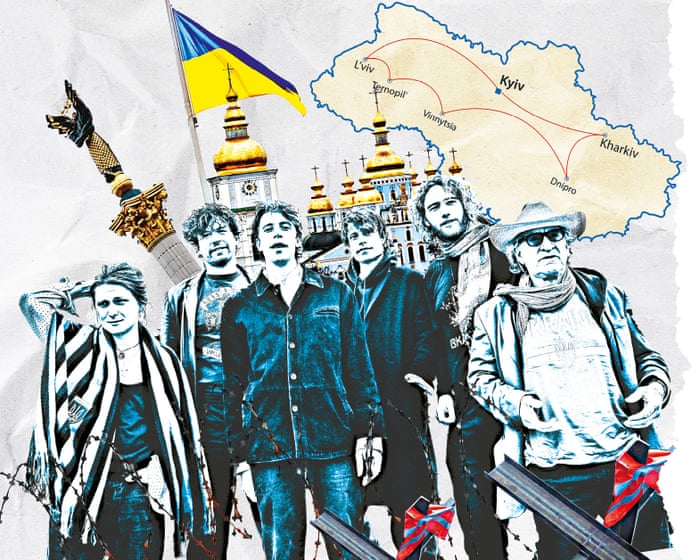
Inside the van is a mixed group: an 81-year-old Irish music industry veteran; a 72-year-old rocker from Texas; an Australian keyboardist; a Ukrainian saxophonist; and three musicians in their twenties from Carlisle, Cumbria. They are headed to a military base to perform for Ukrainian troops.
Dave Robinson, the Irishman, compares the chaotic nature of this tour to when he managed Jimi Hendrix in 1968. Joe “King” Carrasco, the lively Texan, likens it to “playing for the Sandinistas in Nicaragua when they were fighting the Contras.” For the younger, less experienced members of the group, however, it’s a very long way from Carlisle and Melbourne to this bleak, cold no-man’s-land.
“We were more excited than anything,” recalls Jonny Foster, lead singer and guitarist of Hardwicke Circus—now safely back home in Carlisle. Speaking over a video call with Robinson and Carrasco, he describes what it was like to travel these real-life highways to hell. “We just wanted to do our bit to support Ukraine’s war effort and thought the locals might enjoy hearing a live rock ‘n’ roll band.”
Hardwicke Circus toured war-torn Ukraine in June of this year, the only British musicians to have done so. The experience made them determined to return, leading to their late October–early November trip. The band didn’t undertake these tours to make money—all proceeds went to local Ukrainian charities—nor as a publicity stunt. “We once toured British prisons,” says Foster, “for the same reason: we believe music is both entertainment and art, and everyone should have access to it.”
Teenage brothers Jonny and Tom Foster formed Hardwicke Circus in 2015 and have since self-released three albums, plus a live-in-Ukraine LP, One Hour Ahead of the Posse. Their classic rock sound might not be trendy—their sax-accompanied storytelling songs bring to mind Thin Lizzy or mid-1970s Bruce Springsteen—but steady touring has earned them a loyal following. Paul McCartney asked for them to be added to Glastonbury’s 2022 lineup (they closed that year’s festival on the Rabbit Hole stage to a rapturous audience), and Bob Dylan included them in the bill for his 2019 Hyde Park concert.
The Foster brothers were inspired to tour Ukraine after performing in the Czech Republic earlier this year. “We were naive,” admits Jonny, “and thought Ukraine was a short drive over the Czech border—it’s actually 1,000 kilometers across Poland! Back in Carlisle, we contacted Derek Eland, a Cumbrian painter who had done a lot to support Ukraine. He connected us with Okazia, a female rock trio in Ukraine, and we asked them about playing some shows together. They loved the idea, and it became the quickest tour we’ve ever booked!”
Remarkably, the band wasn’t warned against the trip by the UK Foreign Office. “We were waiting for someone to shout, ‘Don’t go!'” says Robinson, “but nobody did. People think we’re as mad as a box of snakes,” he laughs, “and maybe we are.”
Still, they did hit a snag: Hardwicke Circus’s members who aren’t part of the Foster family refused to tour Ukraine. “Four of our band got scared,” says Foster, “and their mums forbade them to go.”
“Which is understandable,” adds Robinson.
“Yeah,” agrees Foster. “Saying, ‘Do you want to come play in a war zone for no money?’ isn’t appealing to most people.”I knew we weren’t going to end the war, but seeing people sing along, the tension draining from their faces, made it worthwhile.
Instead, the brothers reached out to former member Bill Wilde and Australian keyboardist Conor Morrissey—both based in London—who joined the band. Also joining on guitar was Carrasco, a Tex-Mex musician who has dedicated his life to rocking all over the world. “I started playing in bands as a teenager,” he recalls, “and since then I’ve played everywhere—all over Latin America, Botswana, Zimbabwe, India, Cambodia, Morocco.”
The connection to Carrasco came through the band’s manager, Dave Robinson, a music industry veteran best known for co-founding and managing Stiff Records, the London-based indie label that launched artists like Elvis Costello, Ian Dury, Kirsty MacColl, the Pogues, and Madness (whom Robinson signed after they played at his wedding and for whom he later directed groundbreaking videos).
Stiff released Joe “King” Carrasco’s self-titled 1980 album, which didn’t achieve the same success as the label’s other artists. “Joe’s always been a brilliant performer and total rock ‘n’ roller,” says Robinson. “The UK wasn’t ready for him in 1980, but that didn’t faze him.”
Carrasco did experience some success in the US: after signing with MCA, his videos were played on the then-fledgling MTV, and Michael Jackson sang backing vocals on his 1982 album Synapse Gap (Mundo Total). “We were both recording at the same Hollywood studio complex. Michael was a nice guy with incredible mic technique,” Carrasco says. “He had a white Rolls-Royce, and there were all these teen girls hanging around his car. Michael seemed perplexed by it all.”
Carrasco’s brush with fame was short-lived, leading him to continue playing bars and touring in places most acts never visit. Robinson invited him to join his young band for UK dates in 2022. “Great band, in it for all the right reasons,” Carrasco says of Hardwicke Circus.
“When Joe heard we were planning to tour Ukraine, he said, ‘Count me in,'” says Foster. “He’s really committed to singing for the people.”
“And I’m committed to dogs,” adds Carrasco. After learning in June how many abandoned dogs are now in Ukraine, he raised funds to buy large amounts of pet food for animal shelters. “We took pet food to a dog shelter just three kilometers from the frontline,” he says. “There, we could feel the intensity of the struggle—that this conflict is a war between good and evil—with the Russians and North Koreans very nearby.”
The band’s June tour of Ukraine, which included eight dates from Lviv in the west to Kharkiv in the northeast, was, all three agree, life-affirming. “We knew we weren’t going to end the war,” says Robinson, “but seeing people smile and sing along, the tension draining from their faces, that made it worthwhile. Our most popular song was one we’d originally written about Tyson Fury, but for the tour, we changed it to be about Oleksandr Usyk.”
Afternoon acoustic concerts in hospitals and schools added another dimension to the tour. “We wanted to bring some light relief to people who have been through so much,” says Foster. “One afternoon, we played a set at an amputee hospital, and there, lying on a stretcher, was a soldier who had recently had his left leg amputated—blood was seeping through his bandages. He was singing along with us and applauding. That was incredibly moving.”
At another venue, a school workshop, they met an autistic teenage girl traumatized from living under Russian occupation for a long time. “She really responded when we played music. So much so that we invited her to sing with us. Her teacher later said our performance helped her begin coming out of her shell.”
The impact the June tour made on Hardwicke Circus was profound.They were determined to do it again. “We considered waiting until winter was over,” says Robinson, “but thought: No, let’s show our support now. And off we went.”
This time, the tour required a lot of preparation. With support from several Carlisle businesses and general fundraising, they purchased two emergency evacuation vehicles to donate to the Ukrainian military. Leaving Carlisle, it took the band five days to drive the SUVs, along with a band van—”Jonny had bought a complete banger for next to nothing,” notes Robinson—to Lviv, where signs of the approaching eastern winter greeted them. “It was getting really cold, with heavy rains, and the Russians were doing their worst before winter really kicks in,” he says.
An early incident almost ended the tour—and their lives. “I was driving down a steep mountain road on a very wet night,” recalls Robinson, “and the van’s steering lost power. I had to make a snap decision, so I drove onto a forest road. When we got out, we saw we were on the verge of a 200-meter drop. If we’d gone over that, we would’ve joined Buddy Holly in rock ‘n’ roll heaven.”
With the group’s van now unsafe to drive, Adrian Simpson, a British national whose organization, Mission Aid For Ukraine, had provided advice and support, stepped in. “Adrian lent us a reconditioned ambulance,” says Robinson. “As we were heading to Donetsk, he advised us to remove the red crosses because Russian drones target ambulances—it’s fucking immoral what Putin’s doing. So I got out my penknife and scratched them off.”
Hardwicke Circus could have left the SUVs in Lviv to be collected, but instead, they were determined to deliver the vehicles to military bases near the frontline and to sing for the soldiers. “We wanted to show our solidarity with those who were doing the fighting,” says Foster. “When we delivered a vehicle to the 81st Brigade, it was one of those ‘lost for words’ moments. We’d spent months fundraising, and here we were giving the vehicle to those who needed it. They signed our British flag, and we signed their Brigade flag—it was all very emotional.”
Traveling by ambulance proved handy when Robinson soon came down with pneumonia. “I woke up in the hospital not knowing where I was,” he says, “and they kept me there for a week. Worst food I’ve ever eaten—but they fixed me.” After eight days recuperating, he traveled to Kraków in Poland and then home.
Meanwhile, the band’s bassist, Wilde, had such bad flu that he couldn’t feel his limbs and was put on a coach to Poland. Not long after, the band’s Ukrainian saxophonist, Ptashka Khromchenko, needed to be hospitalized for bronchitis. The Foster brothers and keyboardist Morrissey came down with the flu, meaning only Carrasco, a veteran of many tours, remained unscathed.
“The weather was bitter, and we were playing concerts in hospitals, so we picked up viruses,” says Foster. “We soldiered on—when you’re in a nation under attack, you don’t complain about feeling poorly.”
The concerts—held in Ternopil, Cherkasy, Dnipro, Poltava, and Kyiv—often took place in subterranean venues and had to finish before the midnight curfew. The audiences were largely female, as most men are on the frontline.
“Touring meant sirens going off, staying in hotels with bunkers, hearing missiles and drones above us, being woken by explosions,” says Robinson, who, even after being hospitalized, felt emboldened. “It was intense and an incredible time.”
“It was dangerous, yes,” says Foster, “and there is no guidebook, but we have a lot of information we can share if people want to take their art to Ukraine.”
“That’s what people in the West need to do,” sa“Get out there and support Ukrainians. See how they live their lives during wartime.” This sentiment is echoed in the story of Ukrainian musicians who continue to perform as an act of resistance, believing that “for now, music is a weapon.”
“Ukrainians fight hard and don’t take any nonsense,” says Carrasco. “They sleep in their bathtubs to avoid shattered glass and don’t complain. Instead, they get up every morning and keep fighting. It’s the Alamo spirit!”
After 18 days touring Ukraine and witnessing this resilience, it was time for the surviving members of Hardwicke Circus to return home. Foster instructed the rest of the band to follow Robinson and fly out of Kraków, while he stayed behind to collect their now partially repaired van. He packed it with the band’s equipment and drove for five days back to Carlisle.
“I kind of collapsed when I got home,” he says. “Exhaustion—I’d driven a five-and-a-half-thousand-mile round trip! But it was worth it. And we all plan on returning to Ukraine in 2026.”
“More touring without a safety net,” says Robinson. The three veterans of Hardwicke Circus’s Ukraine campaign all laugh in recognition.
Hardwicke Circus continues to fundraise for Ukraine at crowdfunder.co.uk/p/hardwicke-circus.
Frequently Asked Questions
FAQs British Band Touring Ukraine During War
BeginnerLevel Questions
Q1 Who is this British band and what are they doing
A The band is called The 1975 Despite the ongoing war they chose to perform a series of concerts in Ukraine in late 2023 visiting cities like Kyiv
Q2 Why would a band tour in a war zone Isnt that incredibly dangerous
A Yes it is dangerous The bands lead singer Matty Healy stated they wanted to show solidarity with the Ukrainian people They believe music and cultural support are important evenor especiallyduring times of conflict
Q3 What specific dangers did they face
A They faced the constant threat of Russian missile and drone strikes which target cities across Ukraine Air raid sirens would interrupt their schedule and they had to be ready to take shelter The lead singer also performed while battling pneumonia
Q4 What does playing in a war zone isnt for everyone mean
A This phrase used by the band or in reports about them acknowledges the extreme physical and mental challenges It highlights that such a decision requires a high tolerance for risk unpredictability and stress that most artists would not undertake
Advanced Practical Questions
Q5 Beyond solidarity what was the practical impact of their tour
A The tour helped bring international media attention back to Ukraine It also provided a sense of normalcy escapism and moral support for Ukrainian fans demonstrating that the world hasnt forgotten them
Q6 How did they manage logistics like safety insurance and equipment
A This is a major challenge They likely worked with specialized security firms experienced in conflict zones local fixers and had to accept significantly higher risks and costs Standard tour insurance would not cover acts of war
Q7 Was it controversial Did anyone criticize their decision
A Some people questioned whether it was a responsible use of resources or if it risked the safety of the crew and fans for a symbolic gesture Others praised it as a powerful act of defiance and human connection
Q8 What are the ethical considerations for artists performing in active conflicts
A Key questions include Does it inadvertently create a dangerous mass gathering Does it divert local security resources Is the motivation genuine solidarity