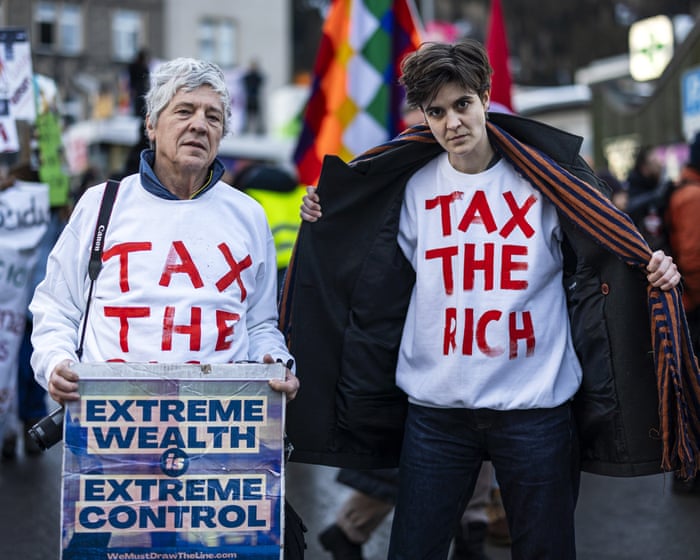
This week, hundreds of government leaders, heads of state, and business executives are gathering at the annual meeting of the World Economic Forum in Davos to discuss solutions to the world’s biggest risks. Yet once again, the greatest threat to humanity and the planet—neoliberal capitalism—is likely to go unaddressed.
All forms of capitalism involve extensive private ownership and a focus on profit. But the neoliberal version, dominant since the late 1970s, goes further: privatizing public assets, shifting power from workers to capital owners, and cutting taxes on the wealthy. This shift has concentrated wealth at the top, undermining democracies worldwide. It’s illogical that elite forums like Davos avoid discussing neoliberal capitalism, since it drives many of the very problems they aim to solve.
Last week, the WEF released its 2026 Global Risks Report ahead of the meeting. Experts identified geopolitical tensions, misinformation, and social polarization as the top short-term risks. Over ten years, extreme weather, biodiversity loss, and Earth system changes ranked highest. Income and wealth inequality came seventh, though the report notes it connects to many other risks. However, the WEF frames inequality mainly as a matter of public perception—people feeling excluded or lacking opportunity—rather than addressing its structural roots.
At its core, inequality is about who gets what share of what we produce together. Neoliberal ideology encourages us to see wealth as the result of individual effort, but this is a myth. Our economy is an interconnected ecosystem: high-profit sectors depend on often undervalued public and care work—like childcare, teaching, and healthcare—without which there would be no productive workforce.
In recent decades, the gap has widened: capital owners grow richer while workers grow poorer. Taxes have shifted from capital to labor, and the wealthiest often pay very little. This is what rightly fuels public anger.
As I argue in my book Limitarianism: The Case Against Extreme Wealth, extreme wealth concentration also causes social, ecological, and political harm. Understanding this requires a systemic analysis of our political economy—something unlikely to happen at Davos. Until we seriously question whether neoliberal capitalism serves our needs and explore alternatives, the world’s key problems cannot be fully understood, let alone solved.
We already know what to expect if extreme wealth concentration continues unchecked.In his book As Gods Among Men, economic historian Guido Alfani notes that throughout history, extreme wealth has been tolerated because the richest individuals have stepped in to aid society during critical times. Today, however, we are largely seeing the opposite. Luke Kemp, who examines 5,000 years of civilizational rise and fall in his book Goliath’s Curse, observes a similar trend toward collapse emerging within global capitalism. According to Kemp, our future faces two possible paths: either global societal collapse or a radical transformation in how we organize our societies. He also identifies economic inequality as a key predictor of societal collapse.
And all of this is unfolding as we stand by, watching—simply because political and economic elites refuse to engage in an honest debate about the kind of economic system we truly need.
If gatherings like the one in Davos won’t even mention capitalism, how can our leaders begin to question it? The Global Risks Report makes no reference to capitalism—let alone socialism, social democracy, or other relevant frameworks. It ignores the extensive academic and public knowledge about the flaws of capitalism and the potential for alternative economic systems.
The elite convening in Davos seem to forget that the economy—including corporations, financial institutions, and other actors—does not exist for its own sake. Economic activity should serve to ensure that all people can lead good, meaningful lives in a just society, within the ecological limits of our planet. Neoliberal capitalism fails to deliver that. So why aren’t we discussing whether a better alternative exists?
The answer is simple: the Davos elite benefit from neoliberal capitalism, and they have propagated a false ideology claiming it is the best system for everyone. They have a strong vested interest in maintaining the system that grants them wealth, status, and power. Under neoliberal capitalism, an ever-growing share of wealth flows to the richest 1%. The rest of the wealthiest 10% are also rewarded for working full-time to protect the fortunes at the top—through what scholars term “the wealth defense industry.”
This is what we need to understand about rising economic inequality. Yet it goes largely unspoken in elite circles. Because if it were acknowledged, those in the economic elite would be forced to look at their own assets and portfolios and ask themselves an uncomfortable question: Am I part of the problem?
Ingrid Robeyns is an economist and philosopher, and holds the chair in ethics of institutions at Utrecht University. Her most recent book is Limitarianism: The Case Against Extreme Wealth.
Frequently Asked Questions
FAQs Wealth Davos and the Greatest Threat
BeginnerLevel Questions
1 What is Davos and who goes there
Davos refers to the World Economic Forums annual meeting in Davos Switzerland Its a gathering of global political leaders top CEOs billionaires and influential thinkers to discuss major world issues
2 What global threats do they typically discuss
They discuss issues like climate change economic instability geopolitical conflicts pandemics and technological disruption
3 What is the greatest threat of all that the question implies
The question suggests that extreme economic inequalitythe vast and growing gap between the ultrawealthy and everyone elseis the greatest threat It argues this inequality fuels social unrest erodes democracy and makes solving other crises much harder
4 Why would they stay silent about inequality if its such a big threat
Critics argue that many attendees benefit directly from the systems that create inequality Discussing it meaningfully would require questioning the very structures of wealth power and tax policies that have enabled their fortunes which could be seen as against their own interests
Intermediate Advanced Questions
5 Isnt inequality already on the Davos agenda Sometimes its mentioned
While terms like inclusive growth are used critics say the discussion often avoids concrete systemic solutions and focuses instead on voluntary corporate philanthropy or stakeholder capitalism which doesnt fundamentally redistribute power or wealth
6 Whats the difference between discussing a threat and taking real action
Discussing climate change for example can lead to investments in green tech that also create new markets and profits Addressing inequality however might require policies that directly reduce the wealth and influence of the attendees such as higher taxes on wealth inheritance or capital gainsactions they often lobby against
7 Can the systems that created massive wealth also solve the problems it causes
This is the core debate Proponents of Davos believe change can come from within the system through partnership and innovation Skeptics believe the concentration of wealth itself corrupts political systems and prevents the bold regulatory changes needed making the forum ineffective for this specific issue