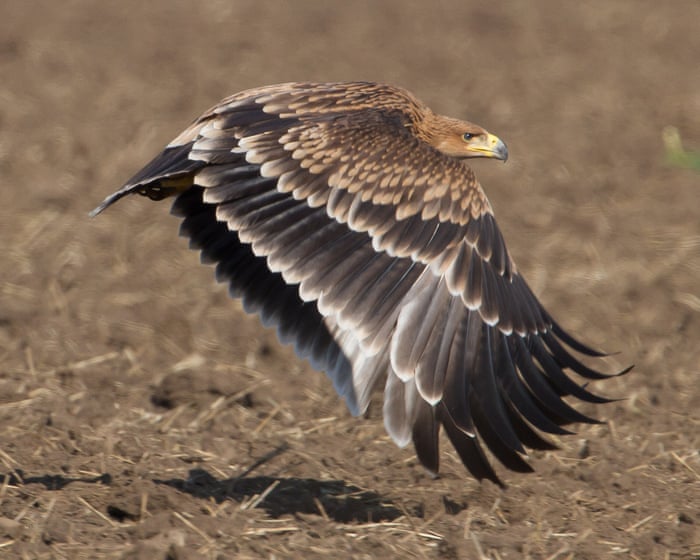
Every spring, before the trees in northern Serbia leaf out, ornithologists drive across the plains of Vojvodina. They check old nesting sites of eastern imperial eagles, scan solitary trees along field edges, and look for signs of new nests.
For years, the work of the Bird Protection and Study Society of Serbia (BPSSS) has grown more demanding—and more rewarding. In 2017, Serbia was down to just one breeding pair. Last year, BPSSS recorded 19 breeding pairs, 10 of which successfully raised young.
Driving through Vojvodina, vast fields stretch to the horizon, crisscrossed by straight farm tracks. As agriculture intensified, oaks and poplars were cut down to straighten fields and maximize yields. This made Vojvodina one of Europe’s least forested regions. In some areas, tree cover falls below 1%. “You can drive here for an hour and a half and not see a single tree taller than five meters,” says Milan Ružić, executive director of BPSSS. “Even if an eagle wants to return, the question is: to which tree?”
The lack of trees is one reason the imperial eagle, once widespread, struggled for decades—but it’s not the only one. Its decline began with persecution. “The region has a history of unrest and war,” Ružić says. “Every household had a rifle. People shot birds of prey for fun or to protect livestock. Raptors were the enemy.”
After the Second World War, the Yugoslav state ran widespread poisoning campaigns targeting large carnivores like wolves and bears, distributing toxic bait to farmers and shepherds. Birds of prey paid the price. “If you poison a sheep carcass in the open, eagles and vultures will be the first to find it,” says Ružić. “If an eagle is shot, others learn. With poison, there is no warning.”
With agricultural intensification, the species (Aquila heliaca) also lost its food source. In Vojvodina, they mainly eat ground squirrels, or sousliks, which thrive in grazed pastures with short grass. When cattle moved into stables and grazing disappeared, so did the sousliks. “The eagles lost their nesting trees, food, and safety all at once,” says Ružić.
By the late 1980s, only two small imperial eagle populations remained in Serbia: one in the Deliblato Sands, a steppe east of Belgrade, and another in the hills of Fruška Gora, near Novi Sad. Deliblato’s eagles were lost in the 1990s. Fruška Gora held on to its birds until 2015.
Ružić has a theory—unproven, he stresses—about what finished them off. After Russia’s annexation of Crimea in 2014, EU sanctions ended fruit exports to Russia. Serbia filled part of the gap. “Fruit production exploded in Fruška Gora. Pastures were turned into orchards and hundreds of new power lines appeared,” says Ružić. “For a fragile eagle population, such change can be fatal.”
While Serbia was losing its birds, a different story was unfolding across the border. Hungary has been protecting imperial eagles for decades. From 20 pairs in the 1980s, the population now numbers 550. As Hungarian territories became saturated, young eagles began dispersing south, first arriving in Serbia in 2011. “Hungary became a source population for the region,” says Ružić. Around the time the species disappeared from Fruška Gora, a new pair showed up in northern Serbia.
Spurred by the EU-funded PannonEagle Life project, BPSSS decidedSerbia was determined not to let its last breeding pair of imperial eagles fail. Volunteers guarded the nest throughout the breeding season, camping at a safe distance to keep farmers, shepherds, and the curious from disturbing it. When a storm damaged the nest just before the chicks were ready to fly, conservationists temporarily removed the young to rebuild the structure. The parents returned, and the chicks survived.
Today, the Bird Protection and Study Society of Serbia (BPSSS) monitors territories, rehabilitates injured eagles, and works with local communities. “In village cafes, we would point out that there were fewer imperial eagles left in the entire country than people drinking beer in the room,” says Ružić. “People suddenly cared.”
Since the imperial eagle is widely believed to be depicted on Serbia’s national coat of arms, that message carried extra weight. “When you tell people there is an eagle nesting nearby, it becomes a brand: ‘our village has the eagle.’ Immediately, people are less likely to shoot or poison them.”
The results are visible. Each year, the search for nests covers more ground. New territories are appearing, with the population expanding southwards along river corridors at an estimated rate of 15–20 km per year.
But recovery remains fragile. Trees are still scarce, and imperial eagles are slow to adapt to artificial nesting platforms. “They don’t trust them,” Ružić says. “White-tailed eagles will nest on anything—you could put a fridge in a tree and they would use it. Imperial eagles are different. They need time.”
Although Serbia is part of the BalkanDetox Life project, an EU initiative aimed at eradicating wildlife poisoning, the practice persists. Despite bans and awareness campaigns, poison and toxic pesticides are still widely available, and the habit is deeply embedded across the Balkans. “It’s a mentality problem,” says Ružić. “It often starts with a neighbour’s barking dog or a fox taking chickens. Poisoning a piece of meat is a cheap, easy solution.” Since 2000, BPSSS has recorded about 300 poisoning incidents.
Power lines and wind farms pose another danger. Conservationists increasingly find themselves at odds with investors, businesses, and farmers. Ružić has been told he should be “hung from a pylon.” Serbia’s pro-Russia stance has further complicated research. Importing satellite tags now requires significant paperwork. “We had to sign documents proving we’re using them to track birds, not to wage a bloody war.”
For now, the eagles are holding their ground. Many of the birds in Serbia are still young, and it can take five years before a newly established pair begins breeding. “They’re still learning,” Ružić says. But if a pair survives long enough, productivity increases with age. Time is on their side.
“The trend has turned,” Ružić says. “Unless something dramatic happens, they will keep coming back.”
Frequently Asked Questions
Of course Here is a list of FAQs about the remarkable comeback of Serbias imperial eagles designed to answer questions from basic to more detailed
Basic Understanding
Q What is an imperial eagle
A Its a very large powerful bird of prey with dark feathers and distinctive white shoulders Its one of Europes most endangered eagles
Q Why were they in danger in Serbia
A They faced three major threats habitat loss a shortage of their main food and illegal shooting or poisoning
Q What does making a comeback mean
A It means their population numbers which were critically low are now steadily increasing More breeding pairs are successfully raising chicks each year
Causes and Conservation
Q How is this comeback even happening
A Thanks to dedicated longterm conservation projects Key actions include guarding nest sites from disturbance restoring habitats working with farmers and raising public awareness
Q What do farmers have to do with it
A Everything Conservationists work with farmers to protect nests on their land and promote wildlifefriendly practices The eagles help farmers by controlling rodent pests
Q Are they still being hunted
A Illegal killing remains a serious threat but it has decreased due to stricter enforcement and education The hunted for sport mention refers to past and ongoing incidental threats
Challenges and Details
Q If trees are cut down where do they nest
A They nest in tall mature trees Conservationists now protect specific nesting zones and even install artificial nesting platforms in safe areas to compensate for lost trees
Q Whats being done about their food shortage
A Projects focus on preserving the open grasslands where their prey live A healthy ecosystem for prey means food for eagles
Q Is this just happening in Serbia
A Serbias success is part of a larger regional effort in the Balkans However Serbia has become a conservation hotspot with its population growth positively impacting eagles in neighboring countries
Getting Involved The Big Picture
Q Can I see these eagles in Serbia
A Yes but responsibly They are in specific regions like V