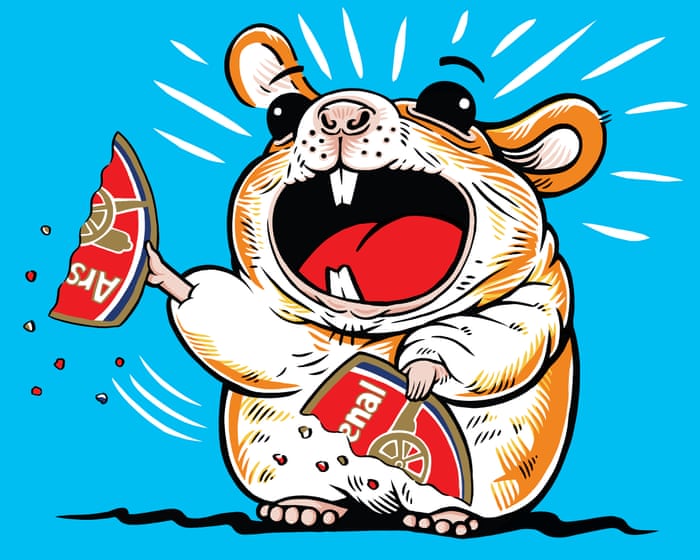
A few years back, there was a minor stir when some American scientists bred a strain of “gene-edited” hamsters with the chemical that causes anger removed. The idea was to achieve one of humanity’s historic goals: the dream of a more docile hamster.
Unfortunately, the opposite happened. What the scientists created was a race of hyper-angry hamsters. The media somewhat glibly called them Mutant Rage Monsters. But science is always more nuanced than that. We shouldn’t put angry hamsters in a box, even when we are literally putting angry hamsters in a box. Longer studies showed more varied results. Sarcastic hamsters. Hamsters that hold grudges. Hamsters that go silent on long car journeys. Even a subset of passive-aggressive hamsters who are, seriously, just fine with this. It’s pretty much what they expected from you, anyway.
Ultimately, the scientists concluded that anger is a highly complex response, that understanding it requires a broader study, and that maybe they should stop messing around with rage-hamsters and take that job putting lipstick on moles. But they are clearly right about rage. It is a strange, many-headed thing, with hard-to-pinpoint sources. And at this point, Arsenal have already entered the room, there at the edge of your vision, the most reliable source of rage in English football right now.
Why do people hate Arsenal so much? It’s a question worth asking. The league title could be decided on Tuesday. Why will the journey to this point be defined by dismay and resentment? Why, when it comes to Arsenal, do we all turn into rage-hamsters clawing at the bars?
The obvious starting point is: do people actually hate Arsenal? The answer is yes, they do. A recent social-media study concluded that Arsenal’s fans are the most disliked in the Premier League. Even Mikel Arteta drives people into a state of rage, from his unremarkable control-based tactics, to his invariably bland public statements, to his frenetic touchline appearances in a black zippy coat and sober grey slacks, like a traveling hitman on a fishing trip.
Last week, a post-match ESPN panel went viral on social media after the host suggested that other Champions League coaches might want to literally punch Arteta in the face, while his panelists nodded along, as though this is an entirely reasonable conclusion deserving of a deep dive around the lighted tactics table.
Among rival fans, the idea has long been fixed that Arsenal are the bad guys. Neutrals should want Manchester City to win the title and Paris Saint-Germain the Champions League final, because this would be purer, lovelier, better for football. It is certainly an interesting point of view, one that fully embraces the performative aspects of sport, the way beauty, aesthetics, and the halo effect overwhelm everything else. PSG may be a propaganda project, the destroyer of leagues, dependent on $2 billion in loose change and the will to power of a dictator state. But yeah, Désiré Doué is very cool. So good.
Arsenal have simply adapted better than others to the current permissiveness on certain kinds of contact at set pieces.
In reality, Arsenal is an objectively good elite-football entity. If we must have hyper-rich clubs, this is the model of how to do it. Generate your own revenue. Don’t bend the financial rules. Don’t run debts funded by shady interests. And yes, the ground is literally called the Emirates. Also, no thanks, I don’t want to go to Rwanda. But within the limits of a grubby and compromised world, this is perhaps as close as we’re going to get to a functional mega-club.
Arsenal are also a counterpoint to the other great threat to football: the Chelsea soccertainment model, with its destruction of sporting culture and its deeply stupid talent clearing-house methods. This is aAt the very least, it’s a pure football project: develop your own players, field five Englishmen in a Champions League semi-final, and give a young manager five years to build a team. Yet Arsenal is more often held up as a symbol of everything wrong with the game. It’s worth trying to understand why. The simplest explanation is that this is a reasonable reaction to how they play—boring and fussy to watch, built around team defense and set-piece margins.
There’s a legitimate feeling that football, and life in general, is becoming over-planned, broken into data-driven phases, like a Vorticist view of nature where organic shapes are turned into units of human control. Arsenal is the ultimate example of this. But there’s also something oddly traditional about grinding out wins, about saying, “This is the level of defense you’ll need to beat.” It should be tough. If PSG ends up tearing apart Europe’s best defense with their speed and targeted dribbling, it will be hard-earned and made more meaningful by the strength of their opponents.
Plus, Arsenal isn’t cheating by playing this way. They’ve simply adapted better than others to the current leniency on certain types of contact during set pieces, much like Herbert Chapman’s Arsenal team responded to the 1925 offside law change. The rules will change again, and everyone will have to adapt. For now, this is just good coaching—finding a way to top the league with a very basic center-forward and a very good defense.
But then, Arteta is also a problem. Why do people get so angry at him? Most obviously, it’s because of how he jumps around on the TV feed, too close to the pitch, getting in the way of throw-ins, forcing himself into the spectacle. But again, he’s mostly yelling at his own players. He’s not berating officials or doing the Diego Simeone thing of controlling the show. He’s just an intense man desperately trying to find an edge for his team. And let’s not forget, he’s competing against people accused of breaking rules to get crucial points. Is that really the behavior of a mega-villain?
The other thing about Arteta: he isn’t cool. There’s a deep awkwardness in his attempts to manage the vibe, to control and market the idea of being a relaxed, fun group that’s really up for it. Arteta has talked about being “on fire” and “getting on the fun boat,” which still brings to mind a terrible booze cruise with a bunch of corporate surveyors. He forced a dog to support Arsenal. He’s somehow managed to make Pep Guardiola look relaxed and neutral, strolling around in his country-green slacks like a dad at a sports day. But is that grounds for rage?
A bit desperately, you look for deeper reasons. Does hating Arsenal have something to do with London, because people also hate London? Is this a Brexit thing? Arsenal is the most urbane, EU-ish, London-centered club. Do people hate them because of economic entitlement, because they’re middle-class-adjacent and a bit smug, because they seem both tortured and triumphant? But if so, why do other London fans also hate them, even though everyone hates the other big London clubs for similarly grandiose, messy, money-dripping reasons?
Or maybe it’s not really rage at all, but boredom with the spectacle, irritation at the capering man and the touchier parts of the online fandom. Either way, the next few days promise an outcome. If Arsenal can’t beat a relegated Burnley and a Crystal Palace team playing in wayfarers and tie-dyed trousers, they don’t really deserve to win the league anyway. But there’s still the chance the season is building to the promised mega-choke, hamster backflips, hamster joy, an all-you-can-eat schadenfreude buffet.
In the end, it’s hard to avoid the simplest conclusion: people just like hating things now. The content space must be filled. Our hive-mindDigital networks and the voices we hear through them are designed to find, reward, and amplify anger. A recent study of ocean life found that even whales now have to shout underwater because human activity has made the ocean so noisy. That’s us. We’re like hamsters on a wheel. We’re like whales shouting in rage. All we need is a gathering point, a target, somewhere to direct that energy.
Frequently Asked Questions
Here is a list of FAQs based on the article Do people actually hate Arsenal Yes they do The real question is why by Barney Ronay
1 Who is Barney Ronay
Hes a sports journalist for The Guardian known for his sharp witty and often provocative writing about football
2 Does the article say that everyone hates Arsenal
No It argues that a significant number of football fans do dislike Arsenal but its not universal The article focuses on explaining why that dislike exists
3 What is the main reason people hate Arsenal according to the article
The core reason is a perceived sense of entitlement and selfimportance The article suggests Arsenal fans often believe their club is more pure stylish or historically significant than others which irritates rival supporters
4 Is it just about Arsenal fans being arrogant
Partly but the article digs deeper It connects the hatred to the clubs identity under Arsne Wenger the invincibles era the beautiful football and the clubs move to the Emirates Stadium which some saw as a break from its workingclass roots
5 Does the article mention specific incidents that fuel the hatred
Yes It references the famous Battle of Old Trafford the 2003 Battle of Old Trafford and the constant comparisons between Arsenals purist football and the more pragmatic styles of rivals like Chelsea or Manchester United
6 Is the hate really about the football or something else
The article argues its a mix On the surface its about the style of play But underneath its about class identity and the clubs selfimage as a philosophical alternative to other big clubs
7 Does the article offer any practical advice for Arsenal fans
Not directly Its more of a cultural analysis But the implied tip is understand that the hatred is often rooted in a reaction to Arsenals own selfnarrative not just the teams results
8 Is this a new phenomenon or has Arsenal always been hated
The article suggests the modern form of hatred is tied to the