One reassuring thing about France is how consistent it has been over the years: trains still mostly run on time, coffee in the land of cafés remains undrinkable, and no matter the season, the intellectual class keeps offering elegant variations on the same theme—France is always on the verge of collapse.
The current mood feels familiar, and fatalism, of course, is a habit in France. At a recent dinner with friends in Paris, I was treated to a typically balanced menu: great food and good company, paired with apocalyptic predictions. After nine years of Emmanuel Macron’s right-leaning rule, France is at the edge of the abyss, one guy said as he cut the head off an asparagus. The country is somewhere between civil war and financial bankruptcy, another added, cooling her forehead with a glass of cold white wine.
Under the grey Paris sky, blending into the city’s zinc rooftops, there was little agreement on much. Yet one year before the 2027 presidential election, French people seem to have reached the same conclusion: the far-right National Rally (RN) will take the Élysée Palace for the first time.
“France has a talent for depression,” author Michel Houellebecq once said, before adding, with his usual ambiguity, “I resemble France.” That might also be an admission of how spectacularly wrong Houellebecq has often been about French politics. He gave Macron no chance of beating Marine Le Pen in 2017. In his novel Submission, he dared to imagine a fundamentalist Islamist party winning the 2022 presidential election—in a country where Islamophobia is normal and the cocktail hour is sacred.
So, the question comes back. Is the anxiety over next year’s presidential vote just another passing moment in the history of a country prone to hysteria and pessimism?
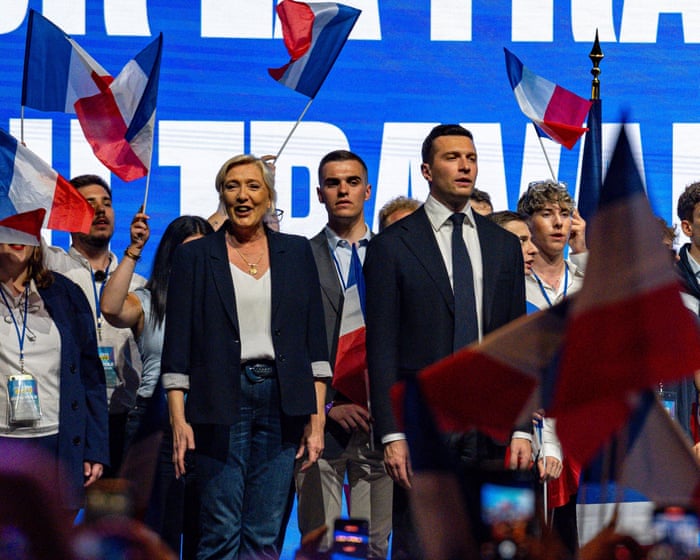
To be sure, the far right has never been closer to power. According to recent polls, the RN candidate—whether Marine Le Pen or Jordan Bardella—would win every plausible runoff, except against Macron’s former prime minister, Édouard Philippe.
But with Philippe now under investigation for corruption allegations, and what feels like half the French political class testing the waters for a presidential run, it’s far from certain he’ll emerge as the centre-right candidate, let alone make it to the second round. France’s electorate has shifted so far to the right over the past decade that a divided left faces an uphill battle.
So, as in the last two presidential elections, the key question could be whether left-wing voters can swallow their pride and vote for the centre-right candidate in the runoff. As mayor of Le Havre, a historically working-class port city, Philippe still has some credibility with left-wing voters. But even before prosecutors announced their investigation on Tuesday, many were simply tired of always having to choose the lesser evil and keep the centre-right in power.
Parts of the non-far-right electorate also seem almost to want the RN catastrophe to happen. Out of nihilism. Out of a craving for spectacle.
More often, though, it’s just resignation. French people sometimes resemble someone who keeps hearing on the news that there’s a burglar in the neighbourhood. Exhausted by fear, they eventually leave the jewellery box on the doorstep. Perhaps, by next year, France will choose to let the RN take power, rather than deal with the anxiety any longer.
Yet two lessons from history are worth remembering.
First, French presidential elections rarely turn out the way pundits and political elites predict a year in advance. Examples are everywhere. No one had François Hollande on their bingo card for victory in 2012, yet he emerged after Dominique Strauss-Kahn had to drop out following his arrest on rape charges (which were later dropped). In 2017, few expected that Macron, then a young former banker turned politician with aFew people know his name, but he could still win. So no, the outcome isn’t decided yet. The presidential race is still wide open.
The second lesson is more unusual. As far as I know, France is the only country with what I’d call a reverse “shy far-right voter” effect. Polls regularly overestimate support for the National Rally (RN) in presidential runoffs. In 2022, the average of all polls taken within a year of the first round gave Marine Le Pen 44.2%; she actually got 41.45%. In 2017, a similar average put her at 37.78%; she ended up with 33.9%.
Usually, voters are reluctant to admit they support the far right. In France, it’s different. At a bar or in the locker room, people might say they’ll abstain or vote RN to send a message to Paris. But in the voting booth, many still choose whoever represents the status quo – much like they keep drinking the bad coffee everyone loves to complain about. In a country as blasé as France, apathy is also a kind of performance.
And while surveys show deep worry about the future, most French people are surprisingly happy with their current lives. In 2026, 75% of respondents in the Ipsos Happiness Index said they were happy. That was even 4% higher than in 2024. With about 60% of French people owning their homes, the country’s citizens remain largely asset-holding and cautious.
Yes, France still has a taste for bold political adventures. The revolutionary spirit is very much alive, as each cycle of protests reminds us. Yet in the history of the Fifth Republic, France has only elected a president with a truly radical platform once: the socialist François Mitterrand in 1981.
Today, the only radical force with a real chance at power is the RN – which is pushing for a revolution of a very different, troubling kind. But as the 2027 presidential campaign picks up after the summer, it’s worth remembering the poet Paul Claudel’s warning to his fellow citizens: “The worst is not always certain.”
If France has a fatalistic and gloomy side, it’s precisely because it also has a deep tradition of willpower and idealism – one that gave birth to the nation of liberté, égalité, fraternité. That tension is what keeps the country politically alive and far from apathetic. And that’s why there are reasons for optimism.
Joseph de Weck is a fellow with the Foreign Policy Research Institute.
This article was corrected on 20 May 2026. An earlier version stated that Édouard Philippe was mayor of Rouen. In fact, he is the mayor of Le Havre.
Frequently Asked Questions
Here is a list of FAQs based on the topic The outcome isnt set in stone France is feeling pessimistic but its not destined to fall under farright control
BeginnerLevel Questions
Q Is France definitely going to be taken over by the farright
A No While there is a lot of pessimism and the farright is gaining support the final outcome of elections and political decisions is not guaranteed It is still possible for other parties to prevent this
Q Why do people feel so pessimistic about Frances future
A Many people are worried because the farright party is polling very high and has won a lot of recent votes There is also frustration with the current government making people feel like a big change is coming
Q What does the outcome isnt set in stone mean in simple terms
A It means the final result is not decided yet Just because things look bad right now doesnt mean the worst will happen Elections and politics can change quickly
Q Who is the farright in France
A The main farright party is called the National Rally led by Marine Le Pen and Jordan Bardella They focus on strong antiimmigration policies and putting France first
IntermediateLevel Questions
Q What would have to happen for the farright to actually take control of the government
A They would need to win an absolute majority of seats in the National Assembly Even if they win the most votes they might fall short of a majority which would block them from forming a government alone
Q How can the farright be stopped if they are so popular
A Other political parties can join together and form a Republican Front This means they agree to not split the vote and instead back the strongest nonfarright candidate in each district to block the farright from winning
Q What does cohabitation mean in this context
A Cohabitation is when the President is from one party but the Prime Minister and government are from a different opposing party It would create a tense divided government