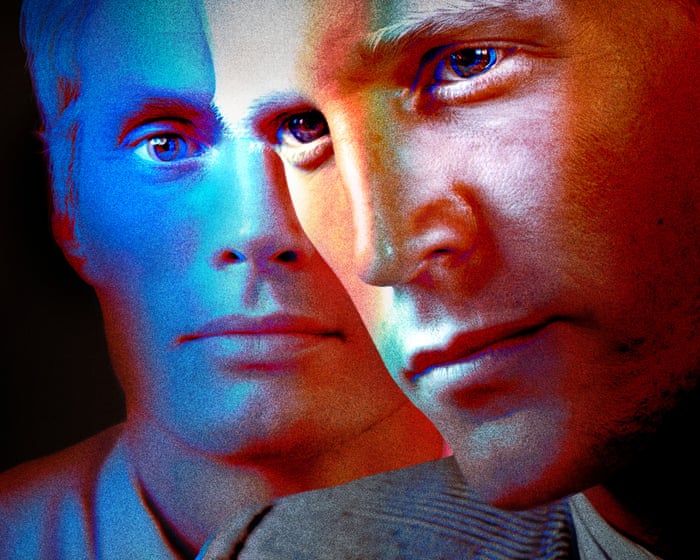
Documentary filmmaker Chris Smith made the influential 1999 film American Movie, which follows an indie director’s struggle to finish a horror movie, hoping it will fund his dream project. More recently, Smith has profiled well-known figures in Netflix projects about Jim Carrey and Andy Kaufman, the bands Devo and Wham!, and the disastrous Fyre Festival, among others. His new HBO miniseries, Bring Me the Beauties, also ties into popular culture, but through a story with much less readily available background: the rise and fall of Eternal Values, a cult started in the 1980s by the eccentric Frederick von Mierers, made up mostly of models.
“What was odd about this story,” Smith said, “is that there was very little about it online.” He met Hoyt Richards—sometimes called the first male supermodel and a former Eternal Values member—while working on another project. “As we started talking, hours went by,” Smith said. “It was one of those situations where I just became more and more curious about his life.” Richards became the backbone of the series, sitting for many hours of interviews, but he wasn’t sure if Smith and his team could get anyone else to participate. As the series shows, not everyone’s account of their experience with Von Mierers is the same, and some aren’t even convinced they were in a cult at all.
“Hoyt told us that one of the challenges is that you won’t find anyone else who will talk to you about it,” Smith said. “But we always like a challenge, and we’re also really patient. So it took years to make progress and build relationships to get people to speak to us on camera.” What he found, Smith continued, “is that they were all incredibly thoughtful, insightful, and articulate people who talked about their experience in a way I found interesting and thought-provoking.”
Some details about Eternal Values feel very 1980s new-age, when the group started, while other aspects are more openly menacing—especially the stories Richards tells about the organization and its attempts to control his life after Von Mierers died in the 1990s. Toward the end of the series, the filmmakers draw parallels to several active organizations, whether religious or political. (Yes, there’s a brief reference to Scientology.) But followers of modern culture might also think of more recent, less formal, and more influencer-driven trends related to wellness or “looksmaxxing”—a kind of do-it-yourself digital-age version of the supermodel obsession. “When we were doing the initial research, it was shocking to us how ahead of the curve Frederick was in terms of what he was promoting for the group—keeping yourself at peak performance,” Smith noted. “He was incredibly handsome, very fit, and always seemed to have this radiant glow. It would be interesting to see him in the age of social media. I think he would have done incredibly well in an online environment.”
At the same time, Bring Me the Beauties becomes especially captivating because so much of its archival footage has a different kind of radiant glow—a retro, lower-resolution transmission from another era. This includes material from a show Von Mierers hosted himself. “I’m not personally aware of many cults that had a public access show,” Smith said with a laugh. “I felt like a character of the story was New York in the 80s and 90s. We chose all of our archival footage from that period to evoke a feeling that was emblematic of the time they were living in.” Embracing the textures of old, less well-preserved video was key. Smith mentioned his work on the Wham! documentary, where he found that the band’s music videos had beenWhen it was transferred to film, the look changed. “Suddenly, those videos we grew up watching—which had this really soft, beautiful quality—became harsh, like The French Connection. So we took the upgraded masters and made them look worn again, like the original videos. I wanted it to feel like you were being taken back to that time.”
Bring Me the Beauties pulls that off, especially because it covers a story that hasn’t been told as often as other 80s and 90s pop culture relics. It shows there’s still plenty to uncover when we dig into recent popular culture and its strange side. “Back before the internet,” Smith said, “we searched for information any way we could. I remember hunting down weird old VHS tapes of Andy Kaufman or Devo. If you were interested in something outside the mainstream, there were paths you could follow, and they could lead you to something like this.”
With so much material—both new interviews and old footage dug up from archives—Smith and his team had a lot to shape in the editing room. This is especially true now, when documentary footage can be cut into different formats, like episodes or a feature film. “This is one of the most sprawling stories I’ve ever worked on,” Smith said. “There was so much to cover. At one point, we realized we had enough for four episodes, but we could tell the story better in three. Episode one is about the group’s hope and promise, episode two is the downfall, and episode three is the aftermath. Once we figured that out, everything clicked.”
View image in fullscreen
Frederick von Mierers. Photograph: HBO
Still, the series doesn’t completely condemn Eternal Values. It doesn’t just expose wrongdoing or hypocrisy. Instead, it offers a multi-sided look at how one person’s self-help journey can be another person’s cult. “For me, it was a genuine effort to understand every perspective. Life is rarely black and white,” Smith said. He added: “Hoyt has a very specific view of his time with the group, and I really wanted to understand how others saw their experiences with Eternal Values. Everyone we talked to had a slightly different take. You can look at a story like this from one angle, but from another person’s view, they felt what they learned and experienced was positive. Those stories are always more interesting than painting everything with one broad brush.”
This fits into Smith’s larger career, where his work is driven by what and who fascinates him, and how those subjects connect to others. “For me personally,” he said, “movies shaped who I became. So I always see movies as a mirror for people’s own lives. By seeing the different paths people took within this organization, you might relate to different parts of the story. If you think you’re just an outsider judging it, you might have cult-like relationships in your own life without even realizing it. We’re all vulnerable to these things, to different degrees.”
Bring Me the Beauties premieres on HBO in the US on June 1 and on Max in the UK and Australia on June 2.
Frequently Asked Questions
Here is a list of FAQs about the topic We can all be vulnerable how did a group of models end up getting drawn into a cult
BeginnerLevel Questions
1 What is this models in a cult story about
Its about a real case where a group of fashion models were recruited into a secretive controlling group The group used their desire for success belonging and selfimprovement to manipulate them
2 How could smart successful models be tricked into a cult
Cults target people at vulnerable moments Models often face loneliness pressure to look perfect and a search for meaning The cult offered them a family exclusive opportunities and a sense of purpose which made them lower their guard
3 What kind of cult are we talking about
The most wellknown example is NXIVM It was a selfhelp group that turned into a sextrafficking and forcedlabor cult Many of its top members were actresses and models
4 Did the models know it was a cult at first
No It started as a fancy personal development or mentorship program They were told it would help them build confidence and network The control came slowly step by step
5 Why are models specifically targeted
Models are often young far from home and used to being told what to do They also have high public visibility which the cult could use for credibility Plus theyre used to being judged on their looks making them crave deeper validation
Advanced Questions
6 What specific psychological techniques did the cult use to recruit models
They used love bombing baitandswitch and peer pressure They also isolated members from family and created a us vs them mentality
7 How did the cult keep the models from leaving
They used shame blackmail and financial control Members were told their weakness or ego was the problem not the group They