If management has taught Graham Potter anything, it’s that there’s no point in trying to run from failure. “You’ve got to face the bad stuff,” says the 51-year-old, reflecting on how he bounced back from tough times at Chelsea and West Ham. “The more you face it, the better your life can be. Then you get those beautiful moments.”
Potter is thoughtful and sometimes sharp during a long talk about a wild few years and the harsh reality of being a football manager. He notes there have been successes too—after all, he lifted Sweden out of a slump and led them to the World Cup—but he knows people tend to focus on the low points. Potter lasted just seven months at Chelsea after leaving the stability of Brighton in September 2022. Then, after a long break, he was tempted back when West Ham came calling at the start of last year.
‘A real health risk’: Fifa ban on reusable water bottles sparks anger among fans
Read more
It was the wrong move for Potter, who got lost in West Ham’s chaos. He won only six of his 25 games, had a terrible start to his first full season, and found himself at a crossroads after losing his job last September. What next? A career that once held so much promise was in danger of fading away.
“I’ve had enough life experience to put all this into perspective,” he says. “I’m grateful for everything I’ve been through, the good and the bad. In the end, you have to deal with what life throws at you. After West Ham, I had two choices. I could sit around and do media work. Or I could go and work.”
The offer from Sweden came along. They were in big trouble in their World Cup qualifying group and needed to replace Dane Jon Dahl Tomasson. But first, Potter had to take a hard look at himself. He talked to people close to him and figured out how to leave West Ham behind.
“You have to deal with the failure,” Potter says. “But I think it makes you a better person. And sometimes in football, you just can’t explain it. You just think, ‘Maybe it wasn’t meant to be.’ Then you try to move on.
“The lessons you learn from these experiences are painful. I won’t share them with you because they hurt to learn. I think that’s how it should be, because that’s how you improve.”
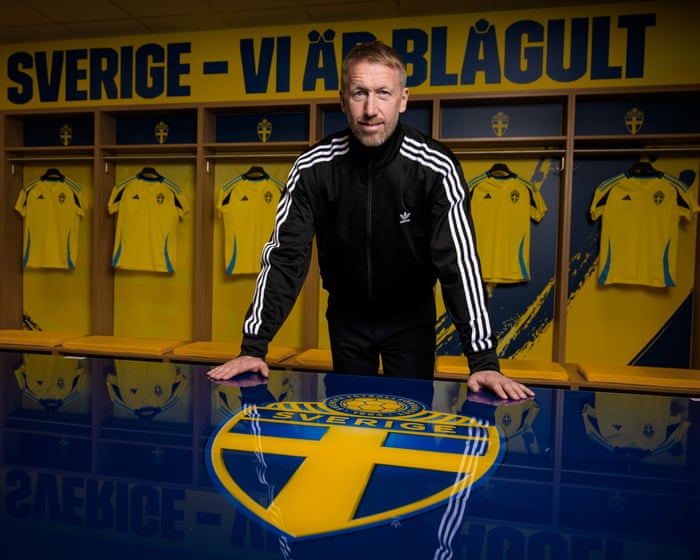
View image in fullscreen
Graham Potter says it felt like an ‘out-of-body experience’ when Sweden scored the goal that sent them to the World Cup. Photograph: The Team
Potter blocks out the outside noise. “If I worry about what people think of me, that’s a miserable life,” he says. Still, he understood what was at stake when he agreed to become Sweden’s manager on a short-term deal in October. He couldn’t get them out of their qualifying group, but they got a second chance thanks to their Nations League results, which earned them a spot in the playoffs. Failing again would have hurt his reputation even more.
Everything changed when Sweden got to work in March. They were calm and composed during the playoffs. Viktor Gyökeres scored a hat-trick in the 3-1 semi-final win against Ukraine and an 88th-minute winner in the 3-2 victory over Poland in the final in Stockholm.
“You go on YouTube and listen to the Swedish commentary of the game; I watched it a couple of months later, and it’s the emotion in the voice,” Potter says. “Viktor scores, and it’s like an out-of-body experience. All our subs just run onto the pitch. There are 15 players on the field, and I’m thinking, ‘That’s yellow cards, that’s trouble.’ But it’s a World Cup, so all the rules go out the window.”
Potter has extended his contract until 2030. The Englishman has built a strong connection with his adopted country. He wasn’t an outsider when he took the Sweden job, having made a name for himself during a seven-year spell with ÖÖstersund, lifting them from the fourth tier all the way into the Europa League.
“I feel very Swedish when I’m working,” he says. “I look a bit Swedish. Two of my kids were born in Sweden.” Potter believes international football carries a deeper meaning. “With the national team, you’re aware you’re doing something bigger than yourself. It’s a larger purpose. You can feel the intensity. That’s what makes it beautiful.”
Graham Potter said Viktor Gyökeres (pictured) has had an incredible impact on Sweden’s run to the World Cup. Photograph: TT News Agency/Reuters
One challenge has been adjusting to international management, especially for a coach known for building things methodically. “You don’t have the time to develop ideas,” Potter says. “The mistake you could make is forming all these ideas from the November camp ahead of the March camp, creating tactical plans to beat Ukraine, when in reality you only have two days to prepare for a game. You don’t want to make it too complicated.”
After the playoffs, there were tough conversations with players who didn’t make Potter’s World Cup squad. Keeping harmony in the camp will be crucial. “Even if you play 11 vs 11 in a training game, four players are left out,” Potter says. “That’s not easy. You want the group to be on the same page.”
Sweden are holding a training camp in Stockholm before flying to their base in Texas. Potter knows he has a lot to live up to, given that Sweden finished third at the 1994 World Cup in the USA. But with Japan, the Netherlands, and Tunisia in Group F, reaching the knockout stages won’t be easy.
There’s a lot to consider before Sweden open against Tunisia in Monterrey on June 14. Managing the heat will be vital. Potter expects slower games and knows set pieces will be important.
“You can see how the game has evolved,” he says of dead-ball situations. “In tournament football, you know the pressure is on, so it’s harder to play expansively. Games become tight. Set pieces are a way to create chances, so I think teams will focus on them a lot.”
Sweden have other threats. They are without the injured Dejan Kulusevski, but a front two of Alexander Isak and Gyökeres could cause problems. Gyökeres faced criticism during his first season at Arsenal, but Potter sees the positives. “It’s a great example of the modern world,” he says. “From our perspective, he got us to the World Cup, so his impact has been incredible. From Arsenal’s perspective, he’s played his role in the team, scored his goals, and the team won the Premier League and reached the Champions League final. Look at how much work he does. He’s had a brilliant season.”
Graham Potter has backed Alexander Isak (left) after a difficult first season at Liverpool. Photograph: Joel Marklund/Bildbyrån/Shutterstock
It has been harder for Isak since leaving Newcastle for Liverpool last summer. He had a disrupted pre-season and has struggled with form and fitness since returning from a broken leg.
“It hasn’t gone as well as he would have liked,” Potter says of Isak’s first season at Anfield. “We sometimes assume that signing a player will improve everything. I’ve been through that – it’s not always the case. Alex played a certain way for Newcastle, but how does he adapt to what Liverpool wants him to do? The player doesn’t change. His quality doesn’t change. He’s still a top player. It’s just about how they work together as a team. It can take some time. He’s a great guy.”
Potter remembers Isak making his AIK debut against Östersund. “We were pretty happy before the game because their center-forward wasn’t playing and some 16-year-old kid was playing instead,” he says. “Then he scored, we lost 2-0, and I learned my lesson.”Potter was encouraged when Isak scored a stunning goal in Sweden’s 3-1 loss to Norway on Monday. He wants both Gyökeres and Isak on his team. “They have different styles, which is good for us. We haven’t played them together yet, so that’s exciting to develop.”
Potter can feel the excitement building. He’s exchanged messages with former Sweden striker Zlatan Ibrahimovic. He’s also thinking about the trend of club managers moving into international football. “I’ve talked to people who’ve done both, and they say tournaments give you the best feeling in football,” Potter says. “With the national team, it feels like you’re doing something with more heart.”
Potter is doing well. West Ham fired him, but they couldn’t avoid relegation. He moved on and is now heading to the World Cup. “My earliest football memories are from ’86, when I was 11, watching Diego Maradona tear up the game. That’s where it all started for me as a kid. Getting the chance to work in that environment is just a dream.”
Frequently Asked Questions
Here is a list of FAQs based on Graham Potters quote When Im working I feel very Swedish and I even look a bit Swedish
BeginnerLevel Questions
Q What does Graham Potter mean when he says he feels Swedish when working
A He means he adopts a very calm organized and unemotional approach to his job similar to the stereotypical Swedish work culture He focuses on logic and process rather than getting caught up in drama
Q Does Graham Potter literally look Swedish when he works
A No hes joking He means his demeanor becomes very serious focused and expressionlesslike the stereotype of a reserved thoughtful Swedish person
Q Is this quote about football tactics
A Not directly Its about his mindset and leadership style Hes saying he becomes very methodical and levelheaded which is how he prefers to manage a team
Q Why does he mention looking Swedish
A Its a lighthearted way to emphasize how much his behavior changes He feels his facial expressions and body language become more stoic and neutral which people associate with Swedish people
AdvancedLevel Questions
Q How does this Swedish mindset affect his teams performance
A It creates a stable lowanxiety environment Players know he wont overreact to mistakes which encourages them to take calculated risks It also prevents emotional highs and lows from disrupting the teams focus
Q Is this approach common among top football managers
A No Many managers are very emotional and passionate on the sidelines Potters Swedish style is more unusual in toplevel football often compared to managers like Pep Guardiola or Mikel Arteta who also prioritize calm control
Q What are the downsides of being too Swedish in a highpressure job
A Critics say it can make him seem detached or lacking in passion Fans and players sometimes want to see visible fight and emotion especially during a losing streak His calmness can be mistaken for indifference
Q Can you give a practical example of this Swedish behavior in a match