On Lukianivska Square, in one of Kyiv’s most bombed neighborhoods, the white letters on a busy McDonald’s have melted from a fire that broke out in a nearby shopping center during the last major attack on May 24.
Inside, though, the restaurant is bustling—until an air raid siren goes off, sending staff and customers down the escalators of the metro station next door to take shelter deep underground. The last strike collapsed part of the metro’s ceiling and filled the platforms with a thick cloud of dust.
This McDonald’s has been damaged three times just this year (a Kyiv resident jokes that the chain’s golden arches have become a “symbol of resistance”). On heat maps showing how often air raids hit Kyiv, the area around Lukianivska Square and the wider Shevchenkivskyi district stands out for the high number of strikes over the past four years.
Local residents say things have only gotten worse in recent months. In a large, sprawling city where signs of war damage often blend in, this corner of Kyiv looks more like a scene from much closer to the front lines.
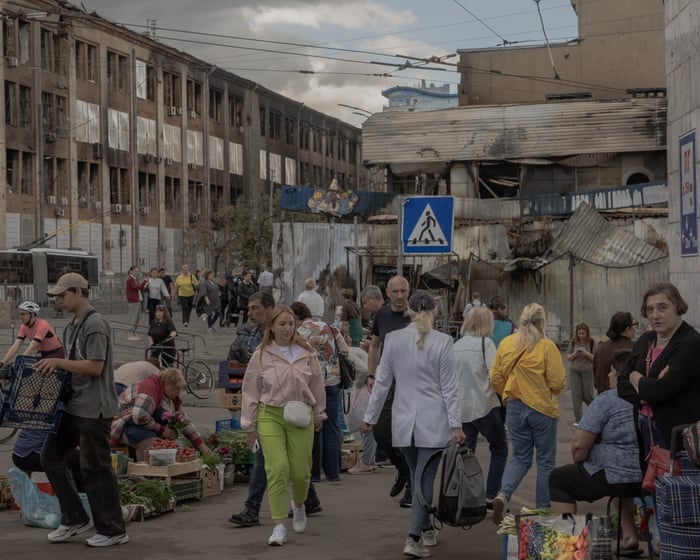
The likely reason is right across the busy street from the metro entrance: the long, red, shattered facade of the gutted Artem plant, once a weapons factory, now mostly ruined and partly covered by a huge mural.
The recent massive strikes, however, have hit civilian buildings. A glass tower that juts out like a ship’s prow over the street is missing many of its windows. A pair of burned-out cars sit by the curb. The metro entrance hall, which has been hit five times, is largely boarded up, while passersby stop to look at a scorched and hollowed-out building.
Aside from the station and the restaurant, most activity in the neighborhood now centers on a small market with flower and vegetable stalls that’s still open under one of the ruined buildings.
Anastasiia Prymak, 23, a product manager who lives in a nearby tower block, drinks her coffee before heading to work. “I moved to Kyiv from Nikopol two years ago because of the constant bombing there. Now we’ve had massive bombings here in recent months,” she says.
First came a drone strike on the roof of a nearby apartment building on April 28. “I thought I could hear planes. Then I told myself it couldn’t be planes because of the war. Then I looked out and saw the explosion on the roof,” Prymak says. “I’ve been diagnosed with severe anxiety disorder. I feel anxious all the time, even for no reason, and I have panic attacks.”
She opens a photo on her phone showing the view from her apartment window. Below, a building is on fire, with flames shooting out of the windows like jets.
“Last month there were these huge strikes. My boyfriend took me to the shelter, and I was praying even though I don’t believe in God. Now I’m begging my boyfriend to move to Lviv [in western Ukraine]. Then the neighborhood was hit again a couple of weeks ago. This is just outside my building.”
Prymak shows a video of wrecked buildings. “I tell my friends it looks like Chornobyl. It’s getting more and more dangerous here. I sleep curled up like a fetus because I’m afraid a drone or a rocket will hit. I want to be killed instantly. I don’t want to lose a limb.”
In a long-range and escalating air war between Russia and Ukraine, the damage in this single neighborhood serves as a warning about where the conflict is heading. Kremlin officials and Vladimir PutinOfficials have flagged Russia’s intention to launch heavier and more “systematic” strikes against Ukraine’s urban areas. The increase in Russian missile threats against Kyiv and other cities comes as Moscow tries to take advantage of a global shortage of missile interceptors—especially for the Patriot system—made worse by the US-Israeli war against Iran.
Staff from the McDonald’s on Lukianivska Square take shelter in the metro during an air raid alarm. Photograph: Peter Beaumont/The Guardian
Volodymyr Zelenskyy has rushed to secure promises of more interceptors, warning the leaders of the UK, France, and Germany during a visit to London on Sunday about “the urgent need to scale up” Ukraine’s air defenses and deep-strike capabilities.
Sitting at her flower stall, Faina Polishchuk says that while most of the stallholders have returned, the customers haven’t. “It’s dangerous,” she says. “After the last big strike in May, most of my colleagues here were crying and nervous and didn’t want to come back for a few days at first. But this is my livelihood.”
The heavily damaged Kvadrat shopping mall near Lukianivska metro station after a massive Russian missile strike. Photograph: Mykhaylo Palinchak/SOPA Images/Shutterstock
She watched the last strike from her apartment window. “The whole building was shaking. I went to the shelter, and a young man came and showed me what was happening on his phone. He said everything is burning.”
At first, Faina says she will stay no matter what, and she sounds optimistic. “I’m not afraid,” she says, but quickly adds a note of caution. “If it does get worse, then I’ll go to Vinnytsia [her original hometown].”
Frequently Asked Questions
Here is a list of FAQs based on the article title Looks like Chornobyl life in Kyivs most bombed neighborhood as Ukraine prepares for another major attack
BeginnerLevel Questions
1 Why do people say this neighborhood looks like Chornobyl
Because the area is heavily destroyed abandoned and covered in dust and debris similar to the ghost town around the Chornobyl nuclear plant after the 1986 disaster
2 Which neighborhood is being talked about
Its likely referring to a frontline or heavily shelled district in Kyiv such as the northwestern areas that were hit hardest early in the fullscale invasion
3 Is it safe to live there now
Not really The article suggests the area is still under threat from missile and drone attacks especially as Ukraine prepares for another major Russian assault
4 Why is Ukraine preparing for another major attack
Russia has been regrouping and launching new offensives Kyiv remains a key target so authorities expect a renewed attempt to capture or pressure the capital
5 Do people still live in this bombed neighborhood
Yes but very few Mostly elderly residents volunteers or those who refuse to leave their homes despite the danger and lack of basic services
AdvancedLevel Questions
6 How does daily life function with no power water or shops
Residents rely on generators well water humanitarian aid and volunteer deliveries Many walk long distances to find food or medicine
7 What specific kind of bombing has caused this Chornobyllike look
Heavy artillery multiple rocket launchers and aerial bombs have flattened buildings and left craters The dust from pulverized concrete coats everything
8 How do people defend themselves in such an exposed area
Some have built makeshift shelters in basements Others rely on air raid alerts and quick access to metro stations Civil defense volunteers also patrol to warn of incoming attacks
9 What happens when a new major attack is expected Do people evacuate
Some do but many stay because they have nowhere to go are too old or sick to move or are determined to protect their property from looters
10 How is this neighborhood different from other bombed Ukrainian cities
It