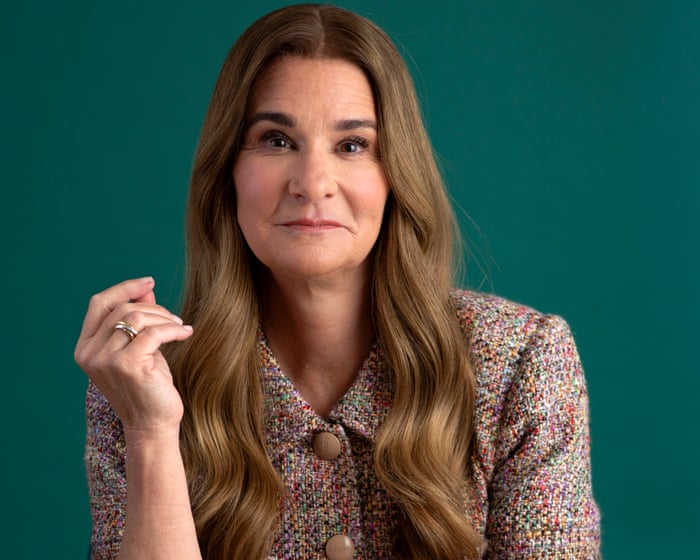
Melinda French Gates says she’s entered a beautiful new chapter in her life. It’s been five years since her painful, public divorce from Microsoft founder Bill Gates, and two years since she left their charity, the Gates Foundation, to focus entirely on Pivotal—the philanthropic organization she started in 2015 to support women’s empowerment. Her three children have all moved out, she goes by “Nonna” to her two granddaughters, and as an empty nester, she finds herself in the unusual position of having free time.
She’s started visiting her local independent bookstore more often, chatting with staff about what to read next. When she finishes work at five, she often texts a friend to meet for a walk, exploring new neighborhoods of Seattle with decaf coffees in hand. She no longer runs every day but insists on a morning stroll to enjoy the natural beauty of her adopted hometown, with Lake Washington glittering in the late-spring light. This morning, she saw a blue heron, she says, sounding almost proud.
These seem like surprisingly simple hobbies for a woman with an estimated net worth of $30 billion. When I point this out, she explains that a few years ago she read a quote about how “sometimes we go out in the world for discovery and to learn new things, but sometimes you just need to keep walking the path near you. Walk it over and over again, and you’ll start to see things.” After years of hectic international travel with the Gates Foundation, she’s choosing the latter.
Her newfound free time is relative, since Pivotal—where French Gates works full-time—is one of the largest private foundations in the US. It has already pledged $2 billion to projects supporting women and their families, and received $12.5 billion from Bill Gates in 2024 as part of their divorce settlement. We meet at Pivotal’s stylish, lakeside offices, with natural wood finishes and large windows overlooking the water. French Gates is 61 and extremely polished, with sleek brunette waves and a golden tan. If she’s had cosmetic work, it’s subtle—no Mar-a-Lago lips here. Billionaire financier Warren Buffett, a close friend of the Gateses, once said that Bill is “smart as hell, obviously,” but French Gates is “smarter.” She’s warm and personable, yet as we talk about the rollback of women’s rights in the US, billionaires behaving badly, and her ex-husband’s involvement with sex offender Jeffrey Epstein, it strikes me that she must have a core of steel.
French Gates has said many things contributed to her decision to divorce Bill in 2021 after 27 years of marriage, including his infidelity and his continued contact with Epstein despite her objections. Then, in January this year, the US Justice Department released a batch of Epstein emails. They included messages drafted by Epstein claiming that Bill Gates had contracted an STI after having extramarital sex with “Russian girls” and was planning to secretly give French Gates antibiotics. Gates denies these claims, telling Australian 9News: “Apparently, Jeffrey wrote an email to himself. That email was never sent. The email is false… Was he trying to attack me in some way?” He also addressed staff at a Gates Foundation town hall meeting to take responsibility for his actions, the company said, telling them he saw and did “nothing illicit.” Gates noted of his ex-wife: “To give her credit, she was always kind of skeptical about the Epstein thing.”
In an interview with NPR soon after the files were released, French Gates said she was happy to be away from “all the muck” and that the men involved, including her ex-husband, had to answer for their actions. Why did she decide to speak out then, I ask. “Well, I had not been silent. II had been asked before what I thought of Epstein, and I told the truth about what I experienced. He was a horrible, disgusting human being. So in situations like this—and this is a tough topic for me, you should know that—my heart goes out to the young girls. I just spoke the truth, which is that they deserve some peace and some justice.
The justice system didn’t do its job. It simply didn’t. Period. Epstein could have been stopped.
Does she feel frustrated that while many women, including Epstein’s victims, have shown great courage in speaking out, his male associates are staying silent? She replies, “What I know is that bad things happen in darkness. We need more transparency.” French Gates understands the secretive, ultra-rich world Epstein moved in better than most. I ask why she thinks he got away with his crimes for so long. “The justice system didn’t do its job. It didn’t. Period. This could have been stopped. So again, I think that’s why we’re finally having a reckoning in society. If we don’t want children to be harmed, the justice system has to work.” But I ask, with clear skepticism in my voice, are we really having a reckoning? She replies, “I think that would be a better question to ask the survivors.”
French Gates has said she met Epstein once and found him so repulsive that she had nightmares afterward. I ask what chilled her so much. Her demeanor changes quickly. She looks like she’s about to cry. It’s upsetting to see a woman so usually composed suddenly lose her poise. She turns away to look at the lake outside her window, and I can see her trying to calm herself. “My heart is racing,” she says after a moment, fluttering her hand over her chest. “Have you ever been around someone you just know is evil?” she asks a moment later. “There you go. That’s your answer. We need to trust our feelings about people.” When she said her heart was racing, was she reliving that gut reaction from meeting him? “I’m done. I can’t answer any more questions,” she says. I watch her, trying to read her reaction, but I can sense her communications person to my right, tense and ready to end the interview if I push too far. Then she answers. “Yes. Any woman who has ever been around someone evil or had an experience, and then you’re around someone else evil. Just no, no.” I notice that while she usually speaks in full sentences, her grammar has broken down. I’m sorry, I say, I can see you’re having a strong—”Visceral reaction, yes,” she interrupts.
When women step into their full power, we see society through a different lens. We are the bedrock of society. We are the bedrock of the family.
French Gates has said that in the months leading up to her divorce, she started having panic attacks, and it’s clear her emotional response to my questions is real. We move on from her personal experiences to broader politics, and she becomes her usual self again. She’s clear about how society can best fight modern misogyny in all its forms. “We have to put women—many more women—in positions of power. That’s why I do the work I do,” she says. “When women step into their full power, we see society through a different lens. We are the bedrock of society. We are the bedrock of the family.”
This month, French Gates is committing $215 million in new funding toward women’s health care, split between initiatives supporting reproductive health and health in midlife, including through menopause. “I’ve always believed that if you don’t start with good health, it’s pretty hard to do whatever you want in life,” she says.She says, “Research shows that women experience higher rates of disability and illness than men, but for every dollar spent globally on medical research and innovation, just 5 cents goes to women’s health. We have under-prioritized women for so long.” For a long time, the medical and scientific community has treated the male body as the norm, which means we know very little about issues that mostly affect women, like autoimmune diseases. And even though half the population goes through menopause, there’s not enough research on how to best support women during this time.
View image in fullscreen: French Gates visiting a girls’ secondary school in Malawi, 2023. Photograph: Courtesy Pivotal Ventures
“It’s like this time in a woman’s life is completely invisible to the world,” French Gates says. Women spend an average of nine years in poor health, and like many, French Gates assumed those years came later in life. “But no, half of that time is during perimenopause and menopause, and we’re starting to hear about women leaving the workforce because of it,” she explains. She remembers how surprising it was for her and her friends when, in their early 40s, they started having perimenopausal symptoms. These symptoms often hit when many women are at the peak of their careers and trying to balance caring for young kids and aging parents. Many suffer in silence with pain and poor health.
French Gates has been funding reproductive healthcare for decades. She learned from field trips to Africa and Southeast Asia how critical family planning can be. “I’ve seen babies die because women couldn’t space out their births, and they were born too close together,” she says. After the overturn of Roe v. Wade, much of Pivotal’s work focuses on maternal mortality, perinatal mental health, and reproductive rights in the US. She finds it “devastating” to see US abortion rights being dismantled. “My granddaughters are growing up with fewer rights than I had,” she says. “I don’t think women’s health should be a political issue. I think women should decide if and when to have a child, and those decisions are best made privately, not by our government. It’s something we have to keep fighting against.” As a Catholic, French Gates once struggled with how to reconcile her faith with what she was learning about the importance of reproductive freedom. True to her nature, she did her research, even inviting scholars from the University of Notre Dame, a Catholic research university in Indiana, to teach her about the history of the church’s position. Now, she is clear in her belief that a woman’s right to abortion should be protected by law. “Only we own our bodies,” she tells me.
In French Gates’s story, she has always tried to stay true to her Catholic, middle-class upbringing in Dallas. Her father worked as an aerospace engineer and was part of the Apollo program; her mother was a homemaker. Her parents taught their four children a strong sense of public responsibility. “We were often volunteering, often putting money in the church basket,” she recalls. She studied computer science and earned an MBA at Duke University before joining Microsoft in 1987, where she quickly moved up the ranks, leading teams that developed products like Microsoft Word, Microsoft Publisher, and Expedia. She met Bill at work, and they married in 1994.
View image in fullscreen: Melinda French Gates photographed at Pivotal Ventures last month. Photograph: Genna Martin/The Guardian
Shortly before the birth of their first child, French Gates left Microsoft to focus on her family and their philanthropic work. A commitment to giving back was something she and Bill shared. “My ex-husband, his parents were incredibly philanthropic, so I think that was sort of in both of our DNA growing up, and it just felt like the right thing to do.””That’s the right thing to do,” she says. They were also inspired by their friend and fellow philanthropist Warren Buffett, who was a major donor to the Gates Foundation. “Once we started down that path, I’ll say for myself, it fed on itself.” Over the past 25 years, the Gates Foundation has given away more than $100 billion to anti-poverty programs, vaccine research, and efforts to fight malaria, HIV, tuberculosis, and other infectious diseases.
French Gates says that at Duke, she met students who had grown up with privilege, and she vowed she never wanted her three children to be like them. “I really worked hard inside of this very large life to ground them,” she says. They may have been raised in a massive mansion that the press nicknamed Xanadu 2.0, with 24 bathrooms, six kitchens, a trampoline room, an indoor pool, and a library containing a Leonardo da Vinci manuscript, but they still had to do chores, received only a modest allowance, and joined her in volunteering for local community projects in Seattle. “One of the great compliments I’ll sometimes hear from people is they’ll meet, say, my oldest daughter and say: ‘Oh my gosh, she’s so normal!'”
French Gates’s philanthropy sometimes feels like a throwback to a less cynical time. Social responsibility is no longer in fashion among the wealthiest. By dismantling USAID, the world’s richest man, Elon Musk, has put much more effort into taking money away from the world’s poorest than giving it back. In 2010, Buffett and the Gateses founded the Giving Pledge, which encouraged billionaires to commit to giving more than half of their wealth to charitable causes. Now, the New York Times recently reported, at least one signatory has dropped out, and “it’s become fashionable, in a Silicon Valley contrarian sort of way, to bash the Giving Pledge.” I ask French Gates what explains this new mood, the rise of the billionaire misanthropist, but she won’t be drawn in. She can’t speak to Musk’s background or motivations, she says, only for the people still actively participating in the Giving Pledge.
At the same time, many of the humanitarian goals that Bill and Melinda French Gates worked toward for decades are being undermined. When USAID was abolished in 2025, it devastated the international development community and caused, according to Boston University estimates, at least 600,000 deaths from infectious diseases that year alone. During the pandemic, conspiracy theorists seized on the Gateses’ vaccine programs and spread absurd but powerful false rumors that they were microchipping children. The US health secretary, Robert F. Kennedy Jr., is helping to spread vaccine misinformation and is dismantling vaccine research. “I think it’s terrible any time something that benefits people’s health gets rolled back or gets attacked,” French Gates says. “I have been in so many countries in Africa where parents go to great lengths to go to clinics to get their kids vaccinated, because they know the difference it makes. Nobody’s forcing them to; they are figuring out how to get the bus fare, they’re walking there for miles, because they know that these vaccines save lives. And so, for me to see in the United States in 2025 we have the largest number of measles cases we’ve had in 25 years … It seems so senseless at times,” she says.
To end up with these resources is a huge privilege, but to whom much is given, much is expected. When she left the Gates Foundation, French Gates wrote in an open letter that she recognized the “absurdity of so much wealth being concentrated in the hands of one person,” and that “giving away money your family will never need is not an especially noble act.” Does she think American society needs more socially responsible billionaires, or an economy that produces fewer billionaires? She looks out the window again, to gather her thoughts.”I think we need more fairness in society, so more people shouldn’t have to struggle to buy food or pay rent. In the US, it’s almost impossible to buy your first home now… the system just isn’t working,” she says. “We have to do something to create more fairness. I don’t know the solution to that.”
It’s a typically careful answer. Throughout the interview, I notice her politician-like skill of seeming to answer a question while revealing very little new information. But then again, why would she? She’s a rare interviewee with nothing to sell and no personal project to promote. She’s not interested in settling old scores, and she doesn’t owe anyone anything. When she feels forced to mention Bill, she doesn’t say his name but refers to him distantly as “my ex-husband.” She clearly has no desire to do something as uncool and destructive as sharing more private details about their marriage—and both she and Bill have been linked to new partners. As far as I can tell, her only reason for talking to the press is to draw attention to the causes she cares about. And while giving away billions isn’t noble in itself, I think dedicating your working life to trying to make the world better is. Her daughter Jennifer once told Vogue that growing up, French Gates often said to her: “We’re not people who sit around and eat bonbons.” She plans to work full-time for at least another decade, into her 70s. “After that, I might start to slow down a little. I don’t know. It depends on how many more grandchildren I have,” she jokes. Then she adds, worried: “No pressure on my kids, though!”
French Gates says she doesn’t think much about her legacy, but she does wonder what kind of world will be left for her two young granddaughters. “I think we’re all only on this Earth for a blink of an eye, and I never, in my wildest dreams, thought I would end up with these kinds of resources. It’s been a huge privilege, but I feel like, okay, if I’ve got them, I’ve believed for a long time that to whom much is given, much is expected.” She says her values haven’t changed since high school, when she quoted words often attributed to Ralph Waldo Emerson but written by Bessie Anderson Stanley in her graduation speech: “To know even one life has breathed easier because you have lived, that is to have succeeded.” By that measure, through her philanthropic work, she has been incredibly successful, I suggest. “I don’t dwell on those kinds of things,” she says. It’s the individual stories of people she has helped—not the numbers—that move her. She talks about a mother she recently met through a maternity care project Pivotal is supporting in Alabama. After the trauma of losing one baby, this mother was recently helped through the difficult process of giving birth again, and her demeanor brightens. Hearing a story like that brings her “great joy,” she says. Her divorce and the Epstein fallout must have taken a huge personal toll on French Gates, but her philanthropic work gives her purpose and comfort. Is she happy, I ask her. “Very happy,” she says, with real feeling, and I believe her.
Frequently Asked Questions
Here is a list of FAQs based on the themes from Melinda French Gatess reflections on Jeffrey Epstein her philanthropy and her postdivorce life
BeginnerLevel Questions
Q Did Melinda French Gates actually say she just knew Jeffrey Epstein was evil
A Yes In interviews she said that after meeting him once she had a visceral negative feeling She told her thenhusband Bill Gates that she didnt want to be around him again
Q Why did Melinda French Gates meet with Jeffrey Epstein in the first place
A She met him once early in her marriage to Bill Gates She went because Bill had already been meeting with Epstein but she quickly decided it was a mistake based on her instincts
Q What does Melinda French Gates do with her billions now
A She gives it away through her organization Pivotal Ventures She focuses on funding womens rights gender equality and family issues in the US and globally
Q How did Melinda French Gates find peace after her divorce
A She says she found peace by focusing on her own work spending time with her children and letting go of the need to fix the past She also credits therapy and time in nature
Q Is Melinda French Gates still involved in the Bill Melinda Gates Foundation
A No She resigned from the foundation in June 2024 to focus on her own philanthropy through Pivotal Ventures
Intermediate Advanced Questions
Q What was the specific red flag Melinda saw in Jeffrey Epstein that Bill Gates allegedly missed
A Melinda has said Epstein was charming but that she felt a deep discomforta sense that he was manipulative and predatory She described it as a smell of evil that she couldnt ignore
Q How did meeting Epstein affect Melindas trust in Bill Gates during their marriage
A It was a major turning point She felt that Bills continued association with Epstein showed poor judgment and a lack of respect for her intuition which eroded her trust over time
Q What is the main difference between the Gates Foundation and Melindas new organization Pivotal Ventures