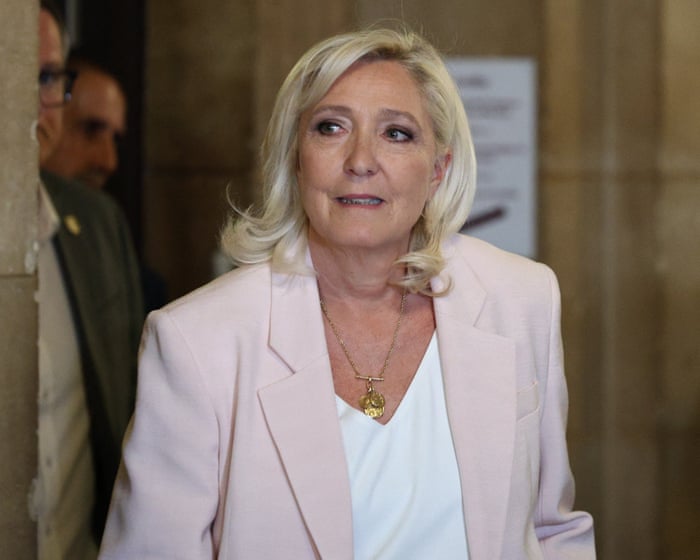
A French appeals court has upheld Marine Le Pen’s conviction for embezzling European Parliament funds, but shortened her ban from running for elected office. This could potentially reopen a narrow path for the far-right leader to run in the 2027 presidential race.
However, the court also sentenced Le Pen to three years in prison, with two years suspended and one year during which she must wear an electronic ankle tag for monitoring. This could make a presidential campaign both politically and logistically difficult.
Le Pen, who leads the anti-immigration National Rally (RN) party, has previously suggested she would not run if she received a modified custodial sentence that restricted her movements or required her to wear an electronic tag.
“If I’m allowed to be a candidate but am effectively prevented from campaigning freely, then you understand that wouldn’t be possible,” Le Pen said in an interview last week.
Her position was not immediately clear after the verdict. A different judge will later decide the exact details of any electronic tag or monitoring for Le Pen.
The far-right figurehead, who appeared in court with allies from her party’s parliamentary group, is expected to consider her position and make an announcement later on Tuesday, possibly on TV news, about whether she will run for France’s highest office next spring.
The Paris court ruled that Le Pen, 57, played a central role in orchestrating a fake-jobs scheme of unprecedented size and duration to embezzle European Parliament funds and funnel the money to pay her party in Paris between 2004 and 2016.
Le Pen’s ban from running for public office was shortened to 15 months, with the remaining 30 months suspended. She was also fined €100,000 (£85,000).
Jordan Bardella, 30, who as party president already handles the day-to-day running of the RN, had been on standby as a potential replacement presidential candidate if Le Pen was unable to run.
Le Pen had said before the verdict that if necessary, she would support Bardella, her protégé, with “energy, confidence and conviction,” adding: “We never give up.”
Recent polls suggest that Bardella, who also leads the far-right Patriots for Europe group in the European Parliament, could make it to the final round of the presidential race. Some polls show support for Bardella exceeding that of Le Pen.
If Le Pen does not run, next year’s election would be the first presidential vote in nearly 30 years without a member of the Le Pen family on the ballot: either Marine Le Pen or her father, Jean-Marie Le Pen, who made it to the final runoff in 2002.
Le Pen had hoped to run for president for a fourth time next spring, when Emmanuel Macron’s two terms in office end. She has twice been defeated by Macron in the final runoff, in 2017 and in 2022, when she increased her share of the vote to over 41%.
Le Pen was considered one of the top contenders for the 2027 presidency until last March, when, after a first trial, she was barred from running for election for five years with immediate effect after being found guilty of the extensive and long-running fake jobs scheme at the European Parliament.
She appealed last year’s verdict, and a new trial at the Paris Court of Appeal was held this year as she fought for her political future. She told the court that there was no “system” set up by her party to misuse European Parliament funds and that “we don’t have the feeling of having committed the slightest crime.”
But state prosecutors summing up the case said Le Pen had been at the center of a “thought-out,” “centralized,” and almost “industrial” system to embezzle European Parliament funds.
They told the court that taxpayer money allocated to members of the European Parliament to pay their assistants based in Strasbourg or Brussels was siphoned off by the party from 2004.In 2016, the party paid its own workers in France, breaking the rules of the European Parliament. Prosecutors said the staff in France had no connection to work done at the European Parliament. The loss to European funds was estimated at €4.8 million (£4.2 million). According to prosecutors, the party—then called the Front National—made significant savings through this system, which was well documented in emails and party documents.
During the appeal trial, state prosecutor Thierry Ramonatxo criticized Le Pen for her public attacks on the judiciary after last year’s verdict. She had claimed a “tyranny of judges” wanted to stop her from running in a presidential race she could otherwise win.
Ramonatxo said judges simply apply the laws voted for by the people’s representatives in parliament. He added that Le Pen had “chosen to attack judges on the political stage instead of reflecting on what she was criticized for.”
He continued: “Talking about a ‘tyranny of judges,’ a ‘violation of the rule of law,’ or ‘political assassination’ is not part of judicial debate in a democratic society. It’s not about debating ideas—it’s about discrediting all judicial actions entirely.” Ramonatxo said her choice was dangerous and that judges had received death threats because of these attacks.
At the original trial, 24 party members were convicted. Le Pen and 10 others appealed. Her sentence in that trial sparked anger among the international populist right. Donald Trump called it a “witch-hunt” by “European leftists.”
After the first trial, Le Pen told La Tribune Dimanche: “There was a time when you could take a bullet. Now you can take a judicial bullet. In reality, that means your death.”
Frequently Asked Questions
Here is a list of FAQs regarding the court order for Marine Le Pen to wear an electronic tag covering various levels of understanding
BeginnerLevel Questions
Q Why did a court order Marine Le Pen to wear an electronic tag
A She was found guilty of misusing EU funds to pay party staff The electronic tag is part of her sentence acting like a form of house arrest or a strict monitoring condition
Q What does wearing an electronic tag actually mean for her
A It means she has to stay at home during specific hours The tag monitors her location and if she leaves when shes not supposed to authorities will be alerted
Q Does this automatically stop her from running for president
A Not automatically The tag itself doesnt ban her from running but the underlying conviction and any separate ban on holding public office could disqualify her The tag is just one part of the punishment
Q Is an electronic tag a normal punishment for a politician
A Its unusual but not unheard of Courts use it as an alternative to prison for nonviolent crimes especially when the person poses a low flight risk but still needs to be monitored
IntermediateLevel Questions
Q Can Marine Le Pen campaign while wearing the electronic tag
A It depends on the specific curfew conditions If the court allows her to leave for work or political activities she could campaign during those allowed hours However it would severely limit her ability to travel across the country or attend nighttime events
Q How does this sentence affect her chances of winning the presidency
A It damages her reputation and creates a huge logistical hurdle Voters may see her as unfit for high office and she cant campaign freely More importantly the conviction itself may trigger a separate ineligibility penalty which is a much bigger threat than the tag
Q What is the difference between the electronic tag and a ban from running for office
A They are separate penalties The tag restricts her physical movement A ban on running for office would legally remove her name from the ballot The court may impose both but the tag is the physical monitoring while the ban is a legal disqualification