On July 30, 2023, Lizzo wrapped up a 10-month world tour. She had performed 80 shows across North America, Europe, Oceania, and Asia, selling over 853,000 tickets and earning $86.3 million. The rapper turned pop star was on top of the world. Then everything fell apart.
Two days later, three of her former dancers claimed they had faced sexual harassment, a hostile work environment, religious and racial discrimination, and fat-shaming during the tour. Two were fired, and one resigned. After the accusations came out, mainstream media and social media piled on heavily. And it seems like it hasn’t stopped since. Lizzo, whose real name is Melissa Viviane Jefferson, disappeared. We were told she was busy recording the follow-up to her hugely successful album Special. But there were also rumors that she had a serious breakdown.
Last month, her new album, Bitch, finally came out. The reviews were disappointing, and sales were even worse. Her previous two albums each sold over a million copies, but Bitch didn’t even crack the top 100 in the US or the UK. It seems the world wasn’t ready to forgive Lizzo, whether the allegations were true or not.
Today, she’s in Los Angeles, and we meet over video link. Just as her publicist warns me about topics that are off-limits due to legal issues, Lizzo bounces onto the screen, sporting new honey-blond curls but still full of her usual unstoppable energy. She could just as easily be addressing a festival crowd as she is me and her publicist. “I can’t talk about that, whatever you’re talking about! Hehehe!” She throws her head back and roars with laughter. “What’s up, y’all? I’m gooooood.”
Of all the downfalls in the music industry, Lizzo’s is one of the saddest. She seemed like such a positive force. She had just stolen the show at Glastonbury in 2023, was incredibly talented, and was the most surprising of role models—a 325-pound, classically trained, sonic sex bomb. Lizzo was like an old-school preacher with a very modern message about body positivity, sex positivity, and diversity positivity. She shook her ass and showed off her flute in the face of the world, proving that anything was possible.
“You get to a level of celebrity where your fame overshadows your art. And I’m there!”
She represented a culture where old boundaries and expectations had been broken down, and we were mostly free to be whoever we wanted, as long as we did it with kindness. Then came the allegations. Were they malicious, meant to destroy the reputation of a woman who seemed too good to be true? Or was Lizzo a fraud? Could the woman who reclaimed the word “bitch” to celebrate her self-worth in Truth Hurts (“I just took a DNA test, turns out I’m 100% that bitch”) really deserve that label in the old-fashioned sense? Was the artist who celebrated her natural curves in Tempo with the mantra “Thick thighs save lives” really a fat-shamer?
Last December, a judge ruled that the fat-shaming allegation didn’t have enough merit to go to a civil trial. But we still don’t know much about the other claims. All we know is that Lizzo has insisted they are baseless and has refused to settle out of court. And that it has taken a huge toll on her. In an essay she wrote last year on her Substack, she confirmed she became “deeply suicidal” and for a while “cut off her loved ones.”
I tell her I saw her at Glastonbury in 2023 and that she was fantastic. She says she knows she was: “Everything was fantastic at Glastonbury.” She sips her iced coffee. It was such an amazing time for you, I say. “It’s always an amazing time for Lizzo.” Well, I suggest gently, maybe the past three years have been tough. Silence. After you were so celebrated, things got a little difficult.I suggest we sit in more silence. The loud, raucous laughter is gone. I ask how she’s been coping. “Ermmmm. You get to a level of fame and celebrity where your fame overshadows your art. And I’m there! Ha!” She laughs, but this time there’s not much humor in it. “I never signed up to just be a famous person. I always thought, I’m going to make art forever. So when my fame comes before me as an artist, it can be uncomfortable, because people care more about what I said than what I made.”
I’m confused by the detailed answer she gives to a question I didn’t ask. It feels like we’re shadowboxing. I’m dancing around the topic, and she seems to be hiding in it. I ask what she means by her fame coming before her art. “Well, you know, I’ll release music, and the critique is never really about the music—it’s more about me. And I think that comes with being this famous. I don’t think it’s unique to me. There’s this ‘I don’t like this person’ attitude. And it’s like, why? It’s not because they made a bad song; you just don’t like them. And now you don’t like their song. It’s an interesting phenomenon, but I’m starting to get used to it.”
We seem to be having two different conversations. I’m talking about the impact of the accusations, and she’s talking about the impact of fame. Gradually, I realize that for her, they are the same thing. She believes the allegations about her behavior and how she treated the three dancers came about because of her fame. And now she thinks critics have reviewed her album Bitch purely through the lens of the scandal.
“Being cruel is trendy and acceptable. We’re seeing it at the top of our society, from our leaders all the way down to comment sections.”
Did she ever think she’d have to face all this? “Face up to what?” she snaps. The level of fame and the scrutiny, I say. Suddenly, the euphemisms, allusions, and coded references to what happened are gone. Now her answer is as direct as you’d expect from straight-talking Lizzo. “No, I don’t think anybody does. Everything was unexpected. The Grammys, unexpected. The number ones, unexpected. The fame, unexpected. The public scrutiny, unexpected. The one thing I did expect was that being a fat, Black, happy girl, they were going to try to take that away from me. They were always going to try to tear me down. I always knew, even when I wasn’t famous, that makes people uncomfortable. So I kind of signed up for that part.”
It feels like you’re fighting back on Bitch, I say. “No, I don’t think I’m fighting. I’m responding. My album is very honest. It’s a real reflection of me and the world right now.” She quotes from a song called A Toast: “I hope it makes you happy / To hurt somebody else / And when you lose it all / I hope you find yourself.” The lyrics could apply to the world at large, friends who betrayed her, or the people who made the allegations against her. And that’s how she’d want it—a broad attack on what she sees as unnecessary cruelty.
“We live in a culture where everyone is racing to get the top comment, and the most hurtful comment wins. We’re in the business of hurting each other. I think everyone was so careful about how we spoke about others, and people were holding each other accountable for the last few years, but now the pendulum has swung the other way. Being cruel is trendy and acceptable. And I think we’re seeing it at the top of our society, from the leaders all the way down to comment sections. We’re seeing cruelty at an all-time high.”
Last year, Lizzo threatened legal action against the Trump administration after it used her song About Damn Time for a military-themed parade in Washington DC. I ask her…She says that if someone sees Trump’s America and the MAGA movement as a reflection of this cruelty, she believes it goes beyond just Trump.
[Image: Fullscreen photograph by Shaniqwa Jarvis for The Guardian]
“I don’t want to talk about American politics. I’ve talked about it a lot. I do think the world is unrecognizable. I’m not talking about any specific political party—I mean in general.” She points out that A Toast was written in 2021. “That was before I met anyone who made legal claims against me. I was already having these crazy realizations; a certain amount of fame and success will reveal the people around you.”
She insists critics are wrong to search every song for references to the allegations. Actually, she says, the overwhelming sense of betrayal is much more personal. “What people don’t know is that most of the sad songs on this album are about a friendship breakup that wasn’t public at all.” She talks about Like a Crime, which is addressed to someone who “Broke my heart and stole my life.” “That song is about a friend I was very close with. I employed them and believed in them, and they were extremely abusive and lied about me. It was one of the hardest friendship breakups I’ve ever had. I really loved this person, and they secretly hated me, and I don’t know why.”
Did she ever confront them? “The last time we spoke, it was like, ‘I’m thinking about you, I love you, I hope everything’s OK,’ and I said, ‘Oh, I love you too.’ Then a year later, they were on the internet talking about how horrible a person I am. I was so confused because I thought we were good. That was the most hurtful thing I’ve experienced in a long time.” Was this one of the dancers who made the allegations? “No. This person has no legal claims; they just joined a hate train.”
Inevitably, she says the tone of Bitch is different from her previous albums. Before, she says, there was a feel-good element to her music. Sure, she sang about her struggles, but she would always come out on top. She says the 2019 song Soulmate about lost love is a typical example. “It’s like, I’ve got my heart broken, but in the chorus I save myself every time. It’s like, ‘Don’t worry, girl, because you’re still feeling good as hell.’ On this album, there’s no resolution. There’s no soft ‘But I’ll be OK,’ because sometimes that’s not reality. Sometimes you’re not OK for a long time.”
In the past, she has said she was never quite the happy-go-lucky personality she was made out to be. It’s not that the happiness is fake—it’s more that it’s been balanced by periods of deep depression. Even between 2018 and 2021, when she first found success, there were times she couldn’t see the point of facing another day. She says it’s overcoming the lows that made the highs so joyful.
“I grew up as the swot. As a black girl, I wasn’t the norm. I was such a nerd.”
[Image: Fullscreen photograph by Shaniqwa Jarvis for The Guardian]
Lizzo grew up in Detroit, Michigan, and then Houston, Texas. Her parents, Shari Johnson-Jefferson and Michael Jefferson, were Pentecostalists, and she was raised in the Church of God in Christ. The couple ran a mortgage business until the 2008 financial crisis. Shari sang and played organ in church, but early on, Lizzo’s parents believed pop music was the devil’s music. When she was 10, they moved to Houston and adopted a less orthodox lifestyle. She says her father started dreaming of creating a Jackson 5-style family band, even though there were only three children—Lizzo and her older brother and sister.
The young Melissa Jefferson was a geek and a swot. “I was a bookworm. An overachiever. And I was bullied in middle school.” Was she big? “Yeah, I was a big girl. But you know in Houston—”In Texas, everything is big, so being big isn’t really a big deal. For me, growing up, I was the swot—the nerdy one. As a Black girl, I didn’t fit the mold. I was such a nerd. I was always reading manga and books, I played the flute, and I was in the marching band. I didn’t have cool hairstyles. I’d just put my hair in little sweaty buns, and I wasn’t friends with any of the popular kids. I was all about books. I’d literally walk into the hall reading one. That’s mostly what I got bullied for—just being different.
Did that bother her, or did she see it as a positive? “I turned being different into my superpower. I remember thinking, ‘You think I want to try to be cool with you? I don’t want to be cool with some bully. I’m fine—I have my best friends for life.'” Was she strong? “I didn’t think of it as strength. It was just who I was. Then, the summer before high school, I stopped reading so much and started rapping, being the class clown, and a bit of a smartass.”
Did that make her more popular? “It definitely helped. I’d never say I was the most popular girl in school, but after that, I was friends with all the cool kids—the basketball players and the cheerleaders.” So it was a big change? “Well, I was still in the marching band, but luckily, I was best friends with the coolest girls in it.”
Did she ever think she’d become a professional classical musician? Her eyes light up, as they do when she gets passionate. “Yes! My absolute dream was to be the principal flutist in an orchestra or for a ballet.” She studied classical music on a scholarship at the University of Houston, but dropped out when her father got sick and the family struggled financially. Her parents moved to Denver, but she stayed in Austin and ended up homeless, living out of her car for six months. Her father, Michael, died in 2009 from complications after a stroke. He had been her inspiration and motivation. She lost hope and direction, and gave up on classical music.
She started singing, applied for a job as a lead vocalist, and joined a prog-rock band called Ellypseas. In 2011, she moved to Minneapolis and formed Lizzo & the Larva Ink, an electro-funk duo with Johnny Lewis, followed by rap groups the Chalice and GRRRL PRTY. In 2013, she released her first solo album, Lizzobangers. Her fast-paced rap and stream-of-consciousness rhymes over minimalist electronic beats drew comparisons to Missy Elliott and Outkast. The album was highly praised but not a commercial success. In 2016, she signed with Atlantic Records, and a new, more commercial Lizzo emerged. Her third album, Cuz I Love You, was full of radio-friendly R&B-pop anthems like “Juice,” “Tempo,” and “Truth Hurts.” She became a star. Then came Special in 2022, which cemented her status.
If she could choose now between being a world-famous pop star or a principal flutist in an orchestra, what would she pick? “In 2026? That’s tough! I think both have pros and cons. It kind of balances out.”
Really? Most people would assume you’d pick world-famous pop star, I say. “Yeah, but I’ve seen it’s not all it’s cracked up to be. I never really wanted to be famous.” What are the downsides? “Fame doesn’t solve any problems. Fame doesn’t make you happier. Fame doesn’t cure depression. Fame doesn’t make your friends any more real.”And fame doesn’t guarantee success. It’s just something that happens to you. I’m grateful for the financial freedom I have, but I also know that fame alone isn’t the cure-all you think it is.”
Rather than transforming your life, she says, fame simply amplifies what’s already there. “I think everything we have, we have. So fame amplified my anxiety, depression, and some of my joy. Fame amplified some of the bad habits of people around me that maybe I wouldn’t have noticed if I hadn’t been this famous.” What does she mean? “I just mean that if your friend was fake before fame, becoming famous shows just how fake they are. Hahaha!”
The three dancers filed their joint lawsuit in the Los Angeles County Superior Court on August 1, 2023, against Lizzo, her management company Big Grrrl Touring Inc., and her dance captain, Shirlene Quigley. This happened two days after the world tour ended. Crystal Williams and Arianna Davis had been fired from the tour in April and May, respectively, while Noelle Rodriguez resigned in protest after Davis was dismissed. Davis and Williams got their contracts by winning an audition on Lizzo’s reality show Watch Out for the Big Grrrls. Rodriguez was already a successful dancer who had performed with big names like Beyoncé and Rihanna.
Flutes, freestyles, and infectious fun: Lizzo’s greatest songs – ranked!
Read more
What made the allegations so shocking was that they went against everything Lizzo claimed to stand for. Davis said there were “thinly veiled” criticisms about her gaining weight. Lizzo responded that she hired Davis after she had gained weight and, as the reality show’s title suggested, she was looking for big girls. The dancers accused Lizzo of sexual harassment, citing a visit to the erotic venue Bananenbar in Amsterdam’s red-light district. They claimed Lizzo pressured them into interacting with nude performers and coerced Davis into touching a performer’s bare breasts. Lizzo countered that only two of the three women had gone to the bar after being invited as part of a group of 17, and that any sexual activity had to be voluntary, or the bar would have been shut down immediately.
The three dancers also said they were subjected to a hostile work environment and, in April 2023, were put through an “excruciating” 12-hour re-audition without breaks. They claimed they faced racial and religious discrimination, saying Black dancers were treated differently and alleging that Quigley aggressively pushed her Christian beliefs and harassed non-believers. (A unified defense team for Quigley and Lizzo has denied all the dancers’ allegations.) The dancers also alleged false imprisonment (Davis said she was held against her will by Lizzo’s security and told she couldn’t leave until she handed over her phone for a physical search), assault, and that their employment was wrongfully terminated, or in Rodriguez’s case, that she was forced to resign under severe pressure.
On closer inspection, some of the allegations seem to be about what the dancers felt rather than what actually happened. For example, Rodriguez said she felt Lizzo might have attacked her after she “aggressively approached” her while “cracking her knuckles and balling her fist,” swearing and telling her she was “lucky.” Davis said she felt she couldn’t ask for a bathroom break during the 12-hour re-audition for fear of being fired on the spot. Lizzo and her legal team have dismissed the claims as made up, legally baseless, and driven by personal grudges.
What Lizzo does seem to admit to is naivety, especially when it comes to friendship. From the start of her career, she worked with friends or people who quickly became friends. That’s what she loved about it – they were “family.” When success finally came, it happened quickly and on a huge scale. It meant that she was suddenly…She was traveling with a big team, and she still assumed they were all friends. As she found out the hard way, they weren’t.
“What a shame it would be if I stopped being open and loving to people just because some people wanted to make things up.” Has what happened to her shaken her idealism? “No…” she says, hesitating. “I don’t think it changed that. That’s what makes me me.” Did it change anything? Long silence. “I can’t let other people’s opinions of me change me. The only thing that can change me is me.” I think that might be something she wants to believe more than something she actually believes. “I used to give opportunities to strangers, and that’s still a beautiful thing. Fans come to me at meet and greets for my album, and they’re like, ‘Hey, I really want to do graphic design for you,’ or ‘I really want to dance with you,’ or ‘I really want to be your personal assistant if you have any job openings.’ And what a shame it would be if I stopped being as open and loving to people who want opportunities just because some people wanted to make things up about me.” It would be a shame, but I think she knows there need to be clearer professional boundaries between her and her employees.
I ask if many people have stood by her. “Simon, if you do good journalism, you’ll include that everyone from my tour—all my dancers—wrote statements backing me up. Literally every single team member, dancer, and band member from the tour wrote statements about what an incredible experience it was being on tour with me. They all reached out to my team, saying, ‘When is she going back on tour? I’d love to go with her.’ This happened, but it wasn’t reported.” It was reported, just not as fully or as often as she would have liked.
In fact, a total of 18 former employees gave statements saying it was a supportive and professional environment. They accused the three dancers of unprofessional behavior, including showing up for shows drunk (which Davis denies).
I say I can imagine she’s a tough taskmaster—her shows are demanding and need rigorous rehearsal. Does she think the three dancers might have confused being demanding with abuse? Another pause. “I’m being really careful about how I answer.” The seconds pass. Eventually she answers, but I’m not sure this is what she was going to say at first. “I think there were people who were very creative, and they wanted to create a story to make it seem like I’m not genuine. I think it’s a fairytale.” (The dancers’ attorney has stated: “Our clients have dozens of independent witnesses who support their stories.”)
When Lizzo first appeared on the call, I didn’t recognize her. Partly because of the blond curls, which give her a very different look, but mainly because she has lost so much weight over the past three years. Even this has been controversial, with her being unfairly accused of rejecting her body-positive past. It horrified her. “There was an article saying, ‘Why do fat girls who lose weight suddenly hate fat girls?’ and I was the cover image. I was like, ‘Huh! So they used me as the image to get clicks. And the top comment was like, ‘Didn’t Lizzo do something like that to promote her album? She’s far from tiny.’ And I was like, now you’re fat-shaming someone? Everyone thinks they’re such a good person, but are you really a good person if you’re just going to do the same thing you’re accusing someone else of doing?”
I read that you initially lost weight because of depression, I say. “There are a lot of reasons. People always want to make it one singleThe headline is one single thing. A lot of things can be true at once. I was in a place where my physical weight was causing joint pain and aches. I also got to the point where I came off the internet, and all I had was the studio and my thoughts. So I poured myself into the things I could control: my body, my lifestyle, my routines and habits. So yeah, both of those things are true. And this is who I am today,” she says with a flourish. “I’ve gained 20 pounds since last year, so everyone can ask me about weight gain too, if they’d like.” There were claims that her weight loss was due to Ozempic, something she firmly denies with a resounding “No!”
Does she worry that we’re returning to the body fascism of the past? “Yes, there’s a system of oppression that constantly puts pressure on people, especially women, and especially women in the spotlight. And that system is relentless. It’s determined to make you feel bad about yourself. And it won’t stop until you’ve bought every product, believed every lie, and turned it all against yourself. That system is working at an all-time high right now. What worries me is the effect it’s having on the people it’s oppressing. We need to criticize the system and the platforms doing this, not the people it affects. Those people are human beings having a human experience. We should show them grace, love, and support.”
Grace and love. Big, important words. Maybe the world should be showing Lizzo a bit more of both. If the claims against her are malicious and made up, it’s unimaginable to have gone through that. And even if there were times she was too tough, too close, or didn’t draw a clear line between being a boss and a friend, suggesting she’s the opposite of everything she stands for seems cruel. It would destroy so many of us, and you get the sense that, despite all the bravado, it almost did destroy Lizzo.
The impact of the scandal is clear. Nobody could have imagined in 2023 that Lizzo’s follow-up to Special would fail to chart. I ask her if she feels she’s gotten through the worst of it, and whether she’s happy today. “Yeah, I’m happy. Going through a sad period in your life isn’t unique. Everyone experiences loss, friendship breakups. Everyone’s been lied about. I just went through it in front of the world. But I’m not going to let anything destroy me. I’m divinely protected, and I’m happy.”
“I’m proof that no matter what happens, you’re going to wake up and have the chance to make that day better than the day before.”
View image in fullscreen
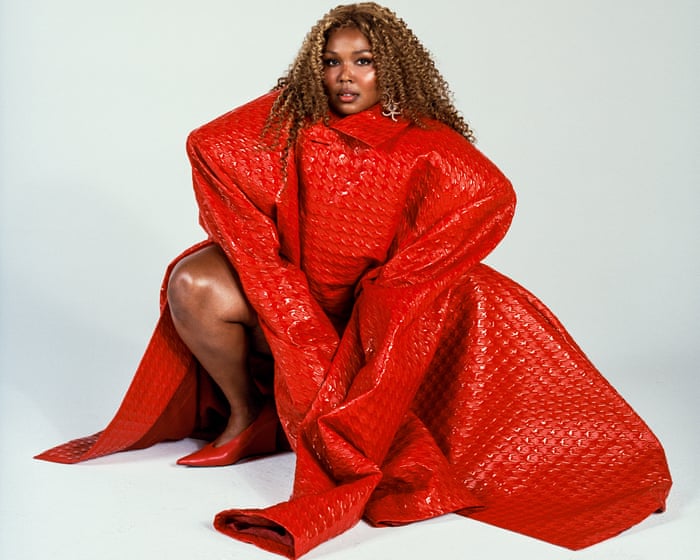
Photograph: Shaniqwa Jarvis/The Guardian. Clothing: Feather boa, Taller Marmo. Sunglasses, Port Tanger at Gogosha Optique. Necklace and earrings, House of Emmanuele. Previous images: Coat, Kilian Kerner. Earrings, Lillian Shalom. Pink Top, Pleats Please Issey Miyake. Sunglasses, ZAHA by Naomie Hadida at Gogosha Optique. Dress, Tyler McGillivary. Bra, CUUP. Rings, Lillian Shalom.
As she says, many friends have stood by her – some famous, some not. In August 2023, just after the allegations first came out, Beyoncé namechecked Lizzo in a performance of her song Break My Soul (“Lizzo! I love you, Lizzo!”). SZA also spoke up, saying, “Based on the values and the energy I see in my friend, I really think she’s a beautiful person.” Lizzo has also thanked her boyfriend, comedian and actor Myke Wright, for being “extremely supportive,” saying, “He doesn’t ask for anything from me, nor does he need anything from me. He pours into me. He takes care of me.”
She tells me she’s ahead of the rest of the world. While we’re still obsessed with the allegations and their impact on her, she has moved on. “I get it. It’s a big thing that happened to me. But it’s so far behind me. Maybe it’s not behind the general public or the media, but it is for me.””It’s so behind me.” She points out that the album ends with Goodmorning!, a song that embraces the present and pushes the past back where it belongs. “I’m proof that no matter what happens, you’ll wake up and have the chance to make that day better than the one before,” she says now. This is Lizzo, the queen of positivity, speaking. I really want to believe her. But I’m not completely convinced.
How can she have put it all behind her when the case is still ongoing? A few weeks ago, on Instagram, she released an alternate version of the song Bitch, with the lyrics: “I fantasize about the trial and exposing the lies / Then everyone will see that they were plotting my downfall.”
I ask her if there’s a difference between Lizzo and Melissa. Her pupils are now so dilated they’ve almost taken over the screen. “There is now. There’s a huge difference now. Lizzo has been my nickname since I was 14, and I was Lizzo to everyone. But now I put Lizzo in front to protect Melissa.”
Lizzo: Bitch review | Alexis Petridis’s album of the week
Read more
Who have I been talking to today? “You’ve been talking to Lizzo.” She lets out that familiar, larger-than-life laugh. “Lizzo, the diva, the pop star.” How different is Melissa from Lizzo? “Not that different, it’s just that the stakes are higher. Melissa needs to be protected. Lizzo can go out there, do interviews with sharp shooters like you, perform on stage, and troll people on Twitter. Melissa needs to be protected. The girl who wants everyone to be happy, who just wants to help, with a pure heart and pure intentions—she needs to be protected.”
I tell Lizzo it’s been great meeting her. And I tell Melissa to take care of herself. Bitch is out now.
Frequently Asked Questions
Here is a list of FAQs based on Lizzos statement Im a fat Black happy girlthey were always going to try to tear me down
BeginnerLevel Questions
Q Why did Lizzo say Im a fat Black happy girlthey were always going to try to tear me down
A She said this in response to online critics and body shamers She was explaining that because she is confident successful and doesnt fit traditional beauty standards some people will always try to bring her down
Q What does fat mean in this context Is it an insult
A Lizzo uses fat as a neutral descriptive word not an insult She is reclaiming the word to describe her body without shame similar to how other communities reclaim labels
Q Who are they that she says will try to tear her down
A They refers to online trolls body shamers and people who judge others based on their size race or confidence It also includes anyone who feels threatened by a happy successful person who doesnt fit the mold
Q Is Lizzo saying all criticism is just hate
A No She is specifically talking about cruel personal attacks about her body and identity She has been open about constructive feedback on her music or performances but she rejects bullying
IntermediateLevel Questions
Q Why does Lizzo think being Black and happy makes her a bigger target
A Shes pointing to double standards Society often expects Black women to be strong but not too loud or joyful A fat Black woman who is unapologetically happy and successful challenges stereotypes which can trigger more hate
Q Has Lizzo faced this kind of criticism her whole career
A Yes She has been bodyshamed since she became famous but the intensity grew as she gained more mainstream success Shes addressed this in songs like My Skin and Soulmate
Q What is body positivity and how does Lizzo connect to it