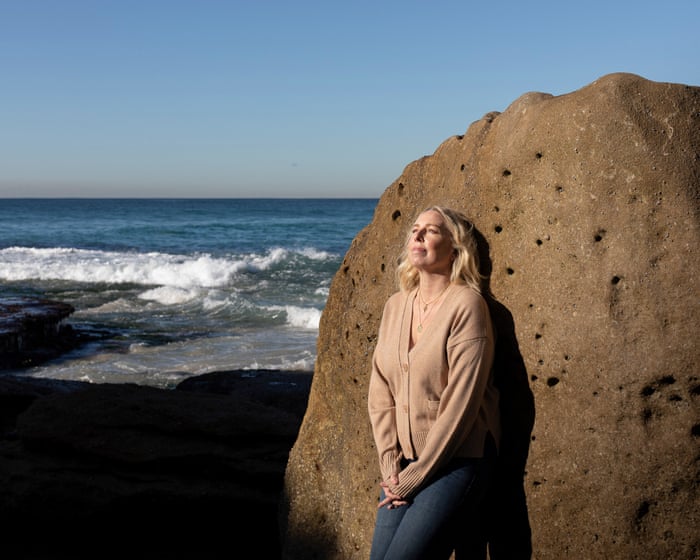
Before surfers enter the water, they study the ocean. They look at the wind and the tides. They examine currents, wave patterns, breaking points, and swells. They try to read the waves. I have traveled across oceans and a day to sit here on Tamarama beach in Sydney on a high-tide weekday morning in 2024. A notebook and pen lie beside me on the sand as I, too, try to read the waves, to find meaning in their endless churning.
Over the past ten years, this beach has stayed in my mind. Even when I’m not here, it’s as if my face is turned toward these waves, and I’ve been knocked around—sometimes stumbling, sometimes falling, always bracing for the next wave to roll in. Because I’ve learned that it only takes one ocean, one day, to sweep you off your feet.
Sydney, 2014
It’s an ordinary Wednesday afternoon in Sydney, the first week of July, when two plainclothes police officers knock at our front door. I’m not home to greet them. I’m a few streets away, buried in my studio, wrestling with the tangled threads of a novel, when I get a call from my husband’s PA.
“I’ve had a call from a Bondi detective,” she tells me. “They were asking for your address. I can’t reach Matt.”
I grab my laptop but leave everything else in place and try Matt’s number as I half-run, half-walk up the steep hill to our house. No answer. I call our childminder. “Weird question but has anyone come to the house?”
“Yes,” she says. Her voice is different, strained.
“Police?”
“Yes.”
The red front door to our tiny sandstone cottage is shut tight. Through the glass pane I see two figures in dark clothing standing in our living room. I fumble for my keys. The door opens and I cross the threshold.
“Hannah Richell?” they ask. I guess I nod, and they introduce themselves as police detectives. One of them, I think, has tears in her eyes.
I glance between them, my panic rising, until the more composed of the two comes right out with it. “I’m sorry to tell you your husband has been in a surfing accident.”
“Is he OK?” I’m already running through childcare options to make a hospital dash.
“I’m afraid he died.”
I’m still in my coat and boots. My laptop bag hangs from my shoulder. I look down at the old wooden chest that stands in the front room, doubling as a coffee table, and notice an unfamiliar box of tissues sitting on its surface—a box of tissues I have not bought or placed there. A small part of my brain, one not yet numbed by shock and disbelief, registers that the police must have brought it. I look at the tissues, then back to the police. My bag slides from my shoulder to the floor.
On the way to the morgue, I gaze out of the window. He is dead, I keep telling myself. You are going to view his body. But I don’t truly believe it. I will see the body and I will feel only relief, because of course it won’t be him. There is no way it can be him, my warm, vivid, drily funny, thoroughly alive husband. It will be another man, belonging to another family, who are at this very moment unaware of the tragedy that awaits them. I will leave the morgue dizzy with relief and return to the life I should be living.
But it is him.
And it isn’t.
The body in the blue gown lying on the gurney belongs to my husband, but it isn’t my husband as I knew him. What lies before me is a stiff wax model of the man I love.
Matt. But not Matt.
It is the longest, shortest, most loving, most painful hour of my life. One hour alone, to kiss and caress him. To stroke his stubbled cheek and hold his hand and lay my head upon his chest and weep. Kissing his temples, I see the cuts on his face and a diamond crosshatch line of stitches across the back of his head from the autopsy. The sight of those stitches makes me reel. They have cut open his beautiful skull. The one I absent-mindedly caressed while reading on the sofa, the prickle of his shaved head under my fingers. The one my three-year-old daughter woHe would stroke his shoulders while high and giggle, calling him “spiky.” I try not to think about what else they might have had to do to him.
From our rough start—when Matt joined the London publishing company to take the promotion I’d wanted—to a deep bond built through travel, marriage, and kids, I sit in this quiet, closed morgue and recall words I wrote in my diary as our first New Year together approached. “Don’t let him hurt me,” I’d written, begging some unseen power. I think I knew, even then, that a love like this could break my heart.
View image in fullscreen
Hannah and Matt on their wedding day in 2007. Photograph: Hannah Richell
Wendy, a counsellor from the forensic science team, comes in and sits quietly with me. “You’re very affectionate with him,” she says.
“I thought his eyes were opening,” I tell her, knowing how crazy it sounds to still hope they might.
“That can happen,” she admits. “Muscles can relax.”
“He smells different.”
“They will have washed him,” she says.
Though maybe not as carefully as they’d planned, because when I try to hold his stiff hand, grains of Tamarama sand fall from his palm into mine. They feel like a last gift: a piece of the country he loved so much. Precious. I want to scoop up the sand and take it home, carry the grains in a locket, but they slip through my fingers and fall to the floor, disappearing with the sound of my crying and the last kiss I leave on his lips.
I text Adam, the friend who was with Matt when he died. “Hi, this is Hannah, Matt’s wife. Yesterday must have been terrible. Are you OK?” We tread carefully, staying politely cautious, until Adam offers to come to our home and walk me through what happened. He’s a stranger at my front door, but the moment he steps inside, I’m with him. The connection feels instant and real. We sit for a couple of minutes on the sofa in our front room, but the kids are noisy in the background and the house feels cramped and all wrong. “I need to get out of here. Can we get some air?”
Adam looks relieved.
We walk to the park and sit on the grass. It’s strange, but out here, in the sunshine and clean air, I feel calmer. Adam’s presence is comforting, like a blanket, muffling me from the horror of the last few days. Slowly, he begins to tell me about the accident. He talks about their joy paddling out from Bronte beach, two work friends choosing to talk shop on their surfboards rather than over lunch in an overpriced restaurant. “Surely this must be the definition of success?” Adam had said.
“Yep,” Matt had replied, and when Adam says it, he delivers it just as Matt would have. In that one word, I can see Matt in his wetsuit, straddling his board, salt water in his stubble and a wide grin across his face as he gazes towards the horizon.
He must have had hope, until that last wave, rushing at him, pushing him forwards. The cliff rising up.
Adam tells me of the suddenly shifting tide conditions and of seeing Matt’s board come loose. He describes the rip, pulling Matt dangerously close to the rocky Tamarama headland. I sense his internal struggle as he relives the tragedy, and I sit quietly, listening.
Adam’s explanation comes to its end. The swallows are dancing around us, twisting and looping over the grass. I lean back and close my eyes. For the very first time since I arrived home to find the police in my house, I feel my heartbeat begin to slow in my chest. It’s shock—madness—but for a moment it’s as if he is here with us. Three people, not two, Matt’s presence hovering lightly between us.
“Have you talked to Wendy?” Adam asks.
“Wendy at the morgue?”
“She offers counselling. You might want to call her.”
My mum appears at the far edge of the park with the kids. They have a soccer ball. I point them out and Adam sprints aWatching him kick the ball back to my son, they look like any other father and child in the park—just a man and a boy passing a ball across the grass. But as I watch them, a deep ache spreads through me, reminding me of everything our children have lost.
Grief is like a sinkhole, opening up where real life used to be. It’s a dark, endless void that swallows everything I hold dear. In a single day, one crashing wave destroyed life as we knew it. The world feels off balance. How do you process something so huge when everything around you keeps shifting and moving?
I go to see Wendy for a counseling session. We sit facing each other in a small room with no windows, a box of tissues ready on a side table. I’m getting used to where they place those tissues. These days, I’m never far from one.
Wendy takes a breath and smiles a greeting. “Hello,” she says. There’s a quiet stillness between us as we look at each other, both aware of the step we’re about to take. Her first question is how I feel about coming to see her. I think it over carefully, trying to make sense of the nervous energy buzzing inside me. “Excited,” I reply, then worry she’ll think I’m losing it.
“And why is that?” she asks, her expression calm.
“Because this was the last place I saw Matt. It feels like I’m coming back to him… although I know I’m not,” I add, sure she must think I’m crazy. “I guess I’m excited to talk about him. Glad to be doing something.”
I feel that familiar ache in my throat, the one that holds all my broken pieces together. “I can’t bear this pain. I need to know how long it will feel like this. I miss him.” And that’s all it takes—I break down in tears.
Wendy doesn’t judge me. There are no rules, nothing off limits in our conversations. Over the months that follow, I learn that in this room with this woman, there’s never judgment—only compassion and a listening ear. Wendy gives me a safe space to explore everything Matt is and was to me, a place where I can open up the dark shell of grief. I think about her job title: forensic counselor. I like that. She lets me examine the details of my grief, not just the big picture of loss but all the tiny, specific pieces I need to go over. And when I leave through those sliding doors, I feel lighter than when I walked in.
Days and months pass in a lonely, dull routine, with a low, breathless panic beating in my chest. I try to get back to my novel, but my brain feels like molasses. I don’t know if it’s exhaustion from being a single parent, grief, or something physically wrong with me, but I can’t focus enough to write fiction. I have no energy for creativity or imagination. “No one ever told me that grief felt so like fear,” writes CS Lewis. I’m full of fear—for the future, for my children, that they’ll grow up with only a faint memory of their father.
A friend tells me about “memory jars,” how they can help grieving children hold onto happy memories and start conversations about the parent they lost. We sit down with pens and paper and begin talking about the things we love and remember about Matt.
My daughter remembers swooping and giggling with her dad on the round saucer swing in the park. My son recalls curling into the crook of Matt’s arm when he read him a bedtime story. I remember the special light in Matt’s eyes whenever he came out of the waves after an ocean swim. We all remember the particular grumpiness he got when he was hungry. I write each memory on a slip of paper and drop it into the jar.
“Singing Frozen songs at the top of his voice in the car.”
“He made the best Yorkshire puddings.”
“He loved us… anWe loved him,” my daughter says.
The kids, needing a sudden escape from the emotion, race outside. I can hear them squealing and laughing in the courtyard, on the edge of meltdown. It’s heartbreaking to reduce the love of your life and the father of your children to fragments of memories scrawled on pieces of paper, but it feels important. They remind us that he existed and the love was real. I turn the jar under the light, scraps of folded paper trapped in glass. How can it ever be enough?
It’s an early spring day when I take the kids to the beach, a gentle bay with a dappled park, a shark net, and tapering cliffs that curve to embrace the thin crescent of sand. It has been chosen carefully. No surf. No swell. No obvious signs of danger. We lay our towels on the sand, unpack fruit and water, buckets and spades, before the kids make a break for freedom.
“Wait! Sunscreen! Hats!”
My son returns grudgingly and allows me to apply the necessary sunscreen, then turns and scampers along the shoreline, lost to the sensory experience of the gently lapping water. I see him stop, then run back. “I’ll put your suncream on, Mummy.” He looks worried, and I hate this new responsibility he bears.
Friends arrive. We drink coffee and watch the children dig tunnels in the sand. Go for a swim, Han. It’ll do you good. I hear it just the way Matt used to say it – teasing, goading, slightly exasperated at my reluctance to hurl myself into the cold waves he loved. I study the water, gently undulating, turquoise. I haven’t been into the ocean since his accident, but the water looks enticing, hardly foreboding.
Fine, I think. Have it your way.
I wade out quickly, eager to get through the chill and minimise the onslaught of emotion before diving under, my body tightening at the sensation of being enveloped. Not thinking. Just doing. Losing myself in movement.
A little way out, I stop and float on my back. Blue below me and blue above me. My skin has cooled enough to feel the water like an embrace. I let go and for a moment it’s as if I am not being held by the water but by Matt. I feel him, right there with me, the warmth and pressure of him, and it is the strangest, most unearthly feeling.
Settled there, I find the perfect, fleeting glimpse of him from another time, another beach. Shaved head, broad shoulders tapering to a slim waist, feet planted in the sand and arms folded. He is sun-speckled and his beard – longer in the holidays – is salt-crusted and scratchy. I notice how, even in this memory, his eyes don’t leave the sea. Whenever I think of Matt by the ocean, it is always like this. Turned away from me, his gaze fixed on the waves he was so drawn to.
More and more, I find myself thinking about Matt’s last moments. Not so much the actual sequence of events now, but the experience of them. The sensation. The decision, turning to paddle, feeling the wave lifting his board. The surge of the water. The snap of his leg rope, the surfboard going in one direction as the rip took him in the other. The wash of water. The scrape of rocks.
I think he must have had hope; he was a hopeful man. The hope of pulling himself out. The hope of survival, until that last wave, rushing at him, pushing him forwards. The cliff rising up. A churn of salt and sunlight – a final letting go to blackness.
I hope it was peaceful.
I hope he didn’t know he was about to die.
I hope he knew we were with him, holding his hand in that moment, loving him. Always.
It is Wendy who tells me, nearly two years later, that an inquest will be held. She explains it is not about pointing fingers or finding fault, but to see if things could be done differently in the future. She adds, gently, that as Matt’s death was so high-profile and in such a popular beauty spot, it is deemed to be “in the public interest.””Interest.” Such a jarring word for something that feels so deeply private, but I nod. The last thing I could bear is for another family to go through a loss like ours, knowing it might have been prevented.
For two days, the fast and dangerous chain of events that led to Matt’s death is told over and over. The facts are laid out, carefully gathered and recorded by the coroner, until the last witness steps down and the coroner closes the hearing to consider all the evidence.
In the quieter days that follow, I retreat to the coast. I find myself thinking more and more about acceptance. The formal process seems to have lifted something inside me. I feel calmer, more balanced. I know he is gone. I know my life has changed forever.
I know now that grief will never leave me. It will always be part of me, just like the love it comes from.
But can there ever be a final stage to grief? I’m not sure there can. The pendulum keeps swinging back and forth, though with less sickening force. And the pain still rises often, as steady as the tides, the absence of Matt a deep ache. What feels different is how I hold myself, the pain more often tucked away inside, less visible to others. The grief is a weight I now hold almost sacred, my body building the strength to carry it.
I realize I’ve been looking at the idea of acceptance all wrong. It’s not about things being right. There will never be anything right about Matt’s death. No, acceptance is allowing it to be, whatever it is. Letting go of the need for things to be different. Acceptance is seeing a new path open up before you, not the one you thought you’d be taking. It’s seeing that path wind ahead and finding the strength to step onto it, one foot at a time.
I get the house ready for sale, sorting through our belongings for the move ahead. Going through the things from our life together isn’t easy, but it’s the last hours in the house that hurt the most. Wandering alone for the final time, I revisit the empty rooms, my footsteps echoing strangely through the space. I look out at the Japanese maple we planted, new purple-green leaves shimmering in the morning light. I let my hand trail up the polished wooden banister, take the creaking steps to the first floor. It’s all so familiar, so touched by us. I know it almost as well as my own skin.
I sit on the floor in my son’s room by the window and let the tears fall. I think of all the moments that made up our lives here. Big and small. Joyful and painful. Through the windowpane, I can see the spire of the church across the road. I remember noticing it the first time Matt and I looked at the house. I think of how many times we tiptoed into this room to check on our sleeping boy. To pick up a fallen toy. To tuck his small body under a sheet. Time breaks my heart. I wonder what of ourselves we’ll leave behind. A lost note, fallen behind the mantelpiece? A stray marble caught between the floorboards? Or maybe just the lingering feeling of lives bound by love and loss, the simplicity of our everyday, echoing in these empty rooms.
Our story here has ended.
I thank the house. I lock the door. I leave.
Tamarama, Sydney, 2024
Golden hour is settling over Tamarama, the sun sliding low onto the hill behind the beach. I’ve been here a while, moving through a decade of grief, honoring and weighing the shifting burden of our loss. With time and patience, I’ve returned to writing, found comfort in books and reading. Slowly, I’ve relearned the world, stitched my heart back together.
Down at the water’s edge, I step into the shallows, the waves washing the sand from my skin. It’s cold, but my feet are planted. Steady. I can breathe, my chest no longer tight and pained. These waves won’t knock me over today.
“Grief became my brand”: Freya Bromley on writingI know now that grief will never leave me. It will always be part of me, just like the love it comes from. What changes is that I begin to want to embrace it – to make it mine. And in that embrace, in pulling it close and looking at it closely, grief has shifted from something ugly and unbearable to something softer, more like love than pain. So when I hear a song on the radio that reminds me of Matt, I can smile now and quietly say thank you.
The waves still come, but we keep going, living lives shaped by both wonder and grief, the two side by side. I think of those on the path, a little behind me. Am I brave enough to share my writing as a way of comfort and support?
The surfers are still out there, sitting on their boards as the waves roll in, sometimes chasing one all the way to the shore. I know everything has its time, and that one day I, too, will be called to take my place in the lineup. But as I stand here in this golden hour, facing the horizon, thinking about this ocean and that day, and all the days that came before, and all the impossible, joyful, painful, beautiful ones lived since, I feel only gratitude to be here, holding this love and this pain.
You will survive your greatest loss.
You will be changed, but you will survive.
Listen to the breathing of your heart. It will show you the way.
This is an edited extract from An Ocean and a Day by Hannah Richell, published by Bedford Square at £16.99. To support the Guardian, order your copy at guardianbookshop.com. Delivery charges may apply.
Frequently Asked Questions
Here is a list of FAQs based on the topic When my husband died in a surfing accident my life as I knew it fell apart A decade later heres what Ive come to understand about grief
General Questions
1 Is it normal for your life to feel completely over after a sudden traumatic loss
Yes A sudden traumatic loss shatters your sense of normalcy and your vision for the future Feeling like your life has fallen apart is a natural albeit painful initial reaction Its your brains way of processing a massive shock
2 How long does grief actually last
Theres no set timeline The acute overwhelming pain usually softens over time but grief doesnt have an end date Its not something you get over but rather something you learn to live with A decade later the grief is still there but it changes shape and becomes less consuming
3 Does the pain ever go away completely
No the sharp searing pain of those early days doesnt completely vanish It evolves What changes is your relationship with it You learn to carry the love and the loss together and the pain becomes less frequent and less intense often replaced by a bittersweet feeling
4 Is it okay to feel happy again years later
Absolutely Finding joy again doesnt mean you loved your husband any less It means youve found a way to integrate the loss into your life Honoring your grief also means honoring the life youre still living
5 Why do I feel like Im forgetting them as time goes on
You arent forgetting them The intense memories that were once at the forefront of your mind are now becoming part of the background of your life This is a natural part of healing You are moving from a state of acute grief to a state of continuing bonds where their influence is still present but less allconsuming
Coping and Practical Advice
6 What was the most useless thing people said to you
Things like Hes in a better place or At least he died doing what he loved were not helpful They felt dismissive of the immense pain and the unfairness of the loss Its better to simply say Im so sorry