At 3:30 a.m., Vello Senkel was woken by a knock on his door. His neighbors were standing there with an urgent request: “Do you have salt? We want to boil macaroni.” He agreed to help, but it soon became clear that salt wasn’t the only thing they were missing: “And do you also have macaroni?” As he tells this story the next morning, smoking a cigarette outside his apartment building, his warm face—framed by white hair that reaches his jaw—shows both amusement and disbelief.
Senkel, whose nickname is Velho (Finnish for “wizard”), is known for his skill in the kitchen. In his apartment, which he shares with 77 other formerly homeless people in a Helsinki suburb, he shows me his fully stocked freezer. From his neatly organized fridge, he pulls out jars of pickled cabbage and shrimp salad that he has prepared to bring to a friend’s house for lunch later.
Senkel, 67, moved here three and a half years ago. Before that, he had been living on the streets of the Finnish capital for ten days after being evicted from his home. Earlier, he had been diagnosed with borderline personality disorder, and he had suffered a devastating loss. His partner, whose photo sits framed on his bookshelf, died after spending two years in a coma, which began when her heart failed while she was sleeping.
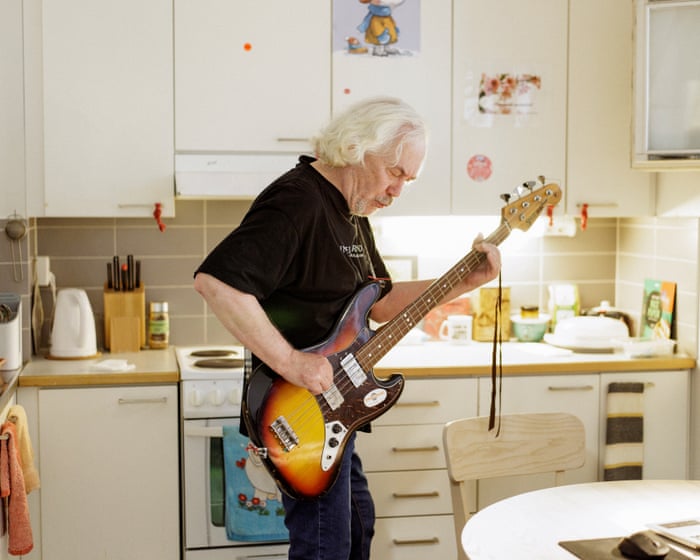
After getting a place here, he slowly started to build a new life. Besides cooking, he enjoys playing a bit of guitar every day. He brings his bass into the kitchen and becomes emotional as he plays along to an Estonian power ballad (he is originally from Estonia).
Having this apartment, he says, has “changed everything.” The housing unit, which is attractively arranged around a courtyard in converted student accommodation, follows the “Housing First” principle that has made Finland a world leader in tackling homelessness. The model treats housing as a fundamental human right rather than a reward. Temporary accommodation is not seen as a solution but as something to be avoided. All support is focused on making sure people have permanent homes, with everything else—treatment, healthcare, employment—following from that. In the long run, advocates say, it is cheaper for the state to keep people permanently housed, as it reduces pressure on other public services.
Another key part of Housing First for Senkel is the 24-hour staff support. Without it, his home would have been a “black hole” of loneliness. He feels understood by the staff here, he says. He has an agreement with the management that if they don’t see him for 72 hours, they will get in touch.
In a communal living room and dining area, porridge and coffee are served every morning, and there is a weekly community meeting to discuss any issues. Residents can volunteer to do small tasks, such as cleaning shared spaces or picking up litter, in return for a small fee that is paid directly into their bank accounts. “You are precious,” a notice on the pinboard says. “We listen and support and together with you we build the life that is true to you. Your pathway, our shared journey.”
Marko Lahtela, who manages the unit where Senkel lives, says their tenants come from a range of homeless situations: some come directly from the street; others may have been evicted from their apartment or had problems paying rent. While housing is essential, it is by no means an instant fix. Many have substance-abuse issues or other long-term problems, which means building trust is vital. It is “more of a marathon than a sprint,” he says. There is no limit on how long you can live here. Some haven’t left since it opened in 2022; others move on to more independent forms of accommodation after just six months.
Tenants range in age from their early 20s to their 60s, but the most common demographic is men around 40. There are two apartments for married couples, but the rest are single-person homes. Usually, people coverThe rent starts at around €850 (£728) a month and can be covered by benefits or, for those who have one, a pension. The unit, run by the health and social care provider Rinnekodit, has many success stories, but the system isn’t perfect. Lahtela notes that there isn’t enough in place to prevent people from falling into rental debt, which can lead to eviction after two months—and for some, a return to the streets.
Since 2008, when the Housing First principle became the foundation of all homelessness policies in Finland, the country has seen remarkable results. Between 2012 and 2023, homelessness increased across Europe, but in Finland, the number of homeless people dropped by more than half, from about 8,000 to roughly 3,400. Homelessness statistics are notoriously hard to measure, but for context, the number of people experiencing homelessness in Spain rose by about a quarter between 2012 and 2022. In December, the charity Shelter reported that homelessness in England had risen 8% in the past year, reaching a total of 382,618—including a record number in temporary accommodation—and that rough sleeping had increased by 20% in just one year. Finland’s success has drawn attention from politicians worldwide, including Britain’s new prime minister, Andy Burnham. In his first speech as PM, Burnham pledged to end rough sleeping in England, and he recently launched a £442m campaign to “get everyone in for Christmas.”
But is Finland still the model? Not long ago, the goal of former Social Democrat prime minister Sanna Marin’s government to end homelessness by 2027 seemed within reach. However, in the last three years, sweeping cuts to social services, healthcare, and benefits by Finland’s rightwing government have reversed the country’s success story. The latest national survey, from last November, found that the number of homeless people had risen for a second consecutive year, to 4,579 people—a 20% increase from the previous year. Key factors cited in the government’s own report include rising housing and living costs, benefit cuts, and more cases of substance abuse and mental health issues. Homelessness has especially increased among women, under-25s, and people with non-Finnish backgrounds.
As people come through the doors for breakfast at the cozy former restaurant premises of Vailla vakinaista asuntoa ry (No Fixed Abode), an NGO founded by homeless people 40 years ago, it’s striking how young many of them are. After picking up food donated by a local conference centre and coffee, people sit down at long tables under low-hanging lights, with a TV playing in the background.
Sitting down for breakfast, Jari Häkkinen, 57, says finding a place to live isn’t the problem—finding one that his benefits will cover is. He’s determined to keep the pensioner’s apartment he’s found, but it’s €14 over his monthly limit. “I’m fighting to get that €14 a month no matter what,” says the former construction worker.
Another visitor, who asked to be named only as Leila, joins the conversation. She’s been homeless for nearly 12 years and currently lives under a nearby bridge. “They are saying [Finland is a] happy country. It is not true,” she says, referring to its reputation as the world’s happiest country. “This is the reality you see.”
There is no ‘one size, one idea, one model, one type of support service,’ says Erja Morottaja of No Fixed Abode. The organization serves breakfast, lunch, and coffee throughout the day, and in winter, when Helsinki temperatures can drop to -30C, they run a night cafe where a small number of people can stay safe and warm. Visitors can also pick up new clothes and speak to peer workers for support and advice.Right now, they get around 100 visitors a day, and that number doubles in the colder months.
“There’s no one-size-fits-all approach, no single idea, model, or type of support service,” says Erja Morottaja, head of communications at No Fixed Abode. “Some people might need quite light support, while others need a lot more.”
Suski Kankaanmäki, 44, now works there as a peer worker, but she first came as a homeless visitor after being evicted in 2015. For six months, she spent her nights on trains and in railway stations around Helsinki—catching the last train somewhere, sleeping at the station, then heading back to the city in the morning. After that, she spent nearly a year in “hidden homelessness,” cooking, cleaning, and walking a friend’s dog in exchange for a place to sleep. It was better than sleeping outside, she says, but there was an uncomfortable power imbalance.
During that time, she managed to get an apartment, but it quickly became a “drug using centre.” Having grown up in 11 different children’s institutions, it took her a while to figure out how to build a stable life. She got help from social workers with managing her finances, but it wasn’t until a major health scare in 2021 that her life truly turned around. The feeling of not being safe is still there, says Kankaanmäki, and she never stops being on alert, but she’s optimistic about the future and is training to become a nurse. She wants to work at a Housing First unit.
Based on what she’s seen here, Kankaanmäki is fairly sure homelessness numbers will keep rising. NGOs are being stripped of resources, and new groups—like working people on low incomes—are becoming at risk of losing their homes. There aren’t enough shelter places, she says, so people are sleeping in shopping centres, stations, public toilets, and Helsinki airport.
Last year, homelessness in Helsinki—which has the largest homeless population in Finland—rose by 25%, to 979 people. The added strain is being felt at the city-run Hietaniemenkatu service centre, one of three places offering emergency short-term accommodation. It’s meant to be for one night, though many stay longer. Staff say they’re seeing more women, especially elderly women, and more people with jobs than before. There’s a sense that the country’s most vulnerable have been left to fend for themselves. “We all came to the conclusion that it’s because of the current government,” says social worker Viveca, who can’t give her last name for security reasons. “There are cuts to everything. The only place they didn’t cut from is the rich.”
Its 52 emergency housing places, with multiple beds per room, are free but in high demand. From there, residents can apply for one of its 52 temporary housing spots, which are individual rooms but cost up to €14.60 a day. There’s a day centre with showers, washing machines, and a sauna, plus access to health and housing support. However, staff say there’s something of a revolving-door phenomenon at the centre, where people keep coming back because they lack the life skills to maintain a permanent apartment on their own once they have one.
Despite the recent slowdown in reducing homelessness, there’s still a lot other countries can learn from Finland. Arguably, the recent challenges make it an even better case study for Burnham and others.
Burnham visited Y-Säätiö (Y-Foundation), which played a key role in creating and implementing Housing First, in 2019. Since then, Y-Foundation—which owns more than 19,000 homes in Finland, making it the country’s largest nonprofit landlord—has twice been…He came to the UK to support Burnham’s Manchester homelessness programme, which was inspired by the Finnish model. Juha Kahila, head of international affairs at the Y-Foundation, is excited about what has already been achieved. For people who have been homeless, dedicated housing units with 24-hour on-site support are not the only option. The vast majority of formerly homeless people in Finland live in “scattered housing,” he says: affordable homes spread among different demographic groups. During a walk around Jätkäsaari, a newly developed area of Helsinki built on a former container port, he is proud of how students, elderly people, and low-income residents live alongside prime real estate and green spaces. Often, the affordable housing looks nicer than the most expensive properties.
‘These are not numbers – they are people’: what ex-communist Slovenia can teach the world about child poverty
Read more
There are about 400,000 affordable homes in Finland (in a population of 5.6 million), making up about 30% of the total housing stock. When he talks about affordable housing – a term often misused by property developers – he means the actual construction costs of a property with no profit for anyone. “We have understood that the need has to come first,” he says. “It’s not about the number of affordable homes but how you target them that makes a big difference.”
Comfort and cosiness are often dismissed as a luxury, but they are actually a key part of Finland’s success in reducing homelessness. If an apartment isn’t cosy, you won’t feel safe there, says Kahila, as he shows me around a building where a third of the apartments are reserved for low-income musicians. And if you don’t feel like it’s yours, then it becomes just a roof over your head rather than a home.
“Home is something you want to decorate, you want to spend time there. When you close the door you can…” he pauses to take a deep breath in and out. “You can be whoever you want. It’s your safe place.”
Frequently Asked Questions
Here is a list of FAQs about Finlands approach to homelessness covering both its successes and recent challenges
BeginnerLevel Questions
1 Did Finland really end homelessness
No not completely Finland hasnt ended homelessness entirely but it has reduced it dramatically In the 1980s there were over 18000 homeless people Today that number is around 3500 They are the only country in the EU where homelessness is falling not rising
2 What is the Housing First model they use
Housing First is the opposite of the traditional treatmentfirst approach Instead of requiring a person to be sober employed or mentally stable before getting a home Finland gives them a permanent independent apartment first Then social workers and healthcare providers come to them to help with other issues
3 Why is giving someone a free apartment cheaper than leaving them on the street
Because homelessness is expensive When someone is on the street they use emergency shelters ambulances police time and hospital emergency rooms In Finland they calculated that providing a home plus intensive support costs about 15000 per person per year whereas leaving them on the street costs society about 20000 in emergency services
4 Do people in Finland have to pay rent
Yes they do They receive standard housing benefits from the state but they are expected to pay a portion of the rent themselves If they cant work the social security system covers most of it The key is that they have a normal lease just like anyone else
5 What is the difference between a shelter and the Housing First apartments
Shelters are temporary crowded and often require you to leave in the morning The Housing First apartments are private permanent and have a lock on the door The idea is that you cant fix your life if you dont have a safe stable place to sleep at night
AdvancedLevel Questions
6 What specifically went wrong recently Why is there talk of setbacks
The main setback is that the number of homeless people has stopped falling and has slightly increased in recent years particularly among young people and immigrants The reasons include a severe shortage of affordable rental housing in big cities like Helsinki rising rents and a cutback in the number of new Housing First units being built