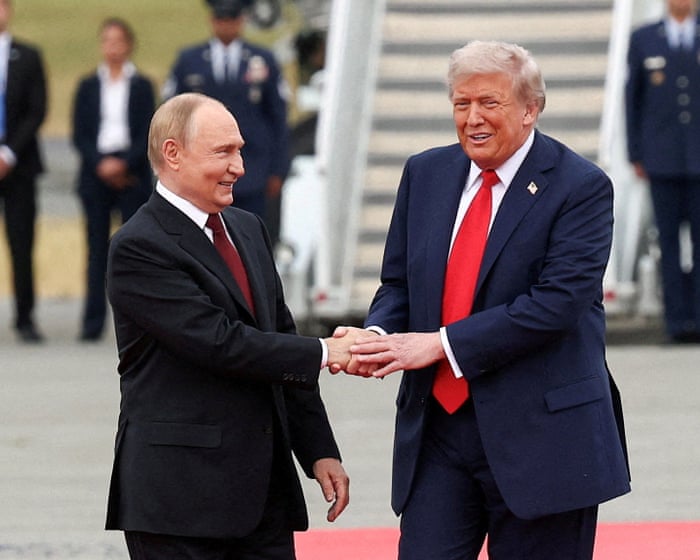
Historical comparisons are never exact. No two conflicts are ever identical. But Donald Trump’s shameless appeasement of Vladimir Putin carries a disturbing echo of Neville Chamberlain’s failed attempt in Munich in 1938 to prevent war with Nazi Germany. To be fair to the former UK prime minister—something history has largely not been—his peace efforts had the enthusiastic support of most people in Britain and France, who, like him, were desperate to avoid another war like the First World War. Trump has no such public support for his treachery. Nor does he face the prospect of a US war with Russia. His betrayal of Ukraine is cynically self-serving, globally dangerous, and utterly contemptible.
US-Russian talks on the shabby terms of a precedent-setting American sellout of Ukraine are at an advanced stage after meetings in St Petersburg this week. Trump has flip-flopped on the war since returning to office. Now, panicked by record-low poll ratings, he seems determined to scapegoat Ukraine and force its de facto surrender. Recent steps—his shocking decision to fund Putin’s war machine by buying Russian diesel, his waiving of tougher sanctions, his mysterious and deadly interruptions in US satellite and intelligence sharing with Kyiv, and his renewed attempt to oust Ukraine’s president, Volodymyr Zelenskyy—mark Trump out as a sneaking Judas, the cowardly Brutus of the modern age. He makes Chamberlain look like a man of iron principle. All that’s missing is an umbrella.
Why does Trump act this way? Partly, it’s personal. He doesn’t like Zelenskyy, and it’s obvious why. Ukraine’s leader is everything he is not: courageous, principled, morally unimpeachable, hard-working, and politically savvy. Partly, it’s about money and power. Trump has set his shrivelled, grasping heart on normalising relations with Putin’s repressive rogue regime, opening the way for lucrative deals on energy, raw materials, and control of the Arctic and outer space. He likes the idea of a world dominated by three all-powerful blocs and authoritarian leaders: himself, Putin, and China’s Xi Jinping. And partly it’s the unexplained, sinister hold Putin appears to exercise over this former society playboy, New York real-estate developer, and serial bankrupt.
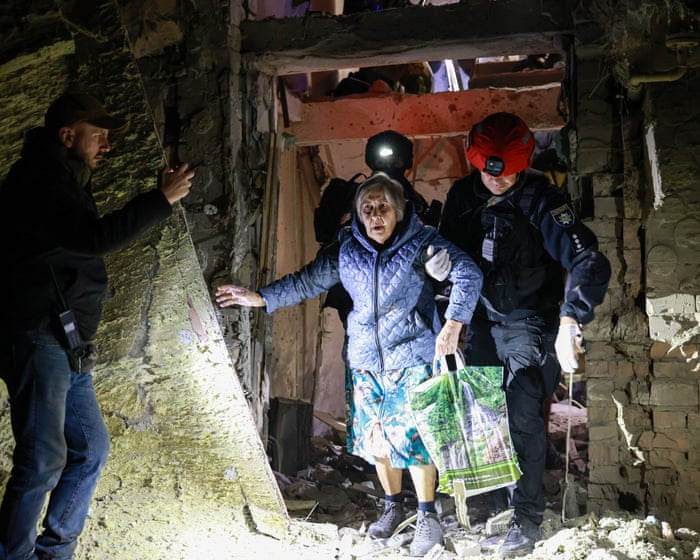
Whatever Trump’s motivations, the short-term consequences of his betrayal could be fatal for Ukraine’s bid to repel the Russian invaders and survive as a sovereign democratic state. For much of this year, Ukraine has been winning, or at least holding its own, in the contested lands of the Donbas and along the Black Sea coast. More than that, by using homemade missiles and drones, it has taken the fight to Russia’s industrial heartlands and oil refineries, significantly undermining Putin’s ability to fund his war. Zelenskyy has also been winning the battle for international opinion, particularly in Europe, which itself is under escalating Russian hybrid attack. Amid Trump’s egregious backsliding, European nations have taken the lead in supporting Kyiv militarily, financially, and diplomatically.
It’s hard not to wonder whether there’s a connection between Trump’s sudden, divisive, decisive lurch toward unabashed support for Putin and the fact that Russia—suffering unsustainable battlefield casualties, severe economic damage, and deepening international isolation—is at increased risk of a humiliating regime collapse. Whatever the truth, Trump’s Putin bailout—his duplicitous Russia rescue act—could turn the tide.
Trump’s perfidy is the shame of the world, and it is the world—not only Ukraine—that will pay the price over the longer term. This calculated attempt to force Kyiv’s submission endangers everyone. Ukraine, if it is allowed to fall, will haunt Europe and the wider geopolitical landscape for decades, as was the case with Czechoslovakia after 1938. Trump’s Molotov-Ribbentrop-style pact with a warmongering dictator, an indicted war criminal, a smirking, bigoted mass murdererThis could fatally weaken the Western alliance and mean the end of NATO as an effective defense against Eastern totalitarianism. Which democratic governments in Western Europe—in the Élysée, in the German and Polish chancelleries, in Brussels, or on Downing Street—can now trust a word coming out of Washington? Its bond is broken, its honor in tatters.
Trump’s betrayal follows a pattern of lesser treacheries: arbitrary tariff wars against trading partners, the smearing of loyal allies, threats against Canada and Greenland, abandoning a two-state solution in Palestine, and most recently, his disastrous war against Iran—the real reason US midterm voters, facing inflated fuel prices, are turning against him and his Republicans. But his Russian folly may be the most egregious and consequential. As MI5 has warned, Britain and Europe are under daily attack from Russia—its spy networks, saboteurs, cyber warriors, and paid agents. Reports this week suggest it is also threatening Western space satellites. Don’t look to turncoat Trump for help. He’s on the other side.
Trump’s Munich moment is a disaster in the making for Europe’s security and defense. A Putin victory, accepted and facilitated by the US, would do lasting damage to respect for international law and sovereign borders. Countless war crimes and crimes against humanity would go uninvestigated and unpunished in a partitioned, fractured Ukraine. China and others might soon follow the precedent set by successful Russian aggression. For all these reasons, Britain and its European allies can no longer afford to hold back. Indignant speeches at the UN, off-the-record murmurings, and carefully calibrated verbal slaps on the wrist will not suffice, if they ever did. Andy Burnham, France’s Emmanuel Macron, Germany’s Friedrich Merz, and Canada’s Mark Carney must lead the way in confronting Trump head-on, even at the cost of a definitive break with Washington.
Tell Trump publicly to stop. Take concrete steps to punish him for rewarding Putin and prove that the world’s democracies will not be bullied and sold out. Tell him that if he really wants to be remembered as the US president who shattered the Western alliance and ensured the triumph of authoritarianism, then he can keep licking Putin’s boots—but he will be on his own. The UK, EU and NATO member states, Japan, South Korea, and other like-minded countries are far from powerless—economically, militarily, and in many other ways. And despite what polls may suggest, healthy majorities of their citizens reject the hateful far-right lies and sick populist myths that Trump and his pitiful imitators feed on.
The US ultimately leads the West by consent, not by right. Consent can be withdrawn. Burnham could start by ordering the closure of US military bases in Britain—offensive symbols of a hostile occupying power. At all costs, Trump’s treachery must not stand.
Simon Tisdall is a Guardian foreign affairs commentator
Frequently Asked Questions
FAQs Trump Ukraine and the Appeaser Comparison
1 What is this article actually arguing
Its an opinion column by Simon Tisdall arguing that Donald Trumps approach to Russia and Ukraine amounts to appeasementgiving concessions to an aggressorand that his stance is even weaker than Neville Chamberlains 1938 Munich Agreement
2 What does appeasement mean
Appeasement is giving in to an aggressive powers demands usually to avoid conflict The classic example is Britain and France letting Hitler take parts of Czechoslovakia in 1938
3 Who was Neville Chamberlain
He was the British prime minister who signed the 1938 Munich Agreement with Hitler famously promising peace for our time It failedHitler kept expandingand Chamberlain became a symbol of naive concessions
4 Why does the writer say Trump makes Chamberlain look like a man of iron principle
Its a rhetorical jab The writer means Trump has made concessions to Russia with even less resistance than Chamberlain showed so Chamberlain looks tough by comparison
5 What specific actions are critics pointing to
Common criticisms include pushing Ukraine toward negotiations from a weak position questioning or pausing military aid at times making friendly overtures to Vladimir Putin and suggesting Ukraine might have to give up territory
6 Did Trump actually betray Ukraine
Thats the columnists characterization not a settled fact Supporters say Trump is pursuing a negotiated end to the war and pressuring Europe to do more Critics say his approach rewards Russian aggression Its a genuine policy debate
7 Is this a news report or an opinion piece
Opinion It appears in The Guardians opinion section and reflects the columnists view not a neutral news account
8 Whats the difference between aid pause and aid cutoff
An aid pause is a temporary halt a cutoff is a permanent end Pauses have happened a full permanent cutoff has not been the stated policy
9 What does negotiating from a position of weakness mean
It means entering talks while your side has less leveragefewer weapons less battlefield momentum or wavering alliesso youre likely to get worse terms