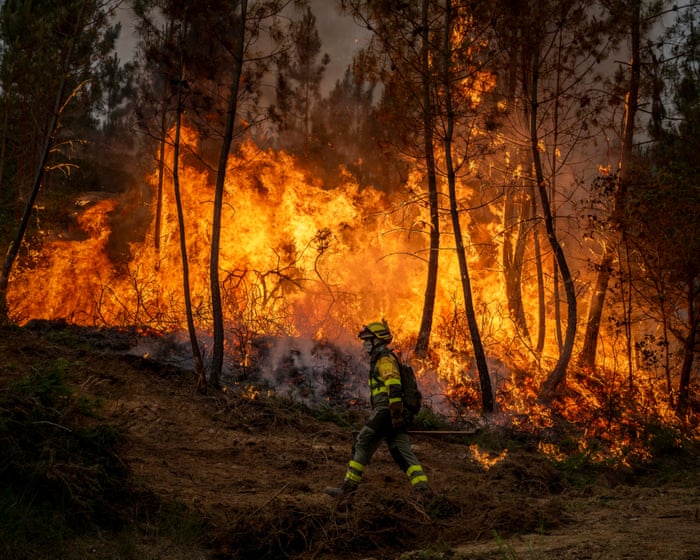
Are we finally getting it? As Europe burns in the west, south, and north, are we realizing that our economies, food systems, political stability, and even our ability to plan for the future will all be scorched in a world on fire?
Paris got a glimpse of what’s coming for us Europeans when, weeks ago, flames tore through the Fontainebleau forest—a bouldering paradise and one of the world’s first nature reserves. But the wildfires now threatening Bordeaux and Madrid, which experts call the most extreme Europe has ever seen, are apocalyptic in comparison. In the Gironde region around Bordeaux, tens of thousands of hectares have burned, creating what the region’s top official called an unpredictable “thunderstorm of fire.” More than 200,000 people have been evacuated in the largest peacetime displacement in French history. Only the bravery of firefighters—dozens of whom have been injured—is keeping the flames within a few kilometers of Bordeaux and its over one million residents.
In Spain, multiple fires have merged on the outskirts of Madrid, forming “the largest fire in Spain’s history.” It has burned more than three times the average July area, as yet another heatwave threatens the country. Scientists blame “weather whiplash” from the accelerating climate crisis for bringing the fires so close to the ancient streets and squares of Madrid and Bordeaux. From Sicily in the south to Norway in the north, the story is much the same: a summer of almost unbearable heat has erupted into storms of flame.
Across the Atlantic, thick smoke drifting south from fires across Canada’s 270 million hectares of boreal forest once again darkened the skies over US cities. Some MAGA-aligned politicians responded not by offering firefighting help—as Canada has consistently sent to US states in need—but by proposing sanctions or tariffs on Canada. As if the problem, to minds clouded long before the skies ever were, is a lack of raking.
A catastrophe this big will inevitably be politicized. Spain’s prime minister, Pedro Sánchez, condemned disinformation and conspiracy theories about the fires. French opposition figures have criticized the government for delaying the purchase of two additional Canadair firefighting planes, while the government accuses the opposition of using tragedy for political gain. But why should the blame game stop at borders, when the carbon we’ve all emitted is drifting through our shared atmosphere?
To borrow a phrase from Animal Farm, we are all responsible, but some are more responsible than others. In this case, the US is the biggest culprit: it has emitted more than one-fifth of all historical emissions and remains by far the highest per-capita major emitter, alongside Saudi Arabia. To be fair, Canada isn’t far behind, and smaller Gulf states like Qatar deserve a special mention of shame too.
It would be one thing if the US were guilty of historic emissions while making a serious effort to change. China, for all its own problematic emissions, is at least fostering breathtaking growth in renewables and now dominates the world’s green industries as a result. Instead, the US has almost always been stubborn—or worse—about the crisis. US fossil fuel, energy, and auto companies hid evidence and blocked action for decades, while the US government undermined and withdrew from the Kyoto Protocol under George W. Bush, promoted a fracking boom under Barack Obama, and withdrew from the Paris Agreement during Donald Trump’s first term.
The US has gone so far beyond stubbornness during Trump’s second term in the White House that it can only be described as waging ecological warfare. The phallic mantra of “drill, baby, drill” guides an administration where the slightest care for the Earth is already too woke. Green policies aren’t just being dismantled—fossil fuel use is being increased.Fossil fuel use is being pursued with reckless abandon. This conflict essentially pits the US against the rest of the world. So let’s take America’s MAGA senators and congresspeople at their word: as the skies fill with smoke and forests turn to ash, shouldn’t the United States—the most guilty party of all—be made to pay?
As the Guardian recently reported, countries individually responsible for less than 2% of global emissions still make up the largest group, collectively accounting for 33% of the world’s emissions. No single country can tackle this catastrophe alone, but there’s no collective solution without every country making cuts.
When it comes to Europe, there’s something else important we can do: use the power of the single market to force the world’s worst ecological offender to change course, or at least make it pay to fund the global effort to adapt to the climate crisis.
For most of the past year, European industry and right-wing parties have been pushing to weaken or slow down regulations, thinking the way to stay economically competitive is to race Trump’s America to the bottom. That’s not the answer. It’s economic suicide to race toward a future where nothing is insurable, crops fail on a massive scale, hundreds of thousands of evacuees become millions of displaced climate refugees, and these disasters push public finances to the breaking point.
To protect its political and economic future, Europe must accept that the US’s environmental war requires an economic response—coordinated with other players, including China. Let’s expand the EU’s emissions trading system (ETS) carbon market to all sectors, strengthen the “carbon border tax” to guard against retaliation, impose tariffs on US finished goods and services that have easy alternatives, and place export taxes on materials and intermediate components used in US-based production. All that revenue could then be pooled, shared, and set aside for decarbonization and adaptation.
This might sound absurd. But what’s truly absurd is that this is only the beginning. This is what three decades of inaction and insufficient action have led to. What would be truly absurd is letting the US, under the control of a handful of villainous, ecocide-driven billionaires and ideologues, drag us all into the abyss of even more years of catastrophic inaction.
Alexander Hurst writes for Guardian Europe from Paris. His memoir, Generation Desperation, is out now.
Frequently Asked Questions
Here is a list of FAQs based on the themes in Alexander Hursts article written in a natural conversational tone
General Context Questions
1 What does Europe is burning actually mean in this article
Its a metaphor for the severe climate crises hitting Europe like record heatwaves wildfires and floods The author argues these disasters are a direct result of inaction on climate change
2 Who is Alexander Hurst and why should I listen to him
Hes a European columnist for The Guardian who writes about politics culture and climate His perspective is relevant because hes observing the crisis from inside Europe where the effects are currently very visible
3 What is the main point of this article
The main argument is that the US is actively harming global climate efforts and that Europe must fight back with strong sanctions If they dont the climate crisisand Europes own fireswill get much worse
Questions About Trump US Policy
4 How is Trump attacking climate action
By rolling back environmental regulations pulling out of international agreements promoting fossil fuels and denying climate science The article suggests this isnt just bad policyits a deliberate attack on global progress
5 Why would Europe need to sanction the US over climate
Because words and diplomacy arent working The author argues that if the US is actively sabotaging the planet Europe should treat it like any other economic threatby putting a price on that damage like a carbon border tax or trade penalties
6 Isnt sanctioning an ally a bit extreme
The articles point is that the situation is extreme If one countrys actions cause massive fires and floods in another the victim has a right to defend itself Sanctions are framed as a last resort to force change
Questions About Europes Role Strategy
7 What can Europe actually do to stop the US
Europe can use its economic power The main tool mentioned is a Carbon Border Adjustment Mechanism a tax on goods from countries with weak climate rules This would make US exports more expensive and hurt the US economy
8 Why is Europe in a unique position to act
Europe is still a major economic bloc with strong climate