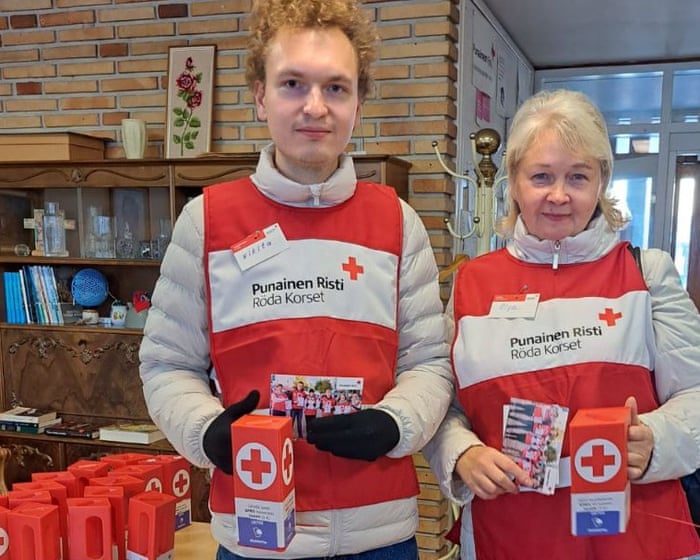
A Russian family facing deportation from Finland—after being denied asylum multiple times despite the threat of arrest, imprisonment, and torture for their pro-Ukraine activism—has won a court appeal, and their case will now be reviewed again.
Nikita Belov and his mother, Olga Belov, fled Russia for Finland in 2022 after drawing the attention of Russian authorities for opposing the full-scale invasion of Ukraine. This included a military summons, threatening messages, and attempts to track them down.
They were set to be deported from Finland within weeks after the Finnish immigration service said they faced “no real risk” if they returned to Russia. In April, they were briefly detained by authorities while awaiting deportation.
The administrative court has overturned the deportation order, citing new evidence—including media coverage in Finnish, Russian, and international outlets—and has sent the case back to the immigration service for a fresh review.
The Belovs’ situation has also gained political attention in neighboring Norway. Last week, politicians from Norway’s Green party tried to intervene, proposing that if the Belovs were deported, Norway should offer them asylum instead.
Bill Browder, a political activist and critic of Putin who heads the Global Magnitsky Justice Campaign, called the case “a defining test of Europe’s commitment to protecting those who have risked everything to oppose Putin’s war.”
Nikita, 25, left his engineering job at a Moscow research institute specializing in metallurgical technologies after learning his work was tied to Russia’s war effort.
Since arriving in Finland, Nikita and Olga, 55, a nurse anesthetist, have been vocal supporters of Ukraine, sending humanitarian aid, including to the Ukrainian armed forces.
Olga said the court’s decision was the first positive news they had received in four years, but it was overshadowed by “constant uncertainty and fear of deportation.”
She added: “My health has deteriorated over these four years, and we still have to wait for a final decision. This is very stressful, and nobody knows how long it will take. This experience has already left a lasting mark on our lives, and we will have to cope with the consequences. No matter what, I’d like to thank everybody who helps us, supports us, and literally saves us from death.”
Nikita said: “Previously, when I imagined my reaction to a positive decision, I was sure it would be a very emotional moment. But actually, I felt nothing. It’s weird, but now it seems to me that I’m already mentally exhausted. We still have to wait for a final decision.”
Their lawyer, who asked not to be named for security reasons, hopes they will be granted asylum soon. “The court has overturned the negative asylum decision as the clients have provided so much new evidence on them being profiled as being at risk of persecution,” they said. “The international attention and vast media coverage on the case and whether it puts them at risk has to be assessed accurately by the Finnish immigration service.”
Browder, whose friend and lawyer Sergei Magnitsky died at the hands of Putin’s regime, said the latest decision was an “important victory for Nikita and Olga, but it should never have got this far.”
He added: “Finland is on the frontline of defending Europe against Putin’s aggression. It would be completely perverse for it to send two people who have stood publicly against that aggression straight back into Putin’s hands. I hope the Finnish authorities will now grant Nikita and Olga the protection they deserve.”
Antti Lehtinen, the director of the department for international protection at the Finnish immigration service, said he could not comment on individual cases, but added: “Only approximately 5% of all decisions are returned for reconsideration each year.”The vast majority of these cases happen because the applicant provides new information about their situation during the court proceedings. “As a result, the asylum decisions made by the Finnish Immigration Service align well with national legal practice and are also consistent with the typical decision-making standards of EU member states.”
Frequently Asked Questions
Here is a list of FAQs about Finland stopping the deportation of a Russian family who spoke out against the war in Ukraine
General Background
1 What exactly happened with this Russian family in Finland
A Russian family living in Finland was facing deportation back to Russia They had publicly spoken out against the invasion of Ukraine which put them at significant risk if they were forced to return Finnish authorities have now decided to halt that deportation
2 Why did Finland decide to stop the deportation
Finlands main concern is the safety of the family By speaking out against the Kremlin and the war they are considered at high risk of persecution arrest or worse if they were sent back to Russia The Finnish government has a duty to protect people from being sent to a country where they face serious danger
3 Why was the family being deported in the first place
The initial deportation order was likely due to a rejected asylum application or an issue with their residence permit Their public antiwar stance is the new critical factor that has made returning them to Russia unsafe which has now changed the decision
4 Is this a common policy for Finland
Finland like all EU countries has a strict rule against sending people to countries where they face torture persecution or serious harm While every case is unique this decision is based on that fundamental principle of nonrefoulement
Legal Policy Questions
5 What does nonrefoulement mean in this context
Its a legal term that means a country cannot force a refugee or asylum seeker to return to a country where their life or freedom would be threatened Finland is applying this principle here arguing that sending an antiwar activist back to Russia would be a direct violation of their human rights
6 Does speaking out against the war automatically grant someone asylum in Finland
Not automatically But it is a very strong piece of evidence If a person has a public profile as a critic of the Russian government it makes it nearly impossible for them to live safely in Russia In this case the risk is so high that it overrides the original deportation order
7 What happens to the family now
Their deportation is halted meaning they can stay in Finland for the time being They will likely need to reapply for a residence permit or go through a new asylum process based on the new