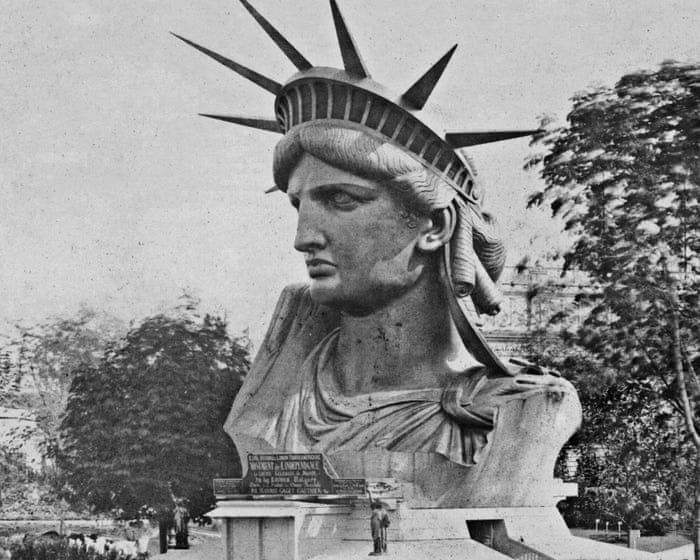
It was one of the most powerful political gifts of modern times: the Statue of Liberty, a huge neoclassical sculpture made in France and offered to the American people in the late 19th century. The size and symbolism of Liberty Enlightening the World (the statue’s original name) was meant as a mark of friendship to commemorate the centenary of the 1776 US declaration of independence. Delivered a decade late, it was also a reminder – perhaps a pointed one – of France’s critical role in helping the US break free from Britain.
The Statue of Liberty is now one of the world’s most recognised monuments, its creator, Frederic Auguste Bartholdi, less so – a situation Paris’s Musée d’Orsay is seeking to remedy with an exhibition highlighting the sculptor’s life and career.
As with most diplomatic offerings, there was an element of self-interest behind the idea of making such a spectacular gift to the US at such a specific time. Over a chic dinner at Versailles in 1865, the liberal politician Édouard Laboulaye suggested the gesture celebrating American liberty might prompt France’s authoritarian ruler Napoleon III, whom he and Bartholdi opposed, to introduce greater liberté at home.
Bartholdi agreed. The artist and sculptor, from Colmar in eastern France, was looking for a monumental project. In his 20s he had drawn up plans for a lighthouse in the form of a robed Egyptian woman bearing a torch to be placed at the entry to the Suez Canal, but it was deemed too expensive by Egypt’s ruler.
Work, however, could not start until after Napoleon III was deposed in 1870. In 1884 residents around rue de Chazelles, in the north-west 17th arrondissement of Paris, would have been amazed to see the statue rise gradually from the workshop to tower above the area, before it was taken to pieces, put on a train to Rouen and then shipped to New York.
View image in fullscreenThe Statue of Liberty, clad in scaffolding, rises above the streets of Paris in 1885. Photograph: Keystone-France/Gamma-Keystone/Getty Images
The Musée d’Orsay exhibition, which runs until 31 January 2027, features 100 works by Bartholdi and includes an immersive virtual reality journey showing the statue’s conception and construction to mark the 140th anniversary of its inauguration and the 250th anniversary of American independence.
The exhibition curators, François Blanchetière and Juliette Chevée, stress that Bartholdi’s concept of liberty was not that of the French revolutionaries. “It is a freedom based on the law, not on violence. The venture is artistic but also political, media related, technical and above all international and diplomatic,” they said.
Bartholdi and Laboulaye, who did not live to see the statue installed, hoped the Statue of Liberty would strengthen Franco-American friendship and ties. Bartholdi has been largely forgotten and the statue’s French connection often overlooked as it became a global symbol of freedom.
In his 2022 book Diplomatic Gifts: A History in Fifty Presents, the career diplomat Paul Brummell, now Britain’s high commissioner to Mauritius, traced how offerings from the Trojan horse to the Statue of Liberty had been used as political, propaganda and diplomatic tools since ancient times.
“Gifts these days are low-key,” he told the Washington Diplomat newspaper. “But looking back into history, diplomatic gifts went right to the heart of the thinking of the great kings. They didn’t hold back.”
View image in fullscreenThe giant panda Hsing-Hsing (left) nuzzles Ling-Ling in their US enclosure. Photograph: Bettmann/Bettmann Archive
But does gift diplomacy work? China famously gave the US two giant pandas, Ling-Ling and Hsing-Hsing, after President Richard Nixon visited Beijing in 1972, leading to the phrase “panda diplomacy”. In return the US sent Beijing two musk oxen named Milton and Matilda. The arrival of the pandas at Washington’s Smithsonian National zoo attracted more than a million visitorsIn their first month, they helped soften American public perceptions of China. Xi Jinping repeated this move this week, sending two pandas he called “envoys of friendship” to Atlanta Zoo. Trump gave Xi a sculpture of a bald eagle, the US national symbol.
In totalitarian North Korea, the windowless International Friendship Exhibition, 90 miles northeast of the capital, Pyongyang, has 150 rooms filled with gifts given to former leaders Kim Il-sung, who died in 1994, and Kim Jong-il, who died in 2011.
The eclectic collection includes an alligator holding a wooden tray of cocktail glasses with a matching ashtray from the Sandinistas of Nicaragua, a ZIS-110 armored car from Soviet dictator Joseph Stalin, a basketball signed by Michael Jordan from former US Secretary of State Madeleine Albright, and a copy of Björk’s 2007 album Volta.
The collection is meant to convince North Koreans isolated from the outside world that their leaders have international support.
Some diplomatic gifts have been hits, others misses. When then British Prime Minister Gordon Brown visited Washington in 2009, he gave Barack Obama an elaborate pen holder carved from the timbers of a Royal Navy anti-slavery ship. Obama’s gift to Brown was a DVD collection of the president’s favorite films.
More problematically, a symbolic button given to Russia by US Secretary of State Hillary Clinton in 2009 to signal improved relations and stamped with the word “reset” in Russian instead read “overcharge” due to a translation error.
Peter Ricketts, who spent 40 years in the diplomatic service and is a former British ambassador to France, said gifts between ministers were “a complete pain.”
“Anything above a few pounds has to be declared and either handed in or bought out of your own pocket, so for politicians they can be a bit of an embarrassment,” Lord Ricketts said. “At state visit level it can be a little different. [But] it has to be clever and really stand out as something special to make any difference.”
He said British royals had mastered the art of the carefully chosen gift and mentioned two that stood out as “really successful.”
The first was King Charles presenting Donald Trump with the original brass bell from the Second World War British submarine HMS Trump. “It was personal, historic, a lovely object and it was gold colored — President Trump loved it,” said Ricketts.
The second was Queen Elizabeth’s gift of a black Labrador puppy to French President Valéry Giscard d’Estaing during his 1976 state visit. “Giscard d’Estaing loved it and insisted on speaking to it in English all its life,” he added.
Royals regularly receive gifts. Elizabeth II received a giant grasshopper-shaped wine cooler that turned into an occasional table from French President Georges Pompidou in 1972. A tribe on Tanna, a remote island in the South Pacific, who revered Prince Philip as a living god — until his death in 2021 — sent the royal a grass penis sheath as worn by their rulers.
In 1826, Muhammad Ali, the pasha of Egypt, sent French King Charles X a female Masai giraffe called Zarafa, who lived in the Jardin des Plantes for 18 years until her death in 1845. But a camel presented to French President François Hollande during a 2013 visit to Mali was less fortunate; the animal was left for safekeeping with a family in Timbuktu but was promptly slaughtered and used in a tagine. Mali promised to replace it with a “bigger and better-looking camel.”
A few so-called soft-power presents have left a lasting legacy. In 1912, the Japanese capital Tokyo donated 3,020 cherry trees to the city of Washington DC. They still flower toEvery year since 1947, Oslo has sent London a tall Christmas tree to thank the city for welcoming its exiled government when the country fell to the Nazis. Similarly, the Netherlands sends 20,000 tulip bulbs to Canada each year in gratitude for Ottawa sheltering its royal family during the Second World War.
Frequently Asked Questions
FAQs Diplomatic Gifts
The Basics
What is a diplomatic gift
A diplomatic gift is a present given by one countrys government or leader to another It can mark a visit a treaty an anniversary or just help build goodwill
Why do countries give each other gifts at all
Gifts are a friendly gesture They say we value this relationship without needing a formal speech They also create a personal bond between leaders which can make future talks easier
Is the Statue of Liberty really a gift
Yes France gave it to the United States to celebrate friendship and shared ideals of liberty It was dedicated in 1886 and funded by donations in both countries
Are the pandas China sends also gifts
Sort of Most pandas sent abroad are loans under conservation agreements not outright gifts But the tradition started in the 1940s70s with actual gift pandas so people still call them panda diplomacy
Why pandas
Pandas are rare cute and uniquely Chinese They attract huge public attention which makes them a powerful symbol of friendship and they quietly remind the world of Chinas role in protecting them
What Gifts Are Meant to Do
Whats the point of a diplomatic gift
Three main things build goodwill send a message and create a memorable moment A good gift says something about the giver and honors the receiver
Do gifts actually change politics
Rarely by themselves But they can open doors soften a tense moment or celebrate a strong relationship Think of them as relationship maintenance not dealmaking
Why not just give cash or something practical
Cash feels like a transaction not a gesture A gift with meaning shows thought and respect Practical items can work but they need a story behind them
Choosing the Right Gift
How do you pick a diplomatic gift
Match it to the relationship the occasion and the receivers culture Ask What does this gift say Will it be seen as respectful Is it appropriate for their customs
What makes a gift good
It should be meaningful culturally appropriate and not embarrassing in value Too cheap looks careless too expensive can look like a bribe Something handmade or tied