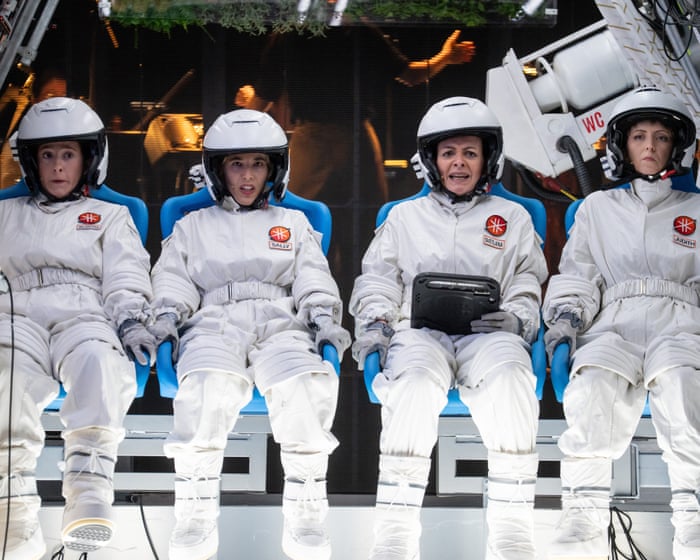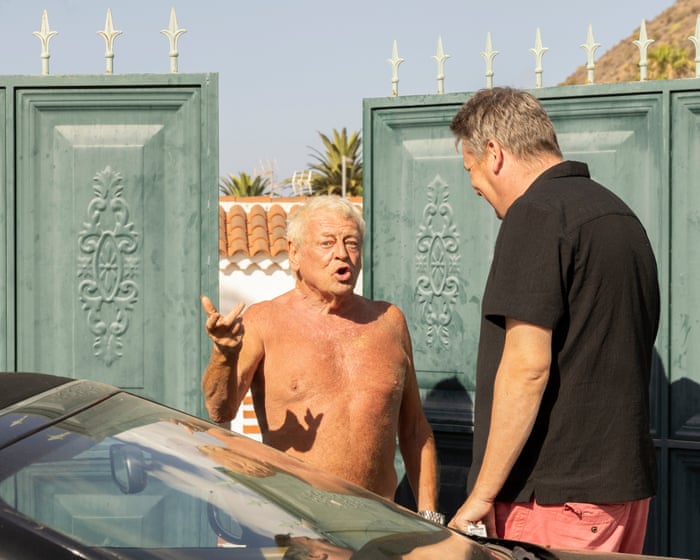
I have a picture of myself in 2011, pushing my newborn son in a big red stroller because he would only nap while moving. As I walked the streets of suburban Birmingham, I felt watched, glanced at, and commented on in ways that ranged from pity to disapproval to excessive admiration. I thought it was silly that this should be such an unusual sight, but there it was. I probably would have felt less self-conscious if I had followed David Bowie’s example and—as in one of the images shown here—worn what looks like a dress.
On how men and women are depicted in art history, John Berger famously said that “men act, women appear.” Men were shown demonstrating their physical power and readiness for action, asserting their dominance. Simply reversing that gaze and using the lens to capture masculinity feels subversive, maybe even a little undermining.
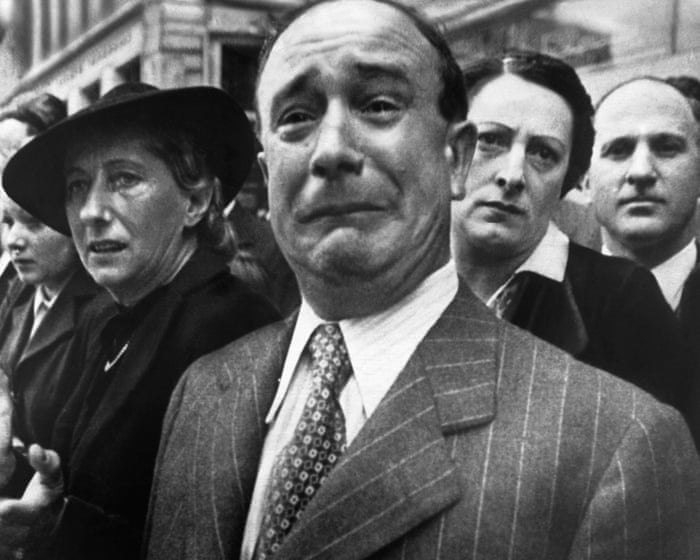
It’s strange that a quarter of the way through the 21st century, images of men crying—like the “weeping Frenchman” during World War II and Paul Gascoigne’s tears during the 1990 World Cup—can still seem remarkable. Judith Butler describes masculinity as a phantasm, a haunting fiction of invulnerability and toughness that is all the more powerful because it’s such a lie. We know this, but we’ve probably all played a part in enforcing it, knowingly or not. Boys are still told they shouldn’t be sensitive, that it’s somehow shameful.
These photographs are proof that masculinity carries strong connotations, histories, and counter-histories—a lot of baggage. However we choose to express ourselves, we stand in some relation to that baggage, and an image can either reinforce or challenge those associations.
Anyone with half a mind must feel some pity for a man who feels the need to be depicted in his finery, or in a way that expresses his prowess or authority—see Karen Knorr’s photographs satirizing the privileged postures of men in gentlemen’s clubs—but we’re still surrounded by them, like it or not.
Despite the wonderful range here, it’s interesting how conventionally muscular many of the men depicted are, from Eugen Sandow, the father of bodybuilding, to Arnie to Hulk Hogan. There’s an absence of the body type enjoyed by roughly 80% of men: basically OK, a bit lumpy, sporadically hairy. We might run a 3k every couple of weeks and feel so pleased with ourselves that we down a bottle of wine and a box of cheese straws the same night.
Judging by our media, one would think we were either waifs or muscle-men. Of course, the super-jacked male form is ubiquitous in film and television now, from Hollywood movies (where you expect it) to depressing ITV crime dramas (where you’d hope for a few more noodle arms and football-shaped tummies). Even the bang-average is barely represented; I feel like cheering when an even slightly flabby man takes his top off.
If there’s no body positivity movement for average men, that’s because men’s bodies are less likely to be scrutinized and judged. Certainly we don’t talk about body image much unless it’s in the context of the gym. It has only occurred to me in my 40s that I can marginally improve my appearance through exercise (I’m still not fully convinced and suspect I’m wearing myself out for no reason). We can say, “What do you bench?” but can’t say, “I’m feeling insecure about my jowls today.”
There’s a powerful defiance to the camp and the performative, to casually putting on a dress or a sarong as a straight man, already aware of the tedious reactions and thinking: “Yeah, and what of it?” There’s also a terrible self-consciousness to masculinity. I find the giant fake Warhammer-figurine shoulders of American football kits absolutely adorable. I’d feel the same about dictators on horseback if they weren’t dictators.
Depictions of queer masculinityOffer an alternative here, from Leigh Bowery’s magnificently confrontational surrealist portraits to Rotimi Fani-Kayode’s beautiful, sculptural compositions of black queer men. Deliberately rougher around the edges, Sunil Gupta’s Exiles series captures the underground (then illegal) culture of gay male life in India in the 80s: a furtive glance, a shy smile, the position of a cigarette, a palpable sense of risk. Protesters, pop stars and pioneers: 38 images that changed the way we see women (for better and for worse). Read more. The current resurgence of the crudest form of strongman masculinity feels overwhelming—a dictatorship of the most dysfunctional, damaged and spiteful parts of the male ego, emotionally unregulated and outright evil. It’s pervasive in the manosphere, but also in government and political administrations. I’ve heard it described as a death rattle before it finally goes extinct. That may be wishful thinking. So many current expressions of masculinity feel beneath contempt—but maybe they’re not. Maybe we should loudly express our contempt for them and hopefully speed their decline. Every significant photograph that enters the collective unconscious shifts our reality a little—the power of an image to either reinforce or undermine machismo is still profound. Luke Kennard is the author of Black Bag. Arnold Schwarzenegger, 1976. By Robert Mapplethorpe. View image in fullscreen. Photograph: © Robert Mapplethorpe Foundation. Used by permission. “He made no effort to seem overpowering,” wrote a Gay Times correspondent of Arnold Schwarzenegger in 1978, “but, rather, radiated a mild—nay—sunny, disposition.” In the 1970s, Schwarzenegger turned bodybuilding from a niche subculture into a national obsession. He combined an exaggeratedly masculine body with a sense that he was secure in himself. “He accepts the inevitable attention of gay men as a compliment,” concluded Gay Times. Robert Mapplethorpe took this portrait of Schwarzenegger in 1976, a year before the release of Pumping Iron, the hit docudrama that led to his Hollywood stardom. Mapplethorpe, who was celebrated for his images of queer and S&M subcultures, was particularly fond of this photograph, using it for postcards and party invitations. “Hot Dirty Man,” read the text over Schwarzenegger’s torso on one invitation from 1979. “You are invited to …” FB. Marlon Brando, 1950. By Warner Bros. View image in fullscreen. Photograph: John Kobal Foundation/Getty Images. “When Marlon Brando appeared on stage in a torn, sweaty T-shirt,” wrote Gore Vidal in 1985, “there was an earthquake.” Before Brando’s breakout performance in A Streetcar Named Desire in 1947, Hollywood leading men had been “nothing but a suit of clothes,” Vidal argued. Brando made it OK for a man to be a sex object. Many of the actor’s performances rejected the buttoned-up vision of masculinity in the films of the 1930s and 1940s. He was emotional, violent and physical. “I’d never seen anything as visceral,” wrote the critic Pauline Kael, remembering her first glimpse of Brando on stage in the late 1940s. FB. Oscar Wilde, 1882. By Napoleon Sarony. View image in fullscreen. Photograph: Sepia Times/Universal Images Group/Getty Images. “Great success here,” wrote Oscar Wilde of the American speaking tour on which this photograph was taken. “Nothing like it since Dickens, they tell me.” Though the 27-year-old had not yet written famous works such as The Importance of Being Earnest and The Picture of Dorian Gray, he was already a society sensation. His tightly controlled performance of a queer, urbane form of masculinity made him famous, but came with great risks. He was later imprisoned for gross indecency with men, and polite society turned on him—perhaps prefigured by newspaper digs at the time about the “effeminate” figure in this portrait. FB. Sessue Hayakawa, 1918. By Fred Hartsook. View image in fullscreen. Photograph: Alamy. You may not recognise him now, but Sessue Hayakawa was one of Hollywood’s first heart-throbs. Born in JapaHe moved to the US in early adulthood and became a major matinee idol with a star-making turn as the villainous lead in Cecil B. DeMille’s The Cheat (1915). He was then one of LA’s highest-paid actors. One photographer recalled Hayakawa arriving at a premiere to a horde of female fans who “spread their fur coats at his feet” so he could avoid stepping in a puddle. As an Asian leading man, Hayakawa had to endure a lot of racialized typecasting, and anti-miscegenation laws meant his characters never got the girl; when anti-Japanese sentiment rose in the 1920s, his star faded. He did enjoy a late-career comeback, however, with his Oscar-nominated role as the tyrannical Colonel Saito in 1957’s The Bridge on the River Kwai. GS
The Wrestlers, Kordofan, Sudan, 1949
By George Rodger
View image in fullscreen
Photograph: George Rodger/Magnum Photos
Nuba mountain communities in the Kordofan region of Sudan have faced violence from outsiders for centuries, from British colonial authorities to the Khartoum central government. Against this backdrop, a renowned tradition of wrestling tournaments developed. This image by Magnum co-founder George Rodger, of a wrestler hoisted on a supporter’s shoulders, brought global—and unwelcome—attention to the area. Former Nazi photographer Leni Riefenstahl produced controversial and exoticizing work there. “When they found out what was going on, people felt exploited,” said Sudanese professor Guma Kunda Komey. FB
Living With the Enemy, 1987
By Donna Ferrato
View image in fullscreen
Photograph: Donna Ferrato
It’s estimated that around one in four women worldwide have experienced physical or sexual violence by a male partner. Since the early 1980s, photojournalist Donna Ferrato has dedicated her career to documenting the devastating impact of these relationships. This photo is from Ferrato’s 1991 book Living With the Enemy, which includes texts based on conversations with victims and perpetrators. Over the course of the project, she spent time in women’s shelters as well as riding in police cars and staying in people’s homes. Here, an eight-year-old boy, Diamond, shouts at his father as he is being arrested at their home in Minneapolis: “I hate you for hitting my mother.” “I’d never seen a child stand up to his abusive father,” Ferrato later recalled. “That blew my mind. The mom hadn’t called the cops—the boy called the cops. He had just shown the police where his father had hidden the screwdriver.” GS
Teddy Roosevelt on a horse, 1898
Photographer unknown
View image in fullscreen
Photograph: Buyenlarge/Getty Images
“The most masculine president in the American memory,” according to one recent biographer of Theodore “Teddy” Roosevelt. He is pictured here on horseback when he was a lieutenant colonel in an army unit known as the Rough Riders. His carefully crafted butch image was, on closer inspection, a jumble of contradictions. Raised in extreme wealth, he was fond of being photographed in suspiciously pristine working-class clothing. And, plagued by physical infirmities since childhood, he was sensitive to any hint of weakness. FB
Repose in a gentlemen’s club, 1982
By Karen Knorr
View image in fullscreen
Photograph: Karen Knorr
Karen Knorr’s languid photograph, part of a series of 26 images she took in gentlemen’s clubs in Mayfair, London, captures how comfortable certain men feel luxuriating in hereditary privilege—”an archetypal image of aristocratic power,” in Knorr’s words. Each photograph is paired with a satirical text written by Knorr, who was inspired by parliamentary speeches and books about the British empire. “I wanted to make work that used irony and parody to explore attitudes prevalent amongst the English establishment in the 1980s,” she said. FB
Putin on a horse, 2009
By Alexei Druzhinin
View image in fullscreen
Photograph: RIA Novosti/Reuters
Russian president Vladimir Putin has a penchant for staging topless photo ops—always while partaking in a macho outdoor activity such as horse-riding o“It’s easy to laugh at,” says Ruth Ben-Ghiat, author of a book on the political figure of the strongman from Mussolini (who also liked to pose shirtless) to the present. “But using masculinity as an authoritarian tool is deadly serious. Strongmen use their bodies to proclaim themselves defenders of the nation, yet they often pose as victims as well.”
John F Kennedy with baby Caroline, 1958
By Ed Clark
“A vital element has been added to the well-planned and generously financed campaign to make Senator Jack Kennedy president of the United States,” reported the North American Newspaper Alliance in 1957: the Kennedys were expecting their first child, Caroline.
A year later, Life magazine staff photographer Ed Clark visited the couple’s family home in Georgetown. Clark later recalled that when he asked if he could take a photo of the senator with the baby, “Jackie said no, that she was upstairs asleep. But Jack bounded up the stairs, and I followed.”
Jackie ended up asking for 75 copies of “that marvellous picture” to give to family and friends. And after JFK became president in 1961, the framed photo hung in the Oval Office. His identity as a father of small children became a key part of his public image as a new kind of male politician: the youthful, vigorous leader of – to borrow his well-known phrase – “a new generation of Americans.”
The naked gunner, 1944
By Horace Bristol
This famous shot of a naked aeroplane gunner was captured by Horace Bristol, who was part of a group of photographers recruited to promote US naval aviation during the second world war. The aircraft had been sent to rescue a US marine pilot shot down while attacking Japanese forces at Rabaul Bay in the Pacific.
“One of our crew stripped off his clothes and jumped in … He couldn’t have swum very well wearing his boots and clothes,” Bristol later recalled. “As soon as we could, we took off.” Though the soldier has never been identified, his image quickly became a symbol of male valour and heroism in wartime.
Leigh Bowery, 1988
By Fergus Greer
“He was a dandy and a great eccentric,” remembered Leigh Bowery’s friend Donald Urquart in 2004, “in the tradition of Curricle Coates, Bunny Roger, Barbara Cartland, Edith Sitwell, and Quentin Crisp.” As a performance artist and “club kid” of the 1980s, Bowery’s intricately constructed – and sometimes controversial – outfits and costumes exploded traditional ideas of what a man could look like and what he could do.
In one famous performance, he birthed his friend and later wife, Nicola Bateman, out of a “vagina”, with an umbilical string of sausages trailing behind. Another was seen by painter Lucian Freud, who immediately asked Bowery to sit for him.
Bowery died in 1994 at 33 of an Aids-related illness. “I miss him,” friend and film-maker John Maybury said last year. “He was like a kinetic beacon, vibrating.”
Adrian Street with his coalminer father, 1974
By Dennis Hutchinson
Adrian Street went by many nicknames, including “the Exotic One”, “the Sadist in Sequins” and “the queen bitch of pro wrestling”. His catchphrase was, “Imagine what I could do to you,” finished with a suggestive, moaning, “Mmm …”
In the 70s, the Welsh former coalminer became famous for his taunting, butch, queer-coded persona. For a profile in a national tabloid in 1974, he arranged this striking photograph – much reprinted over the years – down his former pit with his miner father, who had disapproved of his career.
“That look, even though it’s outrageous, he would have said it was super-masculine,” says artist Jeremy Deller, who made a film with Street before his death in 2023. “It’s a challenge, isn’t it?”You’re challenging other people and society, so you have to back it up.” FB
Gun 1, New York, 1954
By William Klein
View image in fullscreen
Photograph: © William Klein Estate/Courtesy of HackelBury Fine Art, London
“It’s fake violence, a parody,” said William Klein of his 1954 photograph. “I asked the boy to point the gun at me and look tough. He did, and then we both laughed.” Klein saw the image as a “double self-portrait”; he himself was a mix of “the street kid trying to look tough, and the timid good little boy on the right.” Klein saw it as playful, but the twisted face of the child retains a threatening power. FB
The weeping Frenchman, 1940
By Marcel de Renzis
View image in fullscreen
Photograph: Historical/Corbis/Getty Images
This photograph – actually a still from a newsreel – was first published in Life magazine in 1941 to illustrate the fall of France after the Nazi invasion. As the Germans advanced, the French government decided to send the historic regimental flags of its armies to safety in Africa. Before they were put on ships out of Marseille, a parade was held through the streets of the town. It was here that cameraman Marcel de Renzis caught footage of a French citizen named Jerôme Barzetti weeping as they passed by.
The image is often cited as a rare example of public tears from a man, as taboos around male emotional expression have softened in recent years. A 2016 study found that modern men cry in public more than twice as often as their fathers. Barzetti’s tears, however, fit into a long history of martial crying, with roots in Homeric epics. According to one count, men are depicted weeping in the Odyssey more than 30 times. FB
Eugen Sandow, bodybuilder, 1895
Photographer unknown
View image in fullscreen
Photograph: Hulton Archive/Getty Images
“The most wonderful specimen of man I have ever seen” is how a Harvard professor described Eugen Sandow upon taking his measurements in the 1890s. By then, the Prussian-born athlete was a global fitness star. Today, he is remembered as the father of modern bodybuilding, having organised the world’s first major “physique” competition in London in 1901. “He’s Arnold Schwarzenegger before Arnold Schwarzenegger,” says sports historian Conor Heffernan.
As Heffernan explains, Sandow’s “lean and muscular physique” – still aspirational now – had previously been more associated with farmers and sailors than the perfect man. Images such as this helped to reinforce what modern bodybuilders refer to as the “Grecian ideal”: a physical type based on statues from the ancient world. (Although appearances can be deceiving, as Heffernan points out: the dumbbell Sandow is lifting is probably empty.) GS
The Invisible Man, 1952
By Gordon Parks
View image in fullscreen
Photograph: Gordon Parks/The Gordon Parks Foundation
In Ralph Ellison’s novel Invisible Man, the unnamed narrator, an African-American man, hides out in a basement in New York, which he lights with 1,369 bulbs. “Before that I lived in the darkness into which I was chased, but now I see. I’ve illuminated the blackness of my invisibility – and vice versa,” he says, before telling the story of a life that had, until then, been defined by ideas projected on to him due to his race and gender.
Gordon Parks collaborated with Ellison on A Man Becomes Invisible, a photo essay published in Life magazine to promote the book. The striking images recreate key scenes from the narrative; this one shows the final passage, in which the protagonist (played by John Bates, an actor friend of Ellison’s) emerges from his underground retreat through a manhole – a reclamation of his place in society. GS
The Cock (kiss), 2002
By Wolfgang Tillmans
View image in fullscreen
Photograph: Wolfgang Tillmans, courtesy Maureen Paley, London, Galerie Buchholz, Berlin, David Zwirner, New York
“You can show two men killing each other at three in the afternoon in any country in the world on public television,” said photographer Wolfgang Tillmans in an interview in 2022. “But you“can’t show two men kissing each other.” Ghetto was a cult London venue in the 2000s; at a club night there called The Cock, Tillmans captured a tender, passionate moment between two men. When the photograph was exhibited in Washington DC in 2007, one visitor reacted by slashing it with a key. It has since become a symbol of solidarity and resistance: after the shooting at Orlando’s gay nightclub Pulse in 2016, many posted Tillmans’ photograph as a defiant act of protest. FB
David Bowie pushing a pram, 1971
Photographer unknown
View image in fullscreen
Photograph: Trinity Mirror/Mirrorpix/Alamy
In this photograph, David Bowie is captured pushing a pram with his baby, Zowie, alongside then wife Angie. Laura King, a historian of modern Britain, explains its significance: “In the decades after the second world war, there was a real movement towards what I call family-oriented masculinity. Men often weren’t doing anything like what women were doing in terms of looking after children, but fatherhood was very much aligned with masculinity.” Pushing a pram became a way to signal your identity as an involved family man.
Bowie – the famously gender-bending icon – wasn’t exactly a typical dad of his time. “I don’t feel very paternal,” he told an interviewer in 1976. GS
Juan Pablo Rodríguez, 2023
By Santiago Barreiro
View image in fullscreen
Photograph: Santiago Barreiro
“Ballet is woman,” proclaimed the choreographer George Balanchine. The idea that it’s a dance form for girls persists today, especially in cultures where machismo is dominant.
Against this backdrop, Uruguayan photographer Santiago Barreiro documents the diversity of men’s ballet in Latin America. For Barreiro, his subjects offer an example of how traditional gender roles – which he has observed as deeply ingrained in Latin societies – can be deconstructed through art.
This portrait depicts Juan Pablo Rodríguez, a Colombian-born choreographer and principal soloist with the Ballet Nacional del Perú. Rodríguez told Barreiro that he sees freedom of expression as an act of resistance. GS
Hugh Hefner with Playboy bunnies, 1966
Photographer unknown
View image in fullscreen
Photograph: Keystone/Getty Images
Hugh Hefner’s urbane, sex-obsessed vision of masculinity “became central to what it meant to be a modern man” in the 1960s, says historian Amber Batura. Hefner would spin Playboy magazine – first published in 1953 thanks to a loan from his mother, among others – into a global empire of clubs, staffed by women wearing distinctive “bunny” uniforms.
Like Ian Fleming’s James Bond, Hefner modelled a fantasy of masculinity “as gratifying, masterly play”, in the writer Esther Allen’s words, “in which women were seen as a sort of consumer product”. As Hefner put it himself in 1992: “Much of my life has been like an adolescent dream of an adult life.” FB
Untitled, 1988
By Rotimi Fani-Kayode
View image in fullscreen
Photograph: Rotimi Fani-Kayode/Autograph
“Black men from the third world have not previously revealed either to their own peoples or to the west a certain shocking fact,” wrote the Nigerian photographer Rotimi Fani-Kayode in 1988. “They can desire each other.”
After training with the US photographer Robert Mapplethorpe in New York, Fani-Kayode moved to London and produced a stunning body of work from his Brixton home studio, before his death from Aids-related complications in 1989.
Mark Sealy, co-editor of a new book of Fani-Kayode’s work released this month, calls it a “radical transformation of Black male subjectivity”, made at a time when “the Black male subject was wrapped up in violent hostility via the press as muggers and bad guys”. Fani-Kayode’s work presented a subversive and playful vision of queer Black masculinity “at the height of Aids, in a very, very homophobic society”. FB
Hulk Hogan v André the Giant, 1987
Photographer unknown
View image in fullscreen
Photograph: WWE/Getty Images
“The virtue of all-in wrestling is that it is the spectacle of excess,” wrote RolandBarthes said that wrestlers are performers in a pantomime of rivalry and aggression. This photo shows one of the most famous matches of all time: the eagerly awaited showdown between Hulk Hogan and André the Giant (also known as Fezzik from The Princess Bride) at WrestleMania III in 1987. Pro wrestling had exploded in popularity, and a heavily publicized feud between the two superstars—who were actually good friends—raised the stakes. Hogan defeated the 520-pound (37-stone) André with his legendary “bodyslam heard around the world.”
GSGB. England. Wolverhampton. Wolves fans celebrate, 2012
By Martin Parr
View image in fullscreen
Photograph: Martin Parr/Magnum Photos
Over his 50-year career, Martin Parr repeatedly turned his camera on the football stadium—though as a dedicated chronicler of ordinary British life, he was less interested in the players than in the fans. In this 2012 photograph, we see a moment of pure euphoria for Wolverhampton Wanderers supporters, who have just scored in a home match at Molineux stadium.
“[Football fandom is] a way for people to access emotions. It’s very tribal,” Parr said in a 2022 interview. “It’s an important part of creating your own identity. Especially for men; it’s a very welcome way of letting your emotions go.”
There is a dark side, too: recent statistics show that racist and homophobic abuse is on the rise at matches, and reports of domestic violence once again spiked during this year’s World Cup.
GS
Billy Porter at the Oscars, 2019
By Frazer Harrison
View image in fullscreen
Photograph: Frazer Harrison/Getty Images
The actor Billy Porter is known for his bold, gender-fluid red carpet fashion. “This look was interesting because it’s not drag,” he told Vogue about the gown he famously wore to the Oscars. “I’m not a drag queen. I’m a man in a dress.” Inspired by a Renoir painting and made at short notice in just over a week of 18-hour days by designer Christian Siriano, Porter’s tuxedo dress drew huge attention—coming only a month after he wore a bright pink cape to the Globes, which in his words “changed everything for me.” The dress was later displayed at the Victoria and Albert Museum and has its own (extensive) Wikipedia page.
FB
Man With a Box. Fully Automated Nikon, 1973
By Laurie Anderson
View image in fullscreen
Photograph: Laurie Anderson
“I decided to photograph men who made comments to me on the street,” Anderson wrote of her 1973 series titled Fully Automated Nikon (Object/Objection/Objectivity). The artist displayed the images with white strips over the catcallers’ eyes, giving them anonymity while also symbolically taking away their ability to objectify her.
GS
Our Motherland Collective, 2023
By Hassan Hajjaj
View image in fullscreen
Photograph: Hassan Hajjaj/Courtesy of Our Motherland Collective crew, Vigo Gallery, London and Hassan Hajjaj
“Growing up in Morocco, we were definitely not afraid of colour,” Moroccan-British photographer Hassan Hajjaj has said. His playful portraits blend North African textiles with markers of global consumerism; his subjects often wear clothes he designed himself.
This image was part of Hajjaj’s recent My London Rockstars series, featuring portraits of artists in the capital, including Our Motherland Collective, a skateboarding crew that has evolved into an arts group. “The people in the pictures come from all different parts of the world, and when you start putting them next to each other, it becomes a positive image,” Hajjaj has said of his work exploring identity and multiculturalism. If his photos make a young person think, “Oh, I can be that person,” or, “I can be the person taking that picture,” he says, “that’s the greatest feeling you can have as an artist.”
FB
India Gate from the series Exiles, 1987
By Sunil Gupta
View image in fullscreen
Photograph: © Sunil Gupta. All Rights Reserved, DACS 2025.
“I had a personal motivation to establish an Indian gay presence i“In art history,” says the artist and photographer Sunil Gupta, who was born in New Delhi in 1953 and later settled in London in the 1970s, “it was hard for me to be postmodern because I had no references. So I decided to make the references.” He wanted to “visualise” the experience of gay men in Delhi.
Initially, “nobody wanted to be in the picture” – homosexuality in India wasn’t decriminalised until 2018. Eventually, Gupta was introduced to a network of gay men who agreed to model for the project Exiles (1986–87). The accompanying texts came from interviews he’d conducted at cruising sites around the city.
GSL’Enfant (man and baby), 1986
By Spencer Rowell
View image in fullscreen
Photograph: Dr Spencer Rowell
This year marks the 40th anniversary of one of the bestselling posters of all time: a photograph of a hunky man cradling a baby. Paul Rodriguez, art director of the poster retailer Athena, conceived the idea and recruited photographer Spencer Rowell. The image tapped into the archetype of masculinity that emerged in western culture in the 1980s: the New Man, who rejected sexist ideas around domesticity.
The model is Adam Perry, who later claimed to have leveraged the poster’s fame to sleep with more than 3,000 women – not quite a New Man, after all.
GS
Pregnant man, 1970
By Alan Brooking
View image in fullscreen
Photograph: The Advertising Archives
“Ever since that picture of a pregnant man was sprung on an astonished nation,” wrote a Daily Mirror columnist in 1970, “we men haven’t been able to stop wondering what would happen if we really did become pregnant.”
The public information poster, dreamed up by ad company Cramer Saatchi, caused a storm when it was released, aimed at increasing the “sexual responsibility of the male”.
Photographer Alan Brooking, now 98, remembers an extended search for the perfect model – a man in possession of “the subtle kind of embarrassment that one might expect in that situation”.
FB
Congo’s sapeurs, 2019
By Tariq Zaidi
View image in fullscreen
Photograph: Tariq Zaidi
“It is like a resistance movement for peace,” journalist and photographer Justin Makangara says of the sapeurs. “They are fighting with clothes.” The sapeurs of the twin Congolese capitals of Brazzaville and Kinshasa have become famous for their style.
Until recently, many regarded the sapeurs as “foolish, hooligans, idiot people” for spending so much money on flashy clothes. Recently, however, Makangara has seen a change in their public perception. Most sapeurs – like Celestin Moundounga, the 48-year-old technician here – hold down respectable jobs and are “responsible to the needs of their families”. And as the civil war grinds on in the east of the Democratic Republic of Congo, their way of life suggests that “even in conflict, we can try to be in joy”.
FB
*
David Beckham’s ‘sarong-gate’, 1998
By Harry Page
View image in fullscreen
Photograph: Harry Page/News Group
40 outrageous photos that changed fashion, from teenage Kate Moss to Twiggy in a mini and Lady Gaga’s meat dress
Read more
It was the 1998 World Cup in France, a peak moment for British lad culture. Then David Beckham was photographed wearing a Jean Paul Gaultier wrap. The Sun ran the photo alongside the headline “Beckham has got his Posh frock on”.
The footballer has stood by the look. “Sarongs are great,” he said in 2014. “I would still wear it now.” Today his bold outfit is recognised for cementing Beckham’s role as the poster boy for a new type of heterosexual male ideal: the fashion-forward metrosexual of the 2000s.
GS
Portraits of the Taliban, 2001
Unknown photographers
View image in fullscreen
Photograph: Collection T Dworzak/Magnum
Thomas Dworzak was on a photographic assignment covering the fall of the Taliban when he stumbled on a set of highly stylised studio portraits of soldiers of the former regime in a photo shop. The fighters had probably died before they could pick them up.
“I was very surprised, of course,” he says. The Taliban had famousThe Taliban banned all photography of living beings. He bought the prints—the start of a collection that was eventually published in the 2003 photobook Taliban. In these secretly commissioned portraits, the fighters pose against pastel-colored and scenic backdrops, holding props such as flowers and guns. Here, two men clasp hands. The unmistakable “camp aesthetic,” Dworzak explains, was “not specific to the Taliban”—such images can be found across the region. But they also couldn’t be further from what we expect a militant soldier to look like. GS
Daniel Craig with baby carrier, 2018
By Elder Ordonez
View image in fullscreen
Photograph: Elder Ordonez/SplashNews.com
The sight of a man with a baby strapped to him was too much for Piers Morgan in 2018, who posted this picture with the hashtag #emasculatedBond. Men responded in their thousands with photographs of themselves similarly “emasculated”—including wrestling star Adam Copeland holding his child while dressed as Elsa from Frozen. “Any man who wastes time quantifying masculinity,” tweeted actor Chris Evans at the time, “is terrified on the inside.” FB
*
Mods v rockers, 1964
Photographer unknown
View image in fullscreen
Photograph: Bentley Archive/Popperfoto/Getty Images
The clashes that arise between differing factions of masculinity could be summed up by this photograph of a brawl between mods and rockers in Brighton in 1964. That summer, long-standing tensions between the competing youth subcultures erupted in a series of confrontations during bank holiday weekends in seaside towns across the south of England. It’s now thought that the extent of the fighting was overplayed at the time—a moral panic stirred up by the establishment about the youth of the day. But the rivalry was real enough. The rockers, who rode high-speed customized motorcycles known as “cafe racers,” mockingly compared the Italian scooters of the “sissy” mods to their “mums’ hairdryers.” As one mod put it to a BBC interviewer at the time: “You can’t just stand and let a load of kids take the mick out of you, can you?” GS
Hells Angels, 1965
By Bill Ray
View image in fullscreen
Photograph: Bill Ray/The Life Picture Collection/Shutterstock
Hells Angels—the motorcycle gang founded in California—haunted the US psyche in the 1960s. They modeled a rebellious, hyper-masculine image, but were also—for the time—provocatively homoerotic, frequently giving each other “a sloppy wet kiss,” in writer Hunter S Thompson’s words. “It blows their minds,” said one Hells Angel of the effect on “squares”—”especially the tongue bit.” FB
Rusty, 2008
By Catherine Opie
View image in fullscreen
Photograph: Catherine Opie/© Catherine Opie, Courtesy Regen Projects, Los Angeles; Lehmann Maupin, New York, Hong Kong, London, and Seoul; and Thomas Dane Gallery.
An interest in “performing masculinity”—which she first explored in San Francisco’s butch lesbian community in the 1990s—eventually led photographer Catherine Opie to high school football. Her portraits of star players, taken just after practice, show “adolescent boys beginning to form and perform for the first time an image-ideal of manhood,” in the words of one critic. Opie also linked the series to the various wars that the US was involved in at the time. “So many young men were having to make very interesting choices between sports scholarships and becoming a soldier,” she has said. “It was actually very emotional.” FB
A Scottish Pub, 1968
By Jürgen Schadeberg
View image in fullscreen
Photograph: Jürgen Schadeberg
Historically, pubs and other drinking places were considered a “masculine republic,” somewhere for the menfolk to gather while their wives stayed at home. The notion of the watering hole as an almost exclusively male space—with notable exceptions granted to barmaids, landladies and loose women—is summed up in this image of an establishment in the working-class Gorbals district of Glasgow in 1968. German-born Schadeberg, best-kKnown for his portraits of life in South Africa under apartheid, he had been sent to the Gorbals to document an area in rapid transition: the old tenements were being torn down and replaced by modernist housing. GSPaul Gascoigne crying at the World Cup, 1990By Billy SticklandView image in fullscreen Photograph: Inpho Photography/Getty Images
“I had let down the fans, my team-mates, the manager, everybody,” Paul Gascoigne remembered in 2020. “I cried because I thought it was the end of my career.”
In 1990, 23-year-old Gazza had already won the public’s hearts with his skill at the World Cup. When he burst into tears after receiving a yellow card for tackling a West German player, the nation reacted with a mixture of sympathy and, eventually, mockery.
Today, men crying in public is a relatively uncontroversial part of major sports tournaments, with everyone from Tiger Woods to Roger Federer having a good sob. FB These 39 images are a snapshot of men’s lives – which other landmark pictures come to mind for you? Email saturday@theguardian.com
Frequently Asked Questions
FAQs Muscles Metrosexuals and Male Tears The 39 Photos That Changed How We See Men
1 What is Muscles Metrosexuals and Male Tears about
Its a photo essaycollection of 39 images that traces how images of men have shifted over timefrom musclebound ideals to the metrosexual era to men showing emotionand how those images shaped public ideas about masculinity
2 What does metrosexual mean
A term popularized in the 1990s2000s for a straight urban man whos openly into fashion grooming and style Its largely dated now since that kind of selfcare is mainstream
3 What are male tears in this context
It refers to photos of men crying or being emotionally vulnerableimages that challenge the old boys dont cry rule and show masculinity including feeling
4 Why do photos matter for how we see men
Images are repeated everywhereads magazines filmso they quietly set the normal look and behavior for men Change the images and you slowly change expectations
5 What kinds of photos are in the collection
Expect bodybuilders and fitness ads groomed metrosexual style shots and candid images of men in emotional momentsgrouped to show a timeline of shifting ideals
6 Who is this for
Anyone curious about gender media or photographystudents marketers and general readers No background needed
7 Whats the biggest takeaway
Ideas about manhood arent fixed Theyre built and rebuilt through images and they keep changing
8 How has the ideal male body changed over time
Its cycled between lean muscular and bulky idealsand gotten more extreme in advertising The ideal is a moving target not a fact
9 Did the metrosexual trend actually change anything
Yesit normalized men caring about grooming and appearance paving the way for todays skincare fashion and wellness culture for men
10 Is showing emotion still stigmatized for men
Less than before but yes Many men still face pressure to hide feelings which is linked to poorer mental healthso male tears images matter as normalization