What were the last words Brandon Guffey said to his son Gavin? Four years later, he still struggles with that question. “That last exchange bothers me all the time,” he says. “I think I said, ‘Goodnight, buddy. I love you,’ and he said, ‘I’ll see you in the morning.’ I really hope that’s what I said. The truth is, I’ll never know for sure.”
The exchange happened in July 2022, on a hot day in Rock Hill, South Carolina. Just weeks earlier, Guffey had won the Republican nomination to run for the state’s House of Representatives. The election was three months away, his head was full of politics, and he had spent that evening at a local event.
The house was quiet when he got home just before midnight. His wife, Melissa, had gone to bed. His two younger sons, Callahan, 4, and Coen, 16, were asleep, along with both family dogs. The only sounds were the summer cicadas and frogs calling from a nearby creek — and the laughter of his 17-year-old son, Gavin. He was gaming in his bedroom, headset on, talking with friends. It was the long summer break between school and starting college. “I often say Gavin was living his best life at that point,” Guffey says. “He had just become comfortable with who he was. He wasn’t trying to fit in or please anyone. He was looking forward to starting college and pursuing his dream of becoming an art teacher.”
A call came in on Guffey’s phone. He wishes he had never taken it. The thought that Gavin might have needed his dad when he was unavailable, talking politics on the porch outside, is almost too much to bear — but in the hour that followed, Gavin’s life hurtled toward darkness.
A friend request came in on Gavin’s Instagram from BellaJanet28. They had mutual friends — their exchange shows that Gavin thought she was a volleyball player from a local college. Guffey still hasn’t been able to bring himself to read the conversation between them, but he knows that BellaJanet28 suggested a game of truth or dare, which led to Gavin sending intimate photos, and then a sextortion attempt. BellaJanet28 demanded money, or the images would be shared with all of Gavin’s contacts.
At about 1:30 a.m., Guffey saw Gavin on the landing, where they had that last exchange. Moments later, a terrifying sound — a crash, like a bowling ball — boomed from the bathroom, where Guffey found his son lying on the floor. The smell of gunpowder, the blood soaking into his socks, Melissa’s screams — they still haunt and horrify him. “I’ll never stop replaying it,” he says. “They’re etched into me forever.”
Guffey is now a South Carolina state representative and a leading advocate for child online safety. In his own state, he has pushed through new levels of protection. Just a year after Gavin’s death, thanks to Guffey’s campaigning, “Gavin’s Law” was passed in South Carolina, making sextortion a felony and requiring education about it in all schools. Last year, Guffey won more sweeping reforms that will require social media companies to activate safety features when users in South Carolina are under 16, including parental permission for the account and bans on direct marketing, infinite scroll, and automatic video playback — all of which are linked to prolonged screen time. He has founded a non-profit, Less Than 3, which campaigns on these issues and supports affected families. He regularly shares Gavin’s story in schools, churches, and community centers.
Now Guffey has written a book about it. Tomorrow Needs You is a hard, harrowing read — and brutally honest. In many ways, Guffey has blamed himself. Did his career play a part? Most of Guffey’s working lifeHe had spent his life in business, building up a landscaping supply yard that he still runs. But in 2020, he joined the county council and is now working toward a seat in the statehouse. “It’s a big seat. This was a big race that got a lot of coverage,” he says, “and Gavin had already gone viral in the middle of it.” One night out, Gavin spotted basketball player LaMelo Ball’s Lamborghini, mooned beside it, and posted the image on Twitter/X. “I gave him a speech about the Guffey name and told him not to mess it up,” says Guffey. (Gavin posted an apology—”Sorry Melo, I won’t show my ass like that again”—with two thumbs-up emojis.) “Gavin had seen friends lose college scholarships for something stupid they said on Twitter,” says Guffey. “To him, everything stays online. These images were never going to go away.”
Even setting aside his political career, Guffey felt he had failed as a father and as a role model. “Sitting there that night, I was already asking myself, ‘Why couldn’t he come to me? Was he so worried about being vulnerable?'” says Guffey. “It took a tragedy for me to really start diving deep into myself and say, ‘I’ve been doing this wrong my whole life.'”
Guffey himself was raised by a teenage mother who was tough—she worked three jobs and carried a brick in her handbag—and she taught her son to be tough too. “She was scared I didn’t have a male influence, and she pushed me toward that masculine side where ‘boys don’t cry,’ you suck it up whatever happens,” he says. “My entire family, this community, that’s the mindset. Man up. Rub some dirt on it.”
And then there was the gun Gavin had used to act on that terrible, split-second decision. It belonged to Guffey, who had taken it on a recent camping trip for protection, then left it on a high shelf, intending to lock it away. “I didn’t know that the majority of suicides are impulsive,” says Guffey. He has since been told that the median time between deciding to take your life and the act itself is only 20 minutes, but when a gun is involved, it can be less than three. (Hence the name of his non-profit.) He has gotten rid of his guns now. “I’d been so focused on protecting my family from outside threats, I didn’t realize the dangers that can come from within the home,” he says. “The tool I had to protect my son ended up being the tool he used to take his life.”
At first, the weight of grief and failure felt too much to carry. Guffey says he couldn’t go 15 minutes without feeling he was breaking down. At times, he drank too much—to the point of passing out on the path outside his home. It was his son Coen taking him aside and saying how hard it was to see his dad like this that served as a wake-up call. “I was trying to numb myself,” he says. “I haven’t cut out drinking, but I don’t keep alcohol in my house now. I’ve learned that whatever emotion I feel when I start drinking is just amplified.”
That talk with Coen marked a broader turning point. “The only way I could function was to think that two boys were watching to see how I coped, and I was teaching them whether I wanted to or not,” he says. “Dads are great at giving advice. We’re just horrible at following it. So what I’ve tried to do since then is think, ‘What advice would I give to Coen?’ and then try to do that.”
The immediate support from his community helped. From the night it happened, their house, he says, became like a “small city,” filled with people who broughtHe took out the rubbish and looked after four-year-old Callahan. “People who were my political opposites showed up for me,” he says. “Nothing makes you realise how silly half the things we fight about are until you go through a loss like that.”
Meeting Gavin’s friends was another source of comfort. Just 48 hours after his death, Guffey invited everyone who had known Gavin to a local community space to share their memories. “I knew Gavin as a son,” he says. “I wanted their perspective, a full picture of who he was.” He learned that when Gavin used to leave the house at 4am—Guffey had always assumed he was going to the gym before school—he was actually picking up friends who had stayed out too late and were trying to get home. And the reason so many of Gavin’s clothes seemed to disappear—along with Guffey’s, including a hat that had gone missing—was that Gavin had given them away to friends. “I wanted all the stories, no matter how mad or bad,” he says, “and they brought a lot of joy.”
Gavin’s phone quickly gave police a clear picture of the exchange that had led to his suicide. Guffey’s first instinct was to drop out of the election and devote himself to hunting down “BellaJanet28”. Although Meta had closed that Instagram account after a subpoena, someone with the same profile picture and friends list, now using the name BellaJanet30, was contacting Gavin’s family members. It isn’t believed that Gavin was targeted because of Guffey’s career—it was probably a random approach—but the sextortionist had followed events since then and was now demanding money from Melissa, Coen, Gavin’s 14-year-old cousin, and Guffey himself in exchange for the images. One message featured a headline story involving Hunter Biden, with a picture of Gavin superimposed on it. The implication was clear.
View image in fullscreen
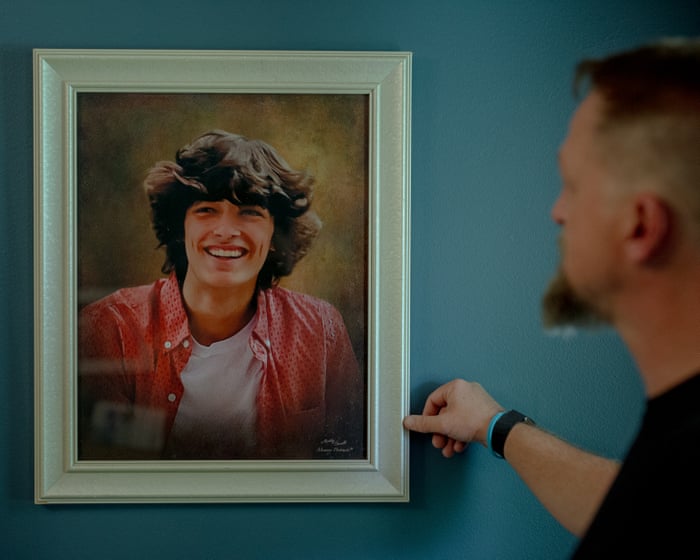
Guffey with some of Gavin’s artwork. Photograph: Mike Belleme
Two days before what would have been Gavin’s 18th birthday, a little less than a month after his death, Guffey received a message from BellaJanet30 that said, “Did I tell you your son begged for his life?”, followed by a laughing face emoji. Guffey replied, “I will find you. I will end you. You will regret this.”
Amid all of this, the idea of “politics”—of fighting an election and serving the community—seemed impossible. “The last thing I wanted to do was deal with other people’s problems. I didn’t feel qualified any more,” he says. Guffey told Melissa he was standing down, but her response was unequivocal. “She said,” recalls Guffey, “‘Absolutely not. You’re one of the few people who can actually make a change. Go down there and save the next Gavin.'”
In some ways, this mission has saved Guffey too, and kept him moving forward. Where once Guffey knew nothing about sextortion—one of the fastest-growing online crimes against children—there are now few who know more.
Guffey is a passionate advocate for repealing section 230 in the US, which gives platforms legal immunity for the content they carry because it is user-generated. “I would love to see no social media for any minor,” he says, “but if the tech companies could be held civilly liable for what they are delivering to children, they would prioritise safety over profits.”
The investigation into BellaJanet28 by the FBI and South Carolina law enforcement required new levels of patience, says Guffey. “It was like holding my breath underwater.” The breakthrough came through bank verification numbers that allowed agents to trace financial transactions linked to the account.
In January 2025, the suspect believed to be responsible for Gavin’s sextortion, Hassanbunhussein Abolore Lawal, was extradited from Nigeria. Guffey and Melissa attended his first court appearance in Columbia, South Carolina, whereHe pleaded not guilty to charges including child exploitation resulting in death, cyberstalking, and coercion. “I waited for him to come out, so full of rage, anger, and anxiety that I cracked a rear molar,” says Guffey. “As soon as he appeared, my wife just broke down, and then it became about protecting her, not anger toward him. He wouldn’t look at us.” The pretrial is scheduled for December.
Guffey with Coen, Callahan, and Gavin. Photograph: Courtesy of Brandon Guffey
In the short time since Gavin’s death, Guffey believes there has been some progress. “For the first couple of years, I was only getting calls from teens who were going through it, and I’d try to convince them to go to their parents,” he says. “Now I’m getting calls from parents whose teens have told them, and they’re coming to me for help.” But nothing he does ever feels like enough. “If you were to ask me what I’ve accomplished, I wouldn’t be able to tell you, because it’s go, go, go,” he says. “That is my grieving. Everyone does it differently, and this feels like what I should be doing. I have to use that anger sometimes, just to get up, get going, and get through the days.”
Gavin has stayed with him every moment, he says—in a crowd, in an audience when Guffey gives a speech, and at home when he walks through the door. He sees grief as a kind of “weather system… you’re always under it,” Guffey says. “And you carry an umbrella at all times.”
Though people often tell Guffey how “strong” he is, that’s not how he feels. “Strength implies choice,” he says. “What I’ve done has been survival. When Gavin died, I made a vow that his death would not be meaningless. My mission until the day I die will be to try to make sure no other teenager feels as trapped, ashamed, and hopeless as he did that night.”
Tomorrow Needs You by Brandon Guffey (John Wiley, £21.99) is published on 22 October. To support the Guardian, order your copy at guardianbookshop.com. Delivery charges may apply.
In the UK and Ireland, Samaritans can be contacted on freephone 116 123. In the US, you can call or text the National Suicide Prevention Lifeline on 988, chat on 988lifeline.org, or text HOME to 741741 to connect with a crisis counselor. In Australia, the crisis support service Lifeline is 13 11 14. Other international helplines can be found at befrienders.org.
Frequently Asked Questions
Here is a list of FAQs based on the article about a mother whose son died by suicide after being scammed online and her mission to protect other children
Beginner Questions
1 What happened to this mothers son
Her teenage son was tricked by an online scammer The scammer threatened to expose him and the shame and fear were so overwhelming that he took his own life His mother heard it happen
2 What kind of scam was it
It was a sextortion scam The scammer pretended to be a girl his age got him to send an intimate photo then threatened to share it with everyone he knew unless he paid money
3 What does sextortion mean
Sextortion is when someone threatens to share sexual images or information about you unless you pay them or do what they say It often starts with a fake online relationship
4 Who usually falls for these scams
Teenagers and young people are common targets especially boys Scammers know they are often embarrassed to tell parents or authorities
5 Where do these scams usually happen
Mostly on social media gaming platforms and messaging apps Scammers create fake profiles and reach out to kids directly
6 Why dont kids tell their parents
They feel ashamed scared and worried about getting in trouble They think they can fix it alone which is exactly what scammers count on
7 What should a child do if they are being scammed like this
Stop all contact immediately Do not pay Take screenshots as evidence Tell a trusted adult right away Report the account to the platform
8 What can parents do to prevent this
Talk openly about online dangers without judgment Monitor apps and friend requests Teach kids that no stranger online should ever ask for private photos
Intermediate Questions
9 How do scammers gain a childs trust so quickly
They use fake profiles with stolen photos lovebomb the child with attention and move fast They often target kids who seem lonely or spend a lot of time online
10 What are the warning signs a child might be a victim
Sudden secrecy with devices anxiety withdrawal from family loss of appetite trouble sleeping or asking for money urgently without explanation