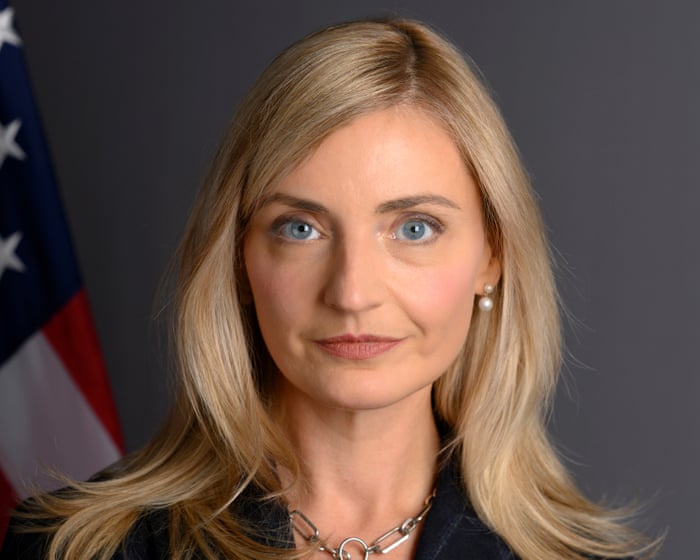
In recent weeks, as Donald Trump intensified his verbal attacks on the European Union and NATO, a senior State Department official, Sarah B. Rogers, publicly criticized hate speech and immigration policies of key U.S. allies while promoting far-right parties abroad.
Rogers has effectively become the public voice of the Trump administration’s increasing hostility toward European liberal democracies. Since taking office in October, she has met with far-right European politicians, criticized prosecutions under longstanding hate speech laws, and boasted online about imposing sanctions on critics of hate speech and disinformation on major U.S. tech platforms.
As undersecretary of state for public diplomacy—a top-tier role created in 1999 to build relationships between the U.S. and foreign publics, rather than foreign governments—Rogers appears focused on winning over a specific segment of foreign opinion.
Her recent social media posts have described migrants in Germany as “barbarian rapist hordes,” commented on Sweden by linking sexual violence to immigration policy (“If your government cared about ‘women’s safety,’ it would have a different migration policy”), and echoed the view that “advocates of unlimited third world immigration have long controlled a disproportionate share of official knowledge production.”
When contacted by The Guardian for comment, Rogers defended her posts. She argued that her remark about German migrants referred specifically to those involved in the Cologne assaults, calling the phrase “a reasonable way to describe the Cologne attackers—and certainly shouldn’t be illegal to say.” Regarding Sweden, she said her comment responded to efforts to use “women’s safety” as a pretext for internet censorship. She clarified that by “official knowledge production,” she meant prestige media, academia, key NGOs, and their bureaucratic funders.
Experts on the European far right see Rogers’s commentary as part of a broader Trump administration strategy to support such movements. Léonie de Jonge, a professor researching far-right extremism at the University of Tübingen, said, “The Trump administration has a vested interest in strengthening anti-democratic movements abroad, as doing so helps advance its own agenda while lending legitimacy to these actors and their activities.”
Georgios Samaras, a public policy lecturer at King’s College London, noted that after the January 6 Capitol riot, Trump’s “contempt for mainstream institutions stopped being tactical and became a governing identity.” He added that Trump’s “warmth towards far-right movements in Europe fits within that same logic. It is culture export and it is power projection.”
Since assuming her role, Rogers has actively engaged with the European far right. Last week, the Financial Times reported that she met with right-wing opposition parties across Europe to “fund MAGA-aligned think-tanks and charities.” According to the report, a senior member of the UK’s far-right Reform Party who attended one meeting claimed Rogers “had a State Department slush fund to get MAGA-style things going in various places” and aimed to “fund European organisations to undermine government policies.”
On December 13, Rogers posted on social media about meeting with members of the German far-right party Alternative for Germany (AfD), describing them as “impressive” and “patriotic.”U.S. Under Secretary Sarah Rogers met with Alternative für Deutschland (AfD) parliamentarian Markus Frohnmaier, as confirmed by a post on Frohnmaier’s X account. According to X’s translation of the post, their “exchange on the new national security strategy of the Trump Administration made it clear that Washington is seeking a strong German partner.”
On December 14, responding to criticism over the meeting, Rogers wrote: “Unlike the Russian government (and the current German one), AfD took an anti-censorship stance in its meeting with me last week. That’s one reason they’re gaining popularity in Germany.”
Rogers told the Guardian: “Mr. Frohnmaier is the foreign policy spokesman for the most popular political party in Germany. He presents AfD’s foreign policy positions in the Bundestag and is the person German media contact for official party statements. For this reason, we engage with him in his official capacity to understand AfD’s positions.”
In 2019, Der Spiegel reported that Frohnmaier was mentioned in a strategy paper “sent from the Russian Duma to the highest levels of the presidential administration,” which advocated supporting his candidacy in the 2017 German federal election to secure “our own absolutely controlled MP in the Bundestag.”
Frohnmaier has made frequent visits to Russia and Russian-occupied Crimea since the 2014 invasion. In 2016, he reportedly attended the Yalta International Economic Forum in Crimea, where he met his wife, Daria, who was then writing for the pro-government Russian newspaper Izvestia.
Regarding Frohnmaier’s Russian connections, Rogers stated: “Allegations of ambiguous provenance that various media and political figures are ‘Russian assets’ have been a fixture of Western politics since 2016.” She added: “I sought guidance within the State Department and determined that the claims of Russian ties were unsubstantiated—and in any event, not a bar to a meeting.”
In 2019, Frohnmaier told the BBC that he was not controlled by Russia and dismissed the Der Spiegel documents as “fake.”
When asked if she disputed the reporting on these ties, Rogers wrote: “I’m not denying the existence of the Der Spiegel reporting, but based on guidance, I formed the view that the allegation in the reporting (‘controlled’ by Russia) remained unsubstantiated in the seven years since it surfaced.”
The German state has classified AfD as a threat to democracy. Last May, Germany’s domestic intelligence agency, the Federal Office for the Protection of the Constitution (BfV), designated AfD as a “confirmed right-wing extremist” group, allowing for increased surveillance of the party.
This designation drew immediate criticism from the Trump administration, including Rogers’s boss Marco Rubio, who called it “tyranny in disguise.” Earlier in the year, JD Vance used a speech at the Munich Security Conference to criticize Germany over the so-called “firewall” that has led mainstream parties to refuse coalitions with far-right groups.
AfD’s legal challenge against the designation is ongoing.
In meeting with the AfD, Rogers followed the example of her predecessor, Darren Beattie, who was acting undersecretary last October when he posted about a meeting with Frohnmaier, noting they discussed “shared priorities on cultural exchange and migration.”
Beattie was fired as a speechwriter in the first Trump administration after attending a white supremacist gathering and speaking on a panel alongside white nationalist commentator Peter Brimelow.
In a 2024 post on X, Beattie wrote: “Competent white men must be in charge if you want things to work. Unfortunately, our entire national ideology is predicated on coddling the feelings of women and minorities, and demoralizing competent white men.”men.” He is currently listed on the State Department website as the “Senior Bureau Official, Bureau of Educational and Cultural Affairs.”
Samaras noted that engagement between the administration and parties like the AfD “serves as a form of legitimization. It also highlights a transatlantic alignment between the U.S. far right and the German far right that is significant, particularly considering Germany’s influential role in Europe and its historical experience with fascism.”
‘As mass migration disrupts societies, liberal political freedoms suffer’
Rogers has also echoed messaging from far-right activists in the UK, at times spreading their preferred narratives.
On January 24, she shared a screenshot of a GB News broadcast with the headline: “Met Police bans ‘Walk with Jesus’ march to avoid provoking local Muslim community.” She captioned it: “As mass migration disrupts societies, liberal political freedoms lose out,” adding, “UK freedom of assembly is a recurring example.”
That march was organized by UKIP, a far-right party that has faced accusations of becoming increasingly Islamophobic since Brexit. Organizers reportedly described the demonstration as a “crusade,” urging supporters to “reclaim Whitechapel from the Islamists.”
UKIP’s previous attempt to organize a march in Tower Hamlets—a London borough with a large Muslim population—last October was titled “The Mass Deportations Tour.” The Metropolitan Police had explicitly invited UKIP to hold their march in a different part of the city.
When asked about her comments on the Tower Hamlets march, Rogers responded via email: “My tweet referenced two marches: one protesting immigration policy and one Christian evangelical ‘Walk with Jesus’ march. I understood both were organized by UKIP, and that some illiberal-left commentators might view UKIP as undeserving of free assembly rights.”
Other actions by Rogers suggest that far-right grievances abroad are influencing U.S. posture toward its allies.
In a December 2 post, Rogers wrote: “As with America’s Somali fraud crisis, Britain’s rape-gang problem has been obscured by gaps—sometimes willful ones—in data collection. The same issue exists elsewhere in Europe. We’re going to help fix that.”
When questioned about the post, Rogers said it was supported by the UK’s 2025 Casey Report on child exploitation and abuse, as well as media reports on “the Minnesota fraud matter.”
Her post shared a video by self-styled independent journalist Jack Hadfield, who promoted claims about higher rates of sexual assault by “foreigners” in the UK.
Hadfield’s arguments relied on data from the anti-immigrant organization Centre for Migration Control—figures that critics have called “dodgy,” disputed, or debunked.
Hadfield, a former Breitbart writer, often contributes to right-wing UK outlets like GB News. However, in 2017, the anti-fascist nonprofit Hope not Hate exposed him as the administrator of a secret Facebook group called the Young Right Society. He described the group in posts as “a Fascist-Juggalo group with traditionalism interest,” and it featured openly racist and antisemitic commentary from about 200 far-right activists.
When his role in the Facebook group was uncovered in 2017, Hadfield told the UK newspaper The Independent that he considered himself “on the moderate right” but “strongly believe[s] that all ideas, including those of the so-called ‘alt-right,’ must be debated.”
Regarding Hadfield, Rogers wrote: “I don’t know what ‘Fascist-Juggalo traditionalism’ means, but this sounds like a joke?” and “I do not excavate the undergraduate Facebook history of every reporter I retweet. Looking at it now, contemporaneous articles concede that Mr. Hadfield ‘may not have posted some of the more controversial content.'”
Frequently Asked Questions
FAQs Trump Allies Europes Far Right and Criticisms of Migration Hate Speech Laws
BeginnerLevel Questions
1 What is this news story about in simple terms
This story is about political figures who were allies of former US President Donald Trump meeting with and supporting farright political parties in Europe They are jointly criticizing two main things liberal immigration policies in European countries and laws that restrict hate speech
2 Who are Trump allies in this context
Trump allies typically refers to former advisors strategists and influential supporters from his administration and political circle such as Steve Bannon or Stephen Miller who are known for their hardline views on immigration and nationalism
3 What is meant by Europes far right
Europes far right refers to a range of nationalist antiimmigration and populist political parties and movements across Europe Examples include Germanys Alternative for Germany Frances National Rally and Italys League
4 Why are they criticizing migration policies
They argue that current immigration levels and policies threaten national identity strain public services increase crime and undermine cultural cohesion They advocate for stricter border controls and a more selective immigration system
5 What are hate speech laws and why are they controversial
Hate speech laws are regulations that prohibit public speech which attacks or incites hatred against people based on attributes like race religion or nationality Critics including these groups argue they violate free speech and are used to silence political dissent and conservative viewpoints
Advanced Practical Questions
6 Whats the strategic goal of this transatlantic alliance
The goal is to build a coordinated international populist movement They share strategies messaging and moral support to normalize their views influence elections and push Western democracies toward stricter nationalism and away from liberal globalism
7 How do they connect criticism of migration and hate speech laws
They frame both issues as parts of a larger conflict a defense of national sovereignty and traditional values against what they see as imposed political correctness and globalist elites They argue that hate speech laws protect the very multicultural policies they oppose preventing honest debate about immigration
8 What are common examples of the hate speech laws they criticize
Examples include Germanys laws banning Holocaust denial and incitement