Thank goodness for cinema—that light in the darkness and the source of all shocking revelations. It tells us to wake up and act before it’s too late. That we’re living in the Matrix. That the CIA killed JFK. That our spouse is a robot and our boss is from Andromeda. Also, that there’s an Escher-style staircase under the Tokyo subway and a disembodied zombie leg haunting the hook-up parks of Brazil.
The Guardian’s journalism is independent. We may earn a commission if you buy something through an affiliate link. Learn more.
How would we react if a trusted friend told us all this? Would we be entertained or horrified, enlightened or freaked out? Would we even still see them as a trusted friend?
“People have a right to know the truth,” says the young whistleblower in Steven Spielberg’s Disclosure Day—a line that echoes countless others. Played by Josh O’Connor, heroic Daniel Kellner carries a backpack of state secrets that irrefutably prove aliens exist and point to a sinister government cover-up. Disclosure Day is fiction, but it hints at insider knowledge. The 79-year-old director—the most trusted name in Hollywood—even appears in the trailer to vouch for the film’s authenticity. He inserts himself among crop circles and spacecraft, commenting on the action like an authoritative news anchor. He says: “Wouldn’t it be wonderful for people to know that all of this is true?”
We are not alone, Spielberg tells us—and neither, for that matter, is his film. Disclosure Day is just the biggest and flashiest in a wave of paranoid conspiracy tales that recall the 1970s heyday of The Parallax View, Soylent Green, Capricorn One, and The Conversation. These modern descendants tell different stories and go down different rabbit holes. But they all speak the language of alienation and mistrust, and seem to be reaching for some final, revealing truth.
‘Do you ever get paranoid that you’re not being paranoid enough?’ … John Malkovich in Wild Horse Nine. Photograph: Entertainment Pictures/Alamy
In Yorgos Lanthimos’s Bugonia, it’s the belief that the world’s millionaire elite are actually aliens in disguise. In Olivia Wilde’s The Invite, it’s the wild speculation about the neighbors’ sexual quirks. In the upcoming Wild Horse Nine, it’s the dark buried secrets of the US’s cold war past. Martin McDonagh’s comedy-thriller casts Sam Rockwell and John Malkovich as two CIA veterans, spinning their wheels on Easter Island as they wait for their next top-secret mission. “Do you ever get paranoid that you’re not being paranoid enough?” Malkovich asks at one point. It’s a rhetorical question. Metaphorically or not, everyone is wearing tinfoil hats.
Oscars 2027: who might be up for next year’s awards? Read more
Is this a trend? Are all these films connected? Common sense—our trusted friend—tells us that life is random and chaotic, and that we’re mostly making it up as we go. But conspiracy theory is like a seductive intruder, sidling up to assure us that, actually, that’s not true at all. Everything is connected, part of a grand design. “There are no coincidences, honey,” explains the wild-eyed dad in the new Netflix thriller The Truthers. So these bizarre productions are all here for a reason. They have a message for us, if we’d only shut up and listen.
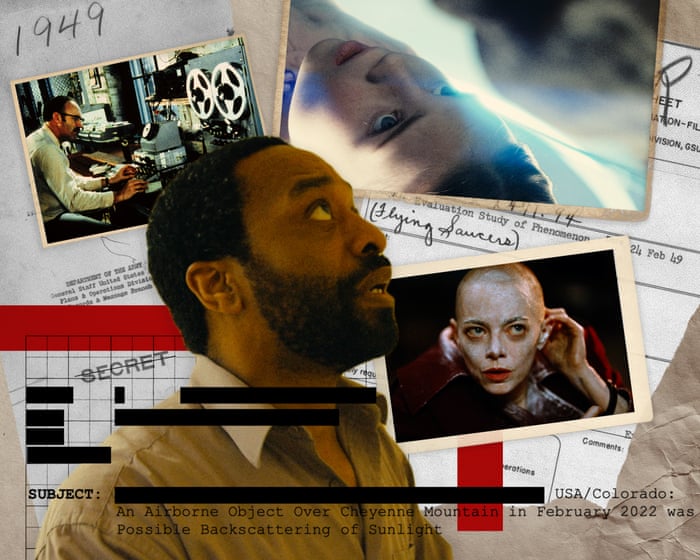
“I found a place,” whispers Chiwetel Ejiofor, who plays a furniture salesman in the mesmerizing Backrooms. He can’t be more specific, because the place is a mystery and doesn’t appear on any map. It’s a network of corridors and office spaces, both sterile and sickly, that has been hiding in plain sight. If you believe the credits, Backrooms was directed by Kane Parsons, then 20, who tested the concept as a popular web series. If you believe the wilder parts of the fanbase, it was secretly directed by its 52-year-old producer, Osgood Perkins. The film is a locked-box mystery.Here’s a riddle meant to tease, so it must be keeping at least one secret of its own.
The Backrooms is the best kind of paranoid conspiracy story because it never feels the need to explain everything. It’s scary, strange, and unashamedly confusing. It’s also deeply cinematic—a ready-made metaphor. The backrooms sit behind a lit window or a screen. They could be the movies, TikTok, or the darker parts of the internet. “It’s like a maze,” Ejiofor says in wonder after pushing through the hinge and stepping inside for the first time. “It just goes on and on.”
[Image: ‘Scary, strange and unashamedly confounding’ … Renate Reinsve in Backrooms. Photograph: PR]
H.L. Mencken used to say that no one ever went broke underestimating the public’s intelligence. But they also rarely lose money underestimating its capacity for wonder. Movie audiences crave magic, spectacle, information, and comfort. A 2024 poll found that 61% of Americans believe in ghosts, 57% in aliens, and 70% in the devil. A sizable minority also believes they’ve been lied to by a shadowy, unaccountable elite. According to a YouGov survey, 18% think the 1969 moon landing was faked, 20% think COVID vaccines contain microchips, and 29% believe voting machines were programmed to switch ballots in the 2020 U.S. elections. Put enough of these niche beliefs together, and they eventually tip the scale. According to a 2024 study by the CHIP50 project, 78.6% of U.S. citizens agree with at least one conspiracy theory. That’s a huge, booming market for tall tales and snake oil.
Set during COVID, Ari Aster’s Eddington stars Joaquin Phoenix as a small-town sheriff running for mayor. He’s an anti-mask libertarian who loves his country, hates Black Lives Matter, and has a banner on his car that reads, “YOUR [sic] BEING MANIPULATED.” He’s a symbol of a conspiracy culture that has come in from the cold—mainstreamed by social media and weaponized by the far right. Eddington satirizes that world, but it’s also a symptom of it.
The films of the 1970s effectively formed the resistance. They were a direct rejection of tired government messaging, built in fiery opposition to failed and corrupt institutions. I’m not sure the same can be said for today’s films. The culture is too cloudy, and the news is full of distractions. Perhaps no modern filmmaker speaks the language of the conspiracy thriller better or louder than the White House itself. Donald Trump rails against the deep state from behind the Resolute Desk and pretends to share common cause with a dispossessed public. These people are right to demand vengeance against the establishment crooks who oppress them. But they can trust no one but him—their protector, the conspiracy-theorist-in-chief.
[Image: Conspiracies … Josh O’Connor in Disclosure Day. Photograph: Universal Pictures and Amblin Entertainment/AP]
“Flood the zone with shit,” says Steve Bannon, the president’s former strategist and svengali. Stage-managed intrigue can serve as a welcome distraction or a cover for incompetence. Disinformation keeps voters confused and exhausted.
The best conspiracy stories point the way to the exit door—which means freedom, which is good. But the genre’s thunder has been stolen, and the way ahead isn’t clear. Bugonia is a fine film, and Backrooms is even better. But both feel like offshoots of the Trump Cinematic Universe—not so different from the wild fan theories that claim Jim Carrey sent his clone to the César Awards or that Eyes Wide Shut was a warning about Jeffrey Epstein.
In the U.S., Disclosure Day coincided with the White House’s underwhelming release of declassified UFO files (“extremely interesting and important,” Trump said). This led to online speculation that the release dates were coordinated as part of a mutually beneficial campaign. Not true, Spielberg said—just more wild theorizing. His film was emphatically not in cahoots with the Trump administration.In fullscreen: Warren Beatty in The Parallax View, 1974. Photograph: Collection Christophel/Alamy
Are all these red-pill productions connected? Tangentially, yes, of course. Is there some grand plan? Almost certainly not. Films are gut reactions to the world around them. They pick up on its tensions and play to public curiosity, much like the medicine shows that once traveled through remote areas looking for new customers. Conspiracy theories give the illusion of order and control. They offer the comfort of a story—the feeling that life makes sense. Which is just another way of saying they’re made up, a lie. What’s more unsettling: thinking the government is hiding aliens, or accepting that they aren’t? What’s scarier: believing aliens want to talk to us, or imagining they never will?
Are we paranoid enough? Thomas Pynchon—the unofficial voice of the conspiracy genre—points to a condition even worse than paranoia: an anti-paranoid state where nothing connects to anything else, where there’s no lock to pick or hidden truth to find. It’s a state, he says, “not many of us can bear for too long.” People need plot twists and cliffhangers, teases and reveals. Spielberg is a master of this and surely already knows it. So are Lanthimos and Aster and the 20-year-old director of Backrooms. And so does Trump.
Frequently Asked Questions
Here is a list of FAQs about the recent surge of conspiracy theories in cinema written in a natural conversational tone
BeginnerLevel Questions
1 What do you mean by cinema falling in love with conspiracy theories
It means that Hollywood and streaming services are making a lot more movies and shows where the plot is driven by a secret plot a coverup or a hidden truth that the main character has to uncover Think The Matrix JFK or more recently Dont Worry Darling and The Menu
2 Why is this happening now Is it just a trend
Partly yes But its also a reflection of our times People feel more distrustful of institutionsgovernments big tech the mediathan ever before Movies are tapping into that realworld anxiety and making it entertaining
3 Are these movies trying to make me believe in real conspiracy theories
Not usually Most filmmakers use conspiracy theories as a metaphor for feeling powerless or for questioning authority Theyre usually more interested in the feeling of paranoia than in promoting a specific theory like QAnon or flat Earth
4 Can you give me a simple example of a recent movie like this
Sure The Menu looks like its about a fancy restaurant but its actually a conspiracy between the chef and his staff to punish a group of wealthy entitled people The conspiracy is the hidden plan they all agree to
5 Is this a bad thing for movies
Not inherently A wellmade conspiracy thriller can be incredibly gripping and smart The problem is when its done poorly it can feel confusing pretentious or accidentally validate harmful realworld ideas
AdvancedLevel Questions
6 How is this different from classic conspiracy thrillers like The Parallax View or All the Presidents Men
The biggest difference is the target Classic 70s films focused on specific powerful institutions Modern conspiracy films often target everything at oncethe rich influencers social media art and even the audience themselves Theyre more abstract and existential
7 Is the rise of streaming services a cause or an effect of this trend
Its a big