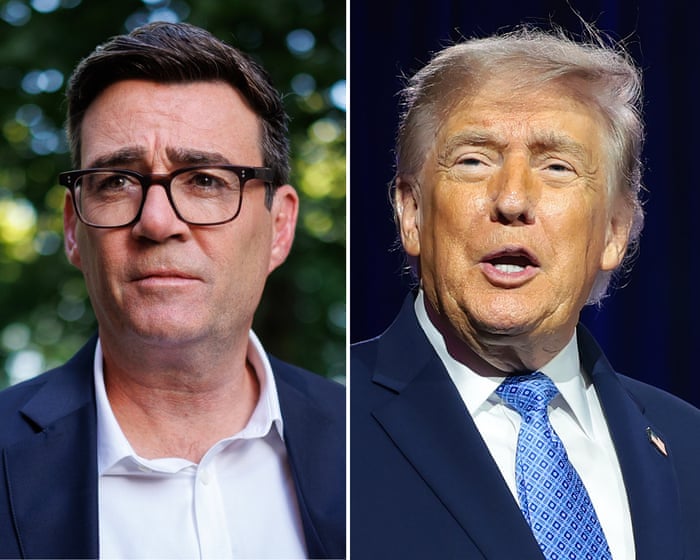
If, as expected, Andy Burnham becomes British prime minister later this month, one of his first phone calls will likely be with Donald Trump. Trump’s mother was Scottish, and he has a nostalgic fascination with Britain. But managing a relationship with the unpredictable, transactional, and demanding US president has been a diplomatic minefield for Burnham’s predecessors.
Andy Burnham is about to get a crash course in hardcore geopolitics | Rafael Behr
Read more
When Trump returned to power in January 2025, the current prime minister, Keir Starmer, went all out to strengthen the special relationship. He invited the president for an “unprecedented” second state visit to the UK during a cheerful photo call at the Oval Office. But their early bond quickly soured over Trump’s threats to Greenland, his criticism of British troops in Afghanistan, and his belief that Britain didn’t support his war in Iran. “This is not Winston Churchill that we’re dealing with” became Trump’s go-to insult. Now, with Starmer announcing his resignation, Trump will meet his fourth British prime minister in five and a half years in the White House.
View image in fullscreen
Keir Starmer picks up UK-US trade deal papers dropped by Donald Trump before a press conference at the June 2025 G7 summit in Alberta, Canada. Photograph: Stefan Rousseau/PA
Like most Americans, the US president seems to have never heard of Burnham, who was until recently the mayor of Greater Manchester, a region of 3 million people in northwest England, where he’s known as the “king of the north.” Asked recently what he knew about the incoming prime minister, Trump replied: “I don’t know, I think I see that he was, I guess, the mayor of a town. I hear he’s extremely liberal, extremely, so that means he probably won’t open up the North Sea.”
Burnham has held high office—leading two major government departments under the Brown government in 2008 and 2009—but the world has changed dramatically since then. Burnham has previously warned about the “poisonous” nature of US-style politics and said Trump had brought “instability” to the world. Two weeks ago, in his victory speech after winning the election that set him on course for Downing Street, Burnham urged British voters to turn away from the path that “takes us to a divided, dark politics of the kind we see in the United States.”
View image in fullscreen
Keir Starmer and Donald Trump hold a press conference at Chequers, the UK prime minister’s ‘grace and favour’ country house, during Trump’s second state visit to the UK in September 2025. Photograph: Leon Neal/PA
How will he handle this erratic and transactional new era of transatlantic relations? Will he go on a charm offensive and play to the president’s ego? How will he respond if—or more likely when—Trump attacks him on social media? Can the special relationship be revived, or does the bond between presidents and prime ministers even matter anymore?
‘Trump wishes to be seen as royalty’
In Washington, longtime observers of the alliance don’t expect a new face to make any difference. Sidney Blumenthal, a former senior adviser to President Bill Clinton and Hillary Clinton, warned: “Prime Minister Andy Burnham will be treated like other British prime ministers by Donald Trump. The special relationship has been replaced by the abusive relationship. He shouldn’t take it personally. Keir Starmer was treated abusively, but so was Theresa May. Trump has very low esteem for British prime ministers and extreme deference to the King of England. Trump wishes to be seen as royalty, and his idea of an equivalent is a king, not a prime minister.”
View image in fullscreen
Donald Trump and King Charles III at a state banquet at Windsor Castle during Trump’s second state visit. Photograph: WPA/Getty Images
Burnham has almost no name recognition in the US—but politPolitical strategists and foreign policy experts agreed that this clean slate could actually be an advantage. Frank Luntz, a consultant and pollster who spends a lot of time in Britain, said: “They’ll probably think he’s a football star. No one in America is going to know who he is. But that’s an opportunity to start fresh.”
Larry Jacobs, a political science professor at the University of Minnesota, added: “Burnham is as unknown a high-level British politician as we’ve seen in decades. From the average person on the street to most people in Congress, he’s a nobody.”
“He’s a regional politician. He’s caught the attention of politicians who are, frankly, desperate to move on from Starmer. So this isn’t someone who has built an international reputation or made major statements on domestic policy that would have crossed the Atlantic.”
View image in fullscreen: A victorious Andy Burnham at June’s byelection in Makerfield, Greater Manchester, flanked by two of the joke candidates who also ran. The win allowed Burnham to declare his candidacy for prime minister. Photograph: Oli Scarff/AFP/Getty Images
As the mayor of Greater Manchester since 2017, Burnham is out of practice when it comes to navigating the tricky world of international diplomacy. For the past decade, his main opponents have been stubborn London civil servants and sometimes narrow-minded town hall leaders in his part of northwest England.
Nina Sawetz, a communications adviser who worked with Burnham’s mayoral team, said the incoming prime minister’s natural reaction to any Trump provocation would be to focus on “outcomes and interests for the UK, rather than competing on personalities.”
“My expectation is that Trump will initially see Burnham’s refusal to engage in a constant public fight as a sign that he has the upper hand. I think that would be a mistake,” she added.
“The bigger opportunity for the president lies in Burnham’s tendency to show his frustrations more openly than many political leaders. That openness will reveal where the pressure points are, and I expect Trump to test them repeatedly.”
View image in fullscreen: Donald Trump with then prime minister Theresa May at Chequers in June 2018. Photograph: Bloomberg/Getty Images
How to handle the famously unpredictable, thin-skinned, and volatile Trump? Many foreign leaders have been desperate to avoid the fate of Volodymyr Zelenskyy, the president of Ukraine, who was berated by Trump in the Oval Office last year.
Jacobs said: “The starting point for dealing with Trump is to accept you’re dealing with an outlier—a highly unstable, erratic president with very low self-esteem. If you do anything that disrupts Trump’s sense of himself, the relationship is over.”
“My advice to Burnham would be to treat Donald Trump like a constituent back home who is poorly informed and quite emotional. How would you handle that person?”
Burnham faces an uphill battle since Trump has shown more interest in oil-rich Gulf Arab nations like Saudi Arabia, the United Arab Emirates, and Qatar than traditional allies in his second term. For a Labour prime minister, there are huge policy gaps on every issue from climate and immigration to Iran and NATO.
View image in fullscreen: Boris Johnson with Donald Trump at the 2019 summit in Biarritz, France, a month after he became prime minister. Photograph: Erin Schaff/AP
But one interesting model comes from another mayor: Zohran Mamdani of New York. A democratic socialist, he is ideologically opposed to Trump yet has gotten along well with the president, who seems to respect him as a charismatic populist—and a winner. Indeed, Trump consistently views diplomacy through a personal lens rather than a policy one.
Philippe Dickinson, deputy director of the transatlantic security initiative at the Atlantic Council think tank in Washington, said: “Mamdani is obviously on a very different side of the political spectrum.”His identity isn’t “I’m the anti-Trump guy.” It’s about his domestic policy platform in New York. For Andy Burnham, there are potentially some lessons there.”
Among them, Dickinson said, are the charm offensives by Mamdani and Mark Rutte, the NATO secretary general. “These are politicians who project confidence and ease in their own skin, and can present themselves as equals to Trump on certain issues. They keep focusing on those specific things—even Mamdani can find them—and can position themselves as problem-solvers for Trump.”
One clear thing Burnham and the US president have in common is their shared belief that mainstream politics hasn’t worked for ordinary people for decades. Trump might admire Burnham’s desire to shake up the stale, over-centralized British political establishment.
Sawetz, the communications adviser, said Trump’s approach has long been to “establish the power dynamic quickly, whether through public criticism, personal remarks, or by provoking new counterparts into a very public response.”
“Burnham won’t take that bait,” she said. “He might brush off the occasional joke, but we know he doesn’t like open political confrontation or the kind of long-running exchanges we’ve seen with Sadiq Khan in London.”
Dickinson, from the Atlantic Council, suggests defense spending could be an early win for Burnham. “I don’t expect he’ll be coming to Washington anytime soon, but when he does, he could come with a story that says, ‘This is my approach to defense investments, and here’s how it helps solve a problem for you: we’re going to go further on defense.’”
Others believe Burnham should be ready to make deals. Joel Rubin, a former deputy assistant secretary of state, advised: “Burnham needs to come with an agenda of what he needs from the US to advance his domestic goals, and be ready to offer tangible benefits to the US that will help Trump and the American people.”
On the other hand, other experts warn that bowing to Trump would be a diplomatic failure and political suicide at home. Brendan Boyle, a Democratic congressman from Pennsylvania, notes that “any leader who takes on Trump benefits domestically from doing so,” whereas if Burnham says “absurd, obsequious things in public, he would get absolutely hammered by his voters.”
Richard Stengel, a former undersecretary of state in the Obama administration, urges Burnham to keep his distance and adopt a “tough love stance.” He cautioned: “First of all, I wouldn’t wear a red tie under any circumstances. A red tie signals that you’re giving in.
“That universal European response of kowtowing to him and sucking up to him just turns out to be a poor strategy. He turns on everyone, so even if he forms an early ‘Oh, he’s my friend,’ he’ll eventually turn on you. Burnham needs some distance.”
Stengel added: “I would stop mentioning the special relationship. That’s a dog that doesn’t hunt anymore. Americans don’t get it, and I don’t know if the Brits do either. And to someone like Trump, it seems like you’re being…Some analysts point to Mark Carney, Canada’s prime minister, as the gold standard. Earlier this year, Carney gave a speech at Davos without naming Trump directly, but he said the US-led “rules-based international order” was facing a permanent break.
Steve Schmidt, a political strategist and former adviser to Senator John McCain, said: “Many people looking at the state of the world would say Mark Carney is the most serious and important leader in the English-speaking world. He’s the one who truly understood Trump and drew a line that other world leaders have rallied behind.”
Bill Clinton and Tony Blair at a NATO signing ceremony in Paris in May 1997, shortly after Blair’s election win. Photograph: Charles Platiau/Reuters
Blumenthal, who introduced Clinton to Blair before Blair became prime minister, has more advice based on November’s midterm elections. “Unlike Starmer, Burnham will very likely have at least one Democratic counterpart in Congress, either in the House and/or the Senate, to work with.
“Burnham represents Parliament himself, and he should engage with them extensively. If the Democrats take control of either chamber, they are his allies and can help him in countless ways. His government should build strong ties with a new Democratic Congress for Britain’s benefit. That didn’t exist for Starmer.”
The phrase “special relationship” was coined by Winston Churchill during a lecture tour of the US after World War II. Churchill and Franklin Roosevelt were allies against Hitler, setting the standard for future partnerships like Harold Macmillan and John F. Kennedy, Margaret Thatcher and Ronald Reagan, Blair and Clinton, and Blair and George W. Bush.
President Barack Obama with then Prince Charles and Gordon Brown, then UK prime minister, at a memorial service at the Normandy American Cemetery on the 65th anniversary of the D-day landings in 2009. Photograph: Peter Macdiarmid/PA
Gordon Brown had a less happy experience with Barack Obama, who seemed more at ease with Germany’s Angela Merkel. Brown tried five times to meet Obama on the sidelines of the 2009 UN General Assembly but only got a “snatched conversation” in a New York kitchen.
Theresa May was the first foreign leader to meet Trump at the White House after his 2017 inauguration; he famously took her hand to guide her down a ramp. But they were complete opposites in temperament. Trump humiliated her several times and, during a 2018 visit to Britain, criticized May’s handling of Brexit while suggesting her rival Boris Johnson would make a “great prime minister.”
The president did find a kindred spirit and personal chemistry when Johnson took over at No. 10, remarking: “They call him Britain’s Trump.”
While Starmer’s relationship with Trump started promisingly – with the prime minister famously reaching into his jacket pocket and pulling out a letter from King Charles – it ended badly. The question now is whether the “town mayor” from Manchester can repair this broken alliance.
Frequently Asked Questions
Here is a list of FAQs about the advice Dont bring up the special relationship for the UKs next Prime Minister dealing with Donald Trump
BeginnerLevel Questions
Q What does Dont bring up the special relationship actually mean
A Its advice for the UK Prime Minister to stop relying on the historical idea that the US and UK have a uniquely close bond Instead of talking about history or friendship the PM should focus on concrete transactional deals and national interests
Q Why shouldnt the UK PM mention the special relationship to Donald Trump
A Trump is a transactional leader He doesnt care about history or sentiment He respects strength deals and what you can do for him right now Reminding him of a special bond can come across as weak or entitled making him less likely to grant favours
Q So what should the PM talk about instead
A The PM should talk about hard numbers trade deficits defense spending percentages and specific UK capabilities that directly benefit the US
Q Is the special relationship a real thing or just a myth
A Its real in terms of deep intelligence sharing and cultural ties But as a political tool its often overblown For Trump its a myth if it doesnt produce a clear immediate payoff for the US
Advanced Strategic Questions
Q Whats the biggest risk if the PM does bring up the special relationship
A The biggest risk is getting a public rebuke or a dismissive response Trump might say Its not so special if you dont pay your NATO bills or What have you done for me lately This would humiliate the UK and weaken the PMs standing both at home and internationally
Q How does this advice apply to trade negotiations with Trump