It’s a damp morning in Venice. In the middle of the lagoon, art world figures with dripping umbrellas climb onto a boat with tiered seating to watch a one-time performance. Across from them is a barge fitted with a large crane, its boom stretching high above the water and its heavy anchor chain sinking into the murky depths.
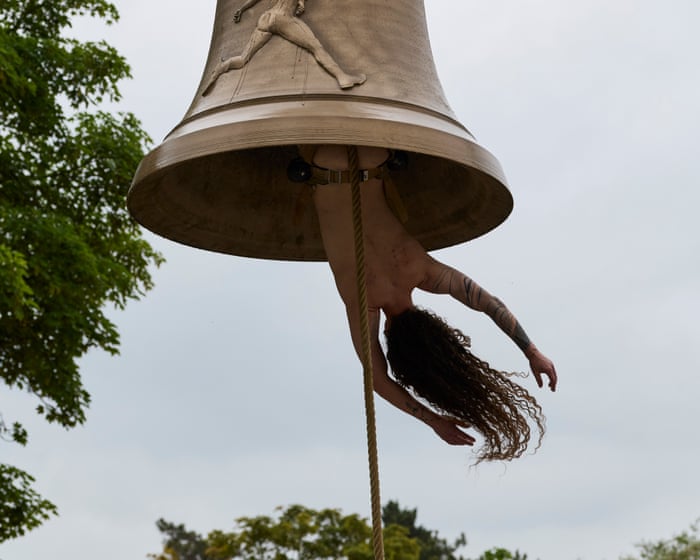
Women, naked except for tattoos and boots, step onto the barge’s deck. Directed by a bandleader in rubber waders, some pick up instruments and create a powerful wall of sound. The electric guitarist clips herself onto the slippery crane, climbs to a dizzying height, and rocks out while straddling a steel bar. She’s joined by a vocalist who screams and wails like Yoko Ono. After 20 minutes of heavy drone, the boom rises, lifting a cast-iron bell from the freezing water. Hanging upside down inside it is a long-haired woman. As the bell rises above the Venice skyline, she starts slamming her body from side to side, sending a ringing sound across the water.
“Nothing could have prepared us for this. I wake up in the morning thinking, ‘What will this day bring?’”
Welcome to the world of Florentina Holzinger: dancer, artist, choreographer, leader of Europe’s coolest performance girl gang, and the person most likely to revive childhood dreams of running away to join the circus. Representing Austria at the Venice Biennale, Holzinger arrives with a reputation. Over the past decade, her performances in European theatres and opera houses have caused fainting spells and sparked plenty of manufactured outrage in the tabloid press—whether from nudity, blasphemy, sex, body piercing, or human waste (real or fake).
On stage, Holzinger seems otherworldly. Earlier this year, at the climax of the opera Sancta, I watched her fly high in the air, suspended by bolts piercing the skin of her back, slamming her body against a thunderous metal sheet like an angel of the apocalypse. Sancta has been touring European opera houses for the last two years. It opens with a 30-minute performance of Paul Hindemith’s short 1921 opera Sancta Susanna, and features a huge climbing wall as its backdrop, where performers in harnesses hang like spiders, swarms of demons, and crucified bodies.
Much of Sancta takes the form of an alternative mass—one dedicated to liberation and acceptance. It includes a close-up magician performing miracles, a pregnant pope lifted by a robot arm, and nuns doing roller skate tricks. For Holzinger, putting a half-pipe on stage answered the question of how nuns—elevated, otherworldly figures—should move on stage. “They’re not going to walk on the floor in a mundane way. Instead, they float, they skate. Somehow this ramp made sense for us.”
It was also Holzinger who was lifted naked from the Venice lagoon, hanging from the bell. In performance, she looks Amazonian: muscular, unaffected by cold, and, crucially, pain. In person, she’s bright and playful, her conversation jumping between research at the Vatican, the late performance artist Valie Export, and skate training in Barcelona. Her small frame is wrapped in thick fleece, as if she’s warming up after hours of exposure.
Turning her work into a performance installation for the Biennale has required some adjustment. Away from the safety of the theatre, accidents are a constant risk. “We’re always in a ‘brace, brace’ position when it comes to performance,” she says, speaking just after Seaworld Venice opens. “We’re not naive. We know what the reactions can be. But nothing could have prepared us for this. I wake up in the morning thinking, ‘What will this day bring?’”
Her companyY performs eight hours a day, in all kinds of weather, while the audience moves freely around the Austrian pavilion. Many visitors aren’t prepared for a show where full nudity is just the starting point. “Venice,” Holzinger explains, “is really where the reclining nude was born—the horizontal, erotic image of women. So why is real nudity seen as so shocking?”
Seaworld Venice is part temple, part gallery, part theme park, and part sewage treatment plant. Parts of the pavilion have pools where Holzinger’s team does jet ski stunts, contortion acts, and poses hanging from climbing harnesses like a living Renaissance altarpiece. In the central courtyard, a performer in a scuba mask stays submerged in a glass tank for four hours straight. The water around her is filtered from two nearby portable toilets.
During the biennale preview, high-end art world visitors treated the pavilion like a human zoo. I walked in behind a world-famous museum director who seemed to ignore the “No photography” sign. He filmed the entire jet ski performance and posted it on Instagram. “It’s really not my style or my ethics to police people,” says Holzinger. “But it’s still outrageous that almost no one can experience art without a screen.” Because visitors flooded social media with the performances, her Instagram account was temporarily suspended.
View image in fullscreen
Unaffected by the cold … one of Holzinger’s jet skiers. Photograph: Giuseppe Cottini/Getty Images
Holzinger’s performers switch roles. One day they might do jet ski stunts, the next they clean the toilets and show visitors how to use them (please, no solids, people!). “I didn’t realize how important the role of the toilet women would be,” says Holzinger, “or how people would treat the performers—thinking they’re ‘just’ toilet women.” She thinks it says a lot about how we value different kinds of work. “Is it harder to spend eight hours underwater or to be a toilet woman?”
Why put these toilets in the Austrian Pavilion? Holzinger remembers her application for Venice—a whole page about sustainability, but only a small space to describe the pavilion’s content. “That made it clear: for us, the content is the sustainability concept.” And truly, few things make you understand the fragile environmental link between water and waste like facing a woman submerged in your own filtered urine. (Yes, reader, I did.)
Bodily functions force the highbrow art world to deal with basic realities—often and inconveniently, especially in the poorly equipped grounds of the biennale. “The Austrian pavilion was always the unofficial toilet,” Holzinger says with a grin. The pavilion is at the back of the site. By the time you get there, you’ve spent “two or three hours looking at art in the Giardini, and your bladder is full. Everyone pees behind the Austrian pavilion. It always smells like a toilet. And we thought, ‘Why not make a nice, clean, working toilet?’”
View image in fullscreen
‘Comedy is an essential part of art-making for me’ … a performer with scuba gear in the audience’s filtered urine. Photograph: David Levene/The Guardian
Holzinger’s work can feel dark and heavy. She tackles big topics, like the Catholic church’s control over women’s bodies. The performers she works with come from circus, stunt work, and body-piercing, as well as contemporary dance. Their commitment is literally written on their bodies. I recognize the performer in the tank from her role in Sancta, where she had a small, wound-like cut made in her stomach. She now has 25 such scars—one for each performance of the opera. Another performer, who does body-piercing, has done “maybe 200 suspensions already.””Already in my shows,” says Holzinger. “Her back really carries this: she calls it a book.”
Naked jetskiers, human bells, and a celebrity seagull! The Venice Biennale’s wildest moments – in pictures.
Read more: Yet the shows are also entertainment, and a key ingredient is the absurd. Sancta featured a stoner Jesus, while Seaworld Venice has a slapstick fake sewage system that “engineers” struggle to keep from exploding with excrement. “Comedy is an essential part of art-making for me,” says Holzinger. “Of course, I want to tackle big existential questions. But I can’t do that without also trying to laugh them away. There always needs to be a hint of hope: a reason to move forward and actively change things.”
She pauses, then adds: “At the end of the day, I’m really not an artist who takes themselves so seriously.” And maybe I can believe that about her – she’s happy to get hurt, to be ridiculous. But art? That, I think, Holzinger takes very seriously indeed.
Florentina Holzinger’s Seaworld Venice is in the Austrian Pavilion at the Venice Biennale until 22 November.
Frequently Asked Questions
Here is a list of FAQs based on Florentina Holzingers provocative performance covering both basic curiosity and deeper artistic questions
BeginnerLevel Questions
Q What is Florentina Holzingers show about
A Her show Sancta is a radical opera that mixes extreme physical stunts with a critique of religion the female body and the history of performance Its meant to shock but also to make you think
Q Why is nudity such a big part of her work
A She uses nudity as a tool to break taboos By showing real unglamorous bodies doing dangerous things she challenges the idea that nudity is only about sex or shame Instead she makes it about power vulnerability and control
Q What is a human bell
A In her performance a performer is suspended and swung like a bell clapper They are naked and the ringing sound is created by their body hitting the structure Its a literal physical metaphor for being a vessel or instrument
Q Is she just trying to be shocking for attention
A While the shock is deliberate its not the only goal She uses extreme images to grab your attention so you cant look away forcing you to question why you find it so provocative in the first place
Advanced Conceptual Questions
Q How does this performance differ from traditional opera
A She replaces trained singers with stunt performers acrobats and dancers The music comes from screaming grunting and the sounds of bodies hitting objects She deconstructs the polished beautiful ideal of opera to show its raw violent and grotesque underbelly
Q What is the artistic point of having a performer pee on stage
A Its a direct attack on the idea of the body being sacred or pure In a religious context urine represents the profane the messy reality of being human Its a way of saying this is a real body not a symbol