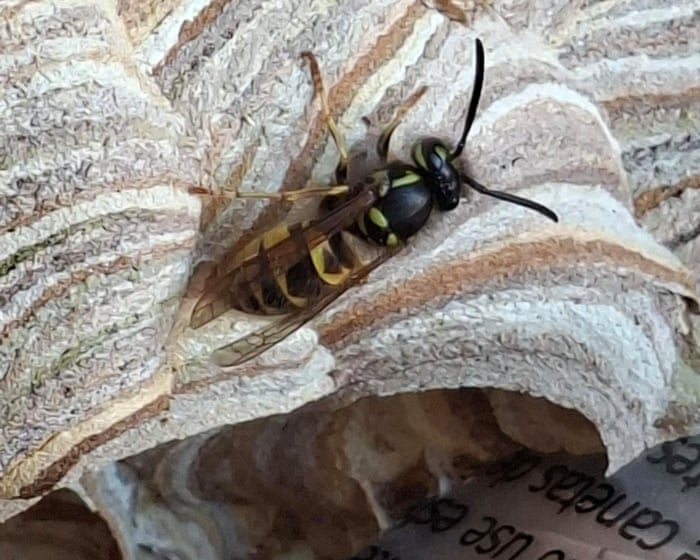
One June morning, wasps started streaming through a rusted gap in Eilish Rothney’s office door. Her first reaction was probably what most people would have: get rid of them. Rothney, who manages the Trinity Broads reserve for the Norfolk Wildlife Trust, found a wasp colony had moved into her office, which is a converted shipping container.
“They just built the nest inside my door,” she says. “My first thought was: ‘Oh no, I have to get rid of that now.’ But then I realized: ‘Wait, why? Why do I have to do that?'”
Two months later, Rothney is sharing her workspace with the nest, which is now over a meter tall and takes up an entire bookshelf of ring binders. It has covered the inside of her office in what she calls “lovely layers of colors,” with thousands of chewed wood pulp cells stacked up like the world’s strangest filing system.
Instead of kicking out her new roommates, Rothney adapted. She opened the window to give the wasps a clear path in and out. “I just stroll past like I’m a browsing cow, calmly going about my day,” she says. “The wasps were fine with me being there. The longer I was there, the more relaxed I felt being alongside them.”
The queen wasp keeps laying eggs, while worker wasps go out to find food and bring it back to feed the larvae. In return, the larvae produce a sugary liquid that the adult workers drink. Rothney describes a low humming sound coming from the nest, which she thinks is thousands of wings beating to keep the colony cool. “It’s almost like the colony itself is a living organism,” she says.
She says she isn’t worried about getting stung – “it wouldn’t be much worse than mosquito bites” – and her advice for anyone less keen than her is: “Insects learn that certain people won’t harm them. Just stay calm, they’ll sense that and won’t feel threatened.”
Rothney traces her love of wildlife back to a university ecology field trip, and to what she calls “a kind of poetry and beauty in understanding the intricate relationships between everything.” She says she’s become more and more frustrated with how easily the label “pest” becomes a reason to kill things. “It’s fair enough if people don’t like wasps,” she says, “but we need to move away from killing things just because it’s convenient. We cause a lot of damage with that approach.”
She’s also quick to defend the wasps that bother picnics every August. By late summer, the larvae stop making their sugary secretion, leaving the adult workers suddenly without their main food source, she explains. “The poor things are starving. It’s not a battle between them and me. They’re desperate. Let’s give them that sugar and maybe draw them away from someone’s beer in the evening.”
“All I want is for people to be more tolerant of wasps, and of nature in general. I’m proud to be working where I am, and it’s our 100th anniversary this year – so maybe the wasps are celebrating too!”
As autumn arrives, Rothney says, the queen will stop laying eggs, the males and workers will die off, and next year’s queens will leave to hibernate on their own. By winter, the nest will be empty.
“It’ll be sad when they leave. I do feel motherly towards them,” she says. “It’ll be odd when they’re gone, because even the noise itself is amazing.”
And when the nest is empty? “I’m going to try to take it apart very carefully when they leave so I can see what it looks like inside.”
Until then, the shelves belong to the wasps.
It’s invertebrate of the year again!From August 3rd to 12th, we’ll feature a different amazing invertebrate each day, chosen from the thousands nominated by our readers. After you’ve seen them all, we’ll open voting so you can pick your favorites. We’d love to hear your thoughts and ideas—email us at environment.desk@theguardian.com with “Invertebrate” in the subject line.
Frequently Asked Questions
Here is a list of FAQs based on the article about the nature reserve manager and her wasp nest office
General Beginner Questions
1 Wait she actually works in the same room as a wasp nest
Yes The nature reserve manager Vicki has a wasp nest in her office at the reserve Instead of removing it she has learned to live alongside it She describes the wasps as being like her children because she watches over them and cares for them
2 Isnt that dangerous Doesnt she get stung
She rarely gets stung She explains that wasps are not naturally aggressive towards humans unless they feel threatened Because she works calmly and doesnt swat at them they mostly ignore her She has been stung a couple of times but says its usually her own fault for startling them
3 Why doesnt she just call pest control to get rid of them
She is a nature reserve manager so her job is to protect wildlife She sees the wasps as an important part of the local ecosystem She believes they have just as much right to be there as any other creature so she chooses to coexist rather than destroy their home
4 What do the wasps actually do in the office
They fly in and out of the nest to build it and hunt for food They are busy collecting wood pulp for the nest and catching insects to feed their larvae They dont bother her her computer or her teathey are just going about their daily business
5 Is this a common thing for nature reserve managers to do
No its very unusual Most people even those who work in conservation would remove a nest from an indoor workspace Vickis decision is a personal and professional choice to demonstrate peaceful coexistence with wildlife
Advanced Specific Questions
6 What species of wasp is it and does that make a difference
The article focuses on common wasps This matters because social wasps are the ones that build paper nests and are territorial Solitary wasps are much less aggressive The species in her office is a social wasp which makes her tolerance even more remarkable as they are typically the ones that sting when provoked