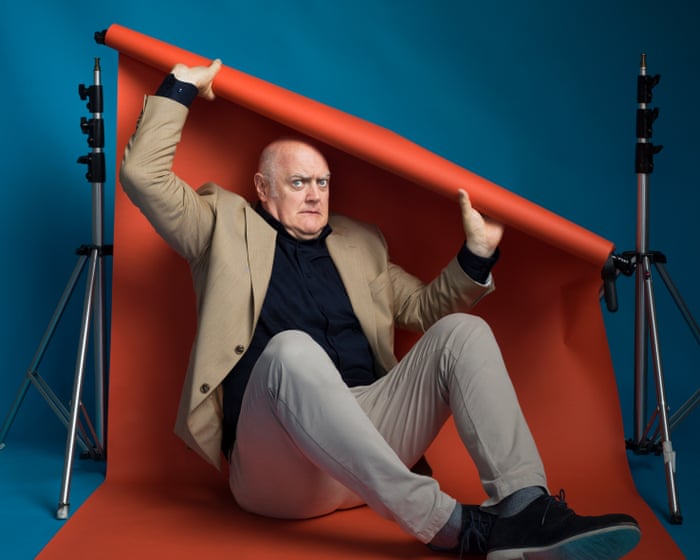
Dara Ó Briain is still having his photo taken when I arrive at the studio in west London. A comedian needs comedy pictures, so Pål, the photographer, has him sitting on the floor holding up a roll of the rust-colored paper he’s using as a backdrop. It looks like the roof is caving in on Ó Briain. He calls over to me. “We can tailor the interview to match the photos,” he says. “Starting with: do you ever feel like you’re trapped in a box?”
Once the shoot is done, he ditches his jacket and we walk up the road to find a quiet corner in a pub. There’s a new season of Mock the Week, the topical satirical panel show that ran for 17 years on BBC Two until 2022 and has now been revived on the free-to-air channel TLC. A lineup of comedians forms two teams and competes in a fake gameshow, supposedly answering questions about the past week’s news, but really just trying to be funny.
Ó Briain, 54, has hosted it from the start. In the original run, regular guests included Hugh Dennis, Frankie Boyle, and Ed Byrne, but up-and-coming comics were often brought in too. “It became a kind of debutante’s ball for people who’ve made it to the top at Edinburgh and are ready to go on screen,” Ó Briain explains, not without pride.
When Mock the Week was on the BBC, there were accusations that the mockery was aimed at the right from a left-leaning perspective. Ó Briain, who describes himself as “centre left,” says that had a lot to do with what was happening in Westminster: “For the vast majority of that time, there was a Tory government – Conservative PM after Conservative PM – so obviously we were looking at them.” But he also admits there was probably some truth to those accusations. “I don’t think anyone made a case for Brexit during the whole thing; nobody on Mock the Week was going: ‘Well, maybe sovereignty or whatever …'”
The show did feature right-leaning comedians like Geoff Norcott and Simon Evans, but the right isn’t as well represented in British comedy. Ó Briain isn’t sure why – perhaps because “the direction in which you punch matters or people don’t warm to it,” he says. “I’ve seen comics do jokes about, say, nurses always asking for money, and the audience go: ‘No, I don’t think that, we’re not coming with you on that one.'” Don’t mock the weak. But equally, he suggests, audiences don’t like it if you go too far the other way – “too happy-clappy.”
View image in fullscreen
‘It was generally seven men around the table: they were trying to find themselves, there were elbows’ … hosting Mock the Week. Photograph: BBC
The other accusation aimed at Mock the Week was that it was vicious, mean, and male – a bear pit of a show where macho comedians shoved each other out of the way to get their jibes in. Jo Brand didn’t like it when she appeared.
Again, Ó Briain says the criticism was fair. “It was generally seven men around the table: they were trying to find themselves; there were elbows.” But he points out that the programme started more than two decades ago, when that was the culture of shows like this (see also Never Mind the Buzzcocks). Ó Briain says he wouldn’t have wanted to be a contestant. “I would have found it too staccato; I like to build up a head of steam on a piece of nonsense. But now it’s become a lot more conversational.”
While there’s plenty to talk about in an average week, some topics are more ripe for mockery than others. Trump, for example, isn’t the gift you might think he is. “Particularly Trump 2, darker Trump. There aren’t even the funny mistakes anymore. Now, it’s self-parody, so utterly ridiculous that maybe it’s normalised the ridiculousness, to a certain extent. And you know, the joke’s already there – what are we adding to it? It would be like doing jokes about th…”Here’s the rewritten text in fluent, natural English:
—
What about Keir Starmer? “Awful. He did nothing and said very little.” He means as a topic for discussion, not as a politician—though he wasn’t impressed with how he ran the country either. He’s not sure about Andy Burnham yet—they haven’t had a chance to mock one of his weeks—but he finds the way he came to power amusing. “Makerfield gets to pick the prime minister now, is that how it works?”
So what or who is a gift to Mock the Week? Peter Murrell and the SNP expenses scandal, he says: “Not quite a victimless crime, because I guess the people who donated to the SNP were victims. But the details were so perfect: the number of video consoles, the £2,000 salt shaker [Murrell spent £2,618.16 on Lalique Feuilles pepper and salt grinders], and the fact Nicola Sturgeon went out of her way to act like she didn’t know her in-laws suddenly had a 30ft camper van.” They got plenty of material from that in the last season—more mileage than the camper van, which only drove from the showroom to the in-laws’ driveway.
Now, freed from the constraints of public service impartiality and scrutiny, and with more women involved—including Sara Pascoe, Maisie Adam, Laura Lexx, and Angela Barnes—perhaps Mock the Week is a nicer place, even if it has far fewer viewers (a little over 1 million including repeats) than the 3 million-plus it averaged during its BBC peak.
Ó Briain wasn’t meant to be a comedian. He studied mathematics and theoretical physics at University College Dublin in the early 90s. He says he was a shy and self-conscious teenager but pushed himself to join the debating society at UCD. During one debate, he told a joke: “It got a laugh and a round of applause, and I remember this rush of adrenaline and me thinking: oh hello!”
He still feels that rush, though the high isn’t as intense, and it might take a two-hour show rather than one joke to get there. But he loves the work, and it takes him to cool places like Athens, Barcelona, and Stockholm (as well as Chatham, Dorking, and Leicester). His two most recent tours have focused less on jokes and more on storytelling—and have been more personal.
Born in Bray, County Wicklow, Ó Briain was adopted into what he has described as “a stable home” and had a happy childhood. A few years ago, he decided to find out about his biological parents. “The plan wasn’t for it to become a show; it was just something I needed to investigate because of normal human emotions. I always knew there was this story waiting to be uncovered, and the push was that none of us are getting younger. I know people who found their parents and then met them in a nursing home, and they had Alzheimer’s.”
He realized the story wasn’t only about him after watching the film Philomena. “I came out of the cinema with a sudden understanding that this isn’t really my story at all—I’m just a baby in it. But there’s a woman who got pregnant and went on this journey,” he says. “It’s her story, and I should probably at least make contact to close that circle for her and let her know it turned out great—I found a lovely family and all that.”
It was difficult—both bureaucratically and emotionally—but he found her, and they met. It was awkward and strange. He gained a bunch of new siblings. He told the story in his show So … Where Were We?, which won best tour at the Chortle Awards in 2023.
His next show, Re:Creation, which he’s been touring across Europe, tells the story of trying to track down his biological father. No spoilers (there are still some dates left, plus it’s on Amazon Prime), but it contains less sadness and anger than the previous set. “It’s a bit of a romp, with a twist t
Frequently Asked Questions
Here is a list of FAQs about Dara Ó Briains essay I remember going oh hello based on his reflections on comedy coolness cruelty and his parents
General Background
Q What is the essay I remember going oh hello about
A Its a personal essay by comedian Dara Ó Briain In it he looks back on his childhood his relationship with his parents and the moment he realized he was funny He uses this to explore bigger ideas about why comedy is seen as uncool how kids can be cruel and how our parents shape our sense of humor
Q Who is Dara Ó Briain
A Hes an Irish standup comedian and television presenter Hes known for hosting panel shows like Mock the Week and QI and for his fastpaced intelligent and often silly style of comedy
Q Is this a full book or a short piece
A Its a short essay or chapter Its the kind of reflective piece youd find in a comedy anthology or a collection of personal stories rather than a fulllength autobiography
Comedy Coolness
Q Why does Dara think comedy isnt cool
A He argues that being cool is about being detached aloof and seemingly effortless Comedy is the oppositeit requires trying hard seeking approval and being emotionally open Making people laugh is a desperate vulnerable act which clashes with the too cool to care attitude
Q What is the oh hello moment in the title
A It refers to a specific childhood memory He recalls a moment where he said or did something that made his friends laugh unexpectedly The oh hello is the moment of realizationlike a switch flipping onwhere he thought Oh I can do this This is my thing
Q Does he think being funny is a good thing or a bad thing