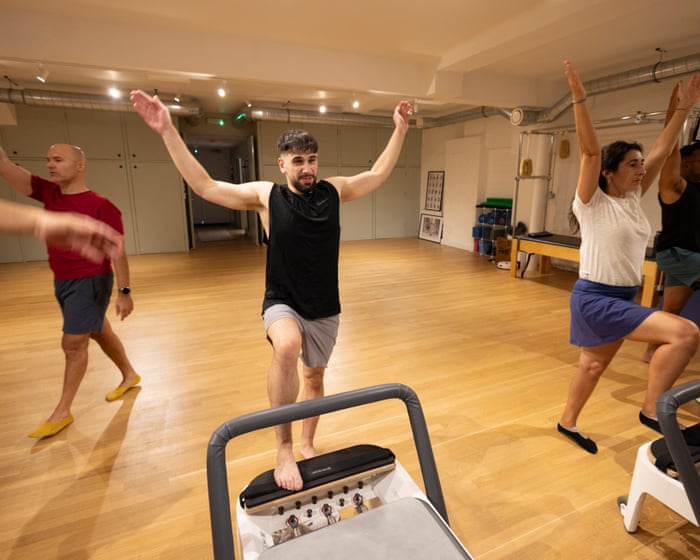
I realized something had to change when I almost fell over trying to tie my shoelaces. I was on a busy high street, with people rushing past carrying shopping bags, when I noticed my shoelace trailing on the ground. I bent down to fix it and felt gravity pulling me forward. Only a quick wave of my arms kept me from landing face-first on the pavement. When I stood back up, I felt a sharp pain in my lower back. This can’t be right, I thought. Bracing my foot on a bin to finally tie my lace, it hit me. I’d let myself go. My core strength was gone, and so was my flexibility. Years spent behind a desk had taken their toll, made worse by an after-work routine of watching TV or playing video games on the sofa. But after getting home and doing some research (yes, from my sofa), I found a possible fix: pilates. Originally called contrology, this so-called “mind-body exercise” was created by a former boxer about a century ago. Joseph Pilates, a German, developed the series of exercises while interned as an “enemy alien” on the Isle of Man during the First World War. In the 1920s, he moved to New York City and opened a studio near a dance school, where ballerinas looking to ease their overworked joints discovered it. Besides improving flexibility, I read that pilates could help with injury recovery. I’ve had shoulder pain since the start of the year, so that seemed like another reason to try it. I’m late to the trend, though. The UK pilates and yoga market is now worth a reported £1.1bn, and although the practice has long been dominated by women, men are increasingly paying attention. As the Wall Street Journal reported this week, “Gym bros are going to pilates – and leaving shaking like a chihuahua.” Sports stars including LeBron James, Cristiano Ronaldo and David Beckham have praised pilates, along with actor Glen Powell and singer Harry Styles. Reggae star Shaggy has become so fond of reformer pilates, with its bed-like exercise machines, that he is thinking about buying some for his homes in Florida and Jamaica. “You’re touching muscles you didn’t know you had,” he told the New Yorker mid-exercise. “Jesus Christ!” His praise (or warning) is ringing in my head as I head to my first class. But before I go, I have to sort out what to wear. Pilates may once have been “more of a male discipline,” according to Hernan Castro-Vidal, who runs the Pilates Nutrition studio in south London, but it’s become associated with images of impeccably groomed “pilates princesses,” showing off their carefully chosen, color-coordinated outfits on social media. My wardrobe is much less stylish. For the gym, I usually throw on an old T-shirt – but that won’t do if I’m to become a “pilates prince.” I manage to dig out a wrinkled gym vest, but despite numerous attempts, it seems resistant to my iron: perhaps I should just embrace the term “pilates pauper.” Week one: ‘After 20 minutes, I am pleading for the class to be over’ I start with reformer, not just the most fashionable form of pilates, but also the easiest-looking. As far as I can see, you just strap your hands and legs into some felt hoops and let the machine do the work. Walking into a mid-afternoon class at my local gym, however, I still feel intimidated. There are more than a dozen machines in the room, looking more intricate than I expected now that I can see them up close. And my classmates – about 50/50 men and women – appear to know them inside out. View image in fullscreen Hernan Castro-Vidal helps Sammy with the exercises. Photograph: Graeme Robertson/The Guardian Before getting strapped in, we are told to touch our toes while keeping steady balance. I falter a few times, getting flashbacks to my shoelace mishap, but eventually get the hang of it. Then the fun part begins. We are told to lie on the machine, remove some colored springs to adjust the resisFor instance, we place our toes on the foot bar—a horizontal pole at the end of the machine—and push, stretching our bodies. Not too hard, I think, but we’re just getting started. After repeating the same movement with both heels, we’re told to lift one leg into the air, bent at the knee, and push the foot bar again. We look like a room full of half-hearted ballerinas, but I can feel a burn starting. We switch legs and do the other side before things intensify.
The next 40 minutes are a blur, though the most brutal exercises I remember include the hundred—where we put our hands in the hoops and, keeping our legs in the air, pump our arms up and down, which leaves my core burning—and leg circles, where we place our feet in the hoops and raise them toward the ceiling before lowering them and widening to make a circle. It looks simple, but after the fifth circle, every part of my lower body is on fire. I struggle to keep up, and the instructor comes over repeatedly to correct my form. After 20 minutes, I’m begging for the class to end.
The next day is when it really hits me. I struggle to stand, and parts of my body I never knew could be targeted are burning. It may have looked easy—but it was far from it.
Week two: ‘The appeal is starting to dawn on me’
After my large class, it’s time for something more intimate. At Castro-Vidal’s studio, I join a session with three others—one woman and two men. I arrive after work, with the aches from last week’s class just about gone and, to be honest, I’m dreading it.
Castro-Vidal says he has seen a sharp rise in men signing up for pilates, with many influenced by “celebrities and footballers.” Most are nervous about jumping straight into a group class and opt for private sessions at first. Of the 15 clients he sees for private classes, 12 are men. “They’re a little shy and don’t want to join a group session yet,” he says. I, however, am thrown into the deep end and plonked onto a reformer machine after a brief warmup. The exercises are similar to the previous class, but Castro-Vidal corrects my form throughout, pressing down on my stomach while angling my body on the machine to make sure my core is properly engaged, and holding my feet down when they’re about to slip off the foot bar. It makes a world of difference. In the larger class, keeping pace with everyone else was my main concern.
Today, the pace is slower, but every movement feels like it’s hitting the right spot. That’s not to say it isn’t utterly exhausting. Halfway through, I feel myself faltering, but with Castro-Vidal’s keen eye on me, I push through. I stretch my body out on the machine, and this time the hundred isn’t the ordeal it was before. I even raise my legs toward the ceiling with ease.
At the end of the session, I’m beat, but I can move my bad shoulder with much less pain. The appeal of pilates is starting to dawn on me. “We need to distinguish between workout classes and the true essence of pilates,” Castro-Vidal tells me. For him, classes with dozens of people might be a good introduction to reformer pilates, but they’re not the real thing. “It’s not just a workout—it’s a discipline. It can even become a way of life,” he says. He believes “six people is the maximum number to be able to give attention to everyone.”
View image in fullscreen’My body aches but not nearly as much as before.’ Photograph: Graeme Robertson/The Guardian
Alongside me in the class is Divanka Wijendra, a 43-year-old GP. He used to attend HIIT (high-intensity interval training) classes and did CrossFit, but as he got older, he thought: “I don’t think I can keep up with the intensity.” This is a trend he has noticed among his male friends. “People are enjoying the slightly slower pace of it compared with the intense HIIT style of training,” he says.
This shift is industry-wide. In 2018, about 14,000 gymsAround the world, people were affiliated with CrossFit. By 2025, that number had dropped to fewer than 10,000. Meanwhile, Pilates, especially reformer Pilates, is booming. In the UK, the business insurance provider Protectivity reported a rise of more than 900% in applications from reformer instructors between 2024 and 2025.
Wijendra’s interest was sparked by social media. “On Instagram, it kept popping up in my algorithm, and I started to see a lot more people doing it. There were a lot of funny videos of men trying it and getting it a bit wrong.”
His first session with Castro-Vidal left him feeling achy and stretched. “I was thinking, ‘Oh my God, this is quite tough,'” but he persisted because he “enjoys a challenge.” Six months on, his core is stronger and his posture has improved. “I can definitely bend down and touch my toes,” he says. I still have some work to do to match him.
Week three: ‘My body is once again on fire’
After two high-intensity weeks, I book a machine-free mat Pilates class and hope for some relief. Oh, how wrong I am. I join a class of eight, including one other man, lying on the mat, placing a ball between my shoulder blades and doing what feel like crunches on overdrive. I’m familiar with most of the exercises that follow, but without the machine, I’m relying on my own balance, strength and flexibility. I topple onto my side many times. After 40 minutes of gut-busting stretches, arduous leg raises and (I never thought I’d say this) some mercifully tame planks, the class is over. It’s far harder than reformer, and my body is, once again, on fire. But if I’d done my research, this wouldn’t have come as a surprise.
“We recommend reformer to people who struggle with mat to help them get stronger,” says Stephanie Tam, a Pilates instructor at Third Space. She has been an instructor for eight years and teaches only mat Pilates.
“Mat is the original. It’s what Pilates started as,” Tam says, calling it the “best form of exercise for everyone.” When she started teaching, she didn’t see men very often, but now they are a common sight in her classes. “I love it when men come,” she says. “I think a lot of them expect it to be really easy, and then they try it and see how challenging it really is.”
Despite the shared exercises, the two variants of Pilates feel distinct. Reformer is great for feeling flexible, but mat feels like a true test of my abilities. I enjoy the challenge, and I can see myself doing both in the future.
Week four: ‘I am beginning to feel at one with the machine’
After three weeks, have I graduated to a “Pilates prince”? I look more like one, having treated myself to a trio of fancy workout vests. But it’s time to test myself with a final session. I return to the reformer class I joined in my first week, in a conquering mood. Like the others in my class, I am beginning to feel at one with the machine.
Before getting started, it’s time to warm up. I bend down and manage to touch my toes without toppling over. Hurdle one complete. Now the hard graft. We begin with pushing ourselves up with our toes and heels on the foot bar. Easy! Then some leg raises. My confidence falters a bit here, and I fail to keep a fixed position, but I bounce back after readjusting and taking things at my own pace, ignoring the veterans around me. Next up is the hundred. It’s tough, but nowhere near as arduous as the first time around.
Before I know it, the 40 minutes are almost over. My body aches, but not nearly as much as before: it seems I’m getting used to it. We finish with “hunchbacks,” our hands sprawled against the ground touching our toes before rolling our spines upwards until we’re standing. Class is over.
Did a month of Pilates change me? My stomach certainly feels firmer. I can also bend down and touch my toes with good balance: an untied shoelace will take me down no longer. Doing the splits is a loMy progress is far from perfect, but my morning stretches feel longer, and my posture has improved a little, though my spine is still not perfectly straight. What about my shoulder? I didn’t expect Pilates to be a miracle cure, but the pain has eased. Will I post my #pilatesprince photos on social media? Not for now. I haven’t become a Pilates fanatic, but I can see myself taking a class every few weeks.
Frequently Asked Questions
FAQs My Body Is on Fire A Dangerous Painful Perfect Month of Pilates
Getting Started
What is Pilates exactly
Its a lowimpact exercise method that focuses on core strength posture flexibility and controlled movement It was developed by Joseph Pilates in the early 20th century
What does my body is on fire actually mean
Its a common way to describe intense muscle burn during and after Pilates especially in the core glutes and thighs It usually means your muscles are working hard not that something is wrong
Do I need experience to try a month of Pilates
No Beginners can start with mat classes or beginner reformer sessions Just expect to be sore thats normal
Whats the difference between mat Pilates and reformer Pilates
Mat Pilates uses only your body weight Reformer Pilates uses a springloaded machine that adds resistance and support
How often should I do Pilates to see results in a month
Most people do 35 sessions per week Daily practice is possible but your body needs at least one rest day to recover
The Pain and the Burn
Why does Pilates burn so much
Pilates targets small deep stabilizing muscles that most workouts ignore Those muscles fatigue quickly which creates that intense burning sensation
Is the burn a good sign
Usually yes A deep muscle burn during exercise means youre activating the right muscles Sharp pain joint pain or numbness is not normal stop and check with an instructor
How sore is too sore
Mild soreness for 2448 hours is normal If soreness lasts more than three days limits your movement or comes with swelling you overdid it
Why do I shake during certain moves
Muscle fatigue Shaking means your muscles are near their limit for that set Its common in moves like the Hundred or leg circles
Can Pilates actually hurt you
Yes if you push through pain use bad form or ignore injuries Thats why the dangerous part of the title is real Pilates is safe when done correctly risky when it isnt
Common Problems